

AI Summary
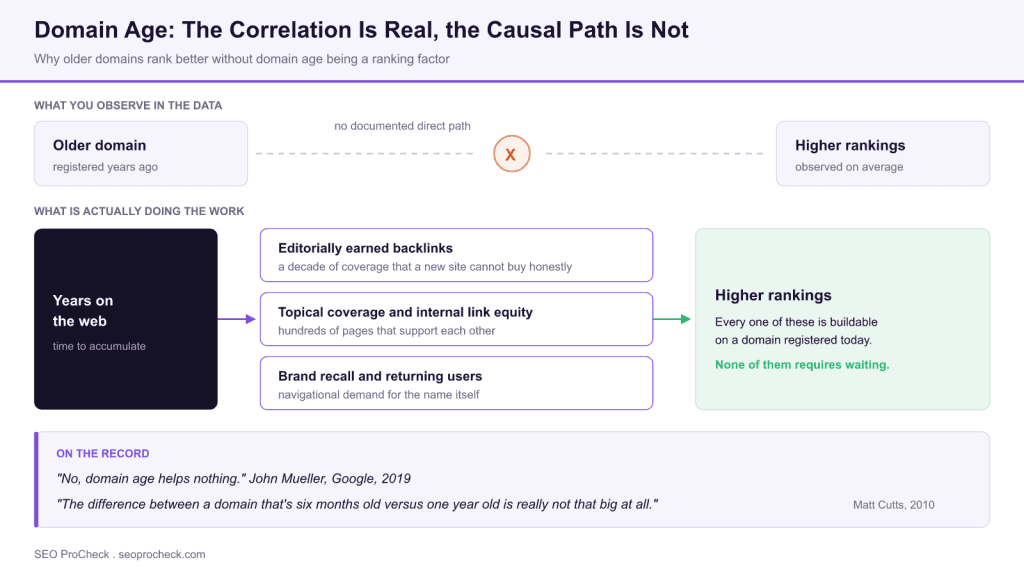
Domain age is not a direct Google ranking factor. Google's John Mueller answered the question directly in 2019 with "No, domain age helps nothing." Older domains do rank better on average, but that is a correlation produced by everything they accumulated during those years: links, content depth and brand demand.
- Google's SEO documentation does not mention domain age anywhere as a ranking consideration.
- The long registration period myth traces to a 2005 Google patent, which describes what was considered, not what shipped.
- Google has never confirmed a formal sandbox. New sites lacking links, history and brand demand produce sandbox shaped results without one.
- Domain history is used, to identify spam, which makes buying an aged domain a risk as often as an advantage.
- Provenance note: the summary below is an uncited internal compilation with no retrievable published study behind it.

The summary below is attributed at the foot of this page to "Domain age research compiled". That is not a citation to a published, retrievable study, and we have not been able to identify an underlying dataset, sample size or methodology behind it. We are keeping the summary and its attribution as published rather than deleting them, but its claims should be read as unverified assertions rather than findings. Everything after it is sourced to statements from Google that you can check yourself.
The original summary, as published
Research into domain age examined whether older domains maintain inherent ranking advantages over newer sites. The study analyzed ranking patterns across domains of varying ages to assess age as a factor.
Age Correlation vs Causation
Older domains showed higher rankings on average, but this likely reflects accumulated authority rather than age itself. Established domains have had time to earn backlinks, build content, and establish reputation. Age may correlate with ranking factors without being one itself.
New Domain Challenges
New domains faced practical challenges including the time required to earn backlinks, build topical authority, and establish trust signals. These challenges created apparent age effects without domain age being a direct ranking factor.
Sandbox Myth Examination
Evidence for a formal Google "sandbox" penalizing new domains was inconclusive. New sites can rank quickly for appropriate query difficulties. Perceived sandbox effects may reflect realistic timelines for building ranking factors rather than algorithmic suppression.
Practical Implications
Focus on building ranking factors rather than waiting for age to help. New domains can compete by targeting appropriate difficulty levels and building authority systematically. Age provides no shortcut around the need for quality content and legitimate authority signals.
What Google has actually said
Unlike many contested ranking questions, this one has direct answers on the record from two different Google representatives, a decade apart, and they agree.
"No, domain age helps nothing."
John Mueller, Google, 2019
"The difference between a domain that's six months old versus one year old is really not that big at all."
Matt Cutts, Google, 2010
Cutts went on in the same answer to say that what determines ranking is mostly the quality of the content and the links earned as a result of it. Fifteen years later that remains the most accurate one sentence summary available.
There is also a useful negative signal in Google's documentation. The SEO Starter Guide contains an explicit list of things that do not matter, including the keywords meta tag, minimum content length and heading order. Domain age is not on that list, but neither is it mentioned anywhere else in the guide as something to consider. For a factor supposedly worth paying a premium for on the aftermarket, its total absence from Google's own guidance is telling.
| Claim | Status | What the record actually shows |
|---|---|---|
| Domain age is a direct ranking factor | Contradicted | John Mueller, 2019: "No, domain age helps nothing." Google's SEO documentation does not mention domain age |
| Older domains rank better on average | Consistent with observation | True as a correlation. The mediating variables are links, content depth and brand demand, all of which take time to build |
| Long domain registration periods help | Unsupported | Originates from a 2005 Google patent that listed registration length as one of many candidate signals. Never confirmed as implemented |
| Google sandboxes new domains | Never confirmed | No Google statement describes a formal sandbox. The observed pattern is fully explained by new sites lacking links, history and brand demand |
| Domain history is used by Google | Supported | Mueller has stated domain history information is used to identify spam. This is a risk of buying aged domains, not a benefit |
The useful frame: age is a proxy variable. It correlates with the things that rank because those things take time to acquire, not because the calendar is an input.
Where the myths came from, and why they persist
The registration length myth
The claim that registering a domain for ten years signals commitment to Google traces to a 2005 Google patent on information retrieval based on historical data. That document discusses domain registration length among a long list of candidate historical signals. This is the single most common category error in SEO: a patent describes what a company's engineers considered patentable, not what the production ranking system does. Google files thousands of patents. Most describe ideas that were never shipped or were shipped and later removed.
Practical consequence: renew your domain for as long as you like for administrative reasons. Do not expect it to do anything in search, and do not let anyone charge you for it as an SEO service.
The sandbox
The original summary is right to call the evidence inconclusive, and it is worth being sharper about why. Google has never described a formal mechanism that suppresses new domains for a fixed period. What is definitely true is that a brand new site has:
- no backlinks, therefore no independent corroboration of anything it claims;
- no history, so no behavioural or quality data to draw on;
- no brand search demand, so no navigational queries it can trivially win;
- low crawl priority, so new pages are discovered and refreshed more slowly;
- typically a thin internal link graph, so no page has meaningful support from any other.
Every one of those produces the pattern people describe as a sandbox. The distinction is not academic. If you believe in a sandbox, the rational response is to wait. If you understand the mechanism, the rational response is to attack each item on that list, and the timeline compresses.
The aged domain purchase
This is the one where the myth actively costs money. Buying an expired or aged domain does not buy you age as a ranking input. It buys you whatever backlink profile survives, whatever brand recognition remains, and, critically, the domain's entire history. Mueller has been explicit that Google uses domain history information to identify spam. If the domain previously hosted a spam network, an expired drop catch, or an entirely unrelated business, you have bought a liability with a nice registration date.
If you are evaluating one anyway, the checks are mechanical:
1. Wayback Machine: what was actually on this domain, year by year?
   https://web.archive.org/web/*/example.com
   Look for: language switches, casino/pharma content, sudden template changes.

2. Backlink profile: are the referring domains real publications,
   or 400 footer links from unrelated directories?

3. Anchor text distribution: a natural profile is mostly brand and URL.
   Heavy commercial anchors are a manipulation fingerprint.

4. Does it still rank for its own brand name?
   site:example.com and a brand query. Nothing indexed is a warning.

5. Registration continuity: has it dropped and been re registered?
   A drop usually resets whatever you thought you were buying.
What to do instead, on a domain registered today
The original summary's conclusion is correct, and it is worth making concrete. Age provides no shortcut, so the only available strategy is to build the things age correlates with, faster than average.
| Timeframe | Realistic focus for a new domain | What to measure |
|---|---|---|
| Months 1 to 3 | Technical foundation, indexation, one tightly defined topic cluster, brand and entity setup | Pages indexed against pages published, in Search Console |
| Months 3 to 6 | Long tail queries with low difficulty, internal linking depth, first editorial links | Impressions growth and average position, not clicks |
| Months 6 to 12 | Expand adjacent clusters, digital PR, first mid difficulty targets | Ranking queries count, referring domains, branded search volume |
| Months 12 and beyond | Compete on head terms where you now have supporting depth | Clicks, conversions, share of voice against named competitors |
This schedule is not driven by domain age. It is driven by how long it takes to build links, coverage and brand demand, which is precisely why age looks like a factor in aggregate data.
The single highest leverage decision on a new domain is query difficulty selection. New sites fail not because Google suppresses them but because they are pointed at terms where the top ten results have a decade of editorial links each. Ranking for a specific, low competition query in month two is not a consolation prize. It is how you acquire the links, engagement and brand demand that let you compete for the harder term in month twelve.
The second highest leverage decision is internal linking. It is the one authority mechanism entirely within your control and requiring no external party's cooperation. A new site with 40 well organised, densely interlinked pages on a single topic will outperform a new site with 400 orphaned pages across ten topics, every time.
Related reading
If you are deciding where a new site's effort should go, technical SEO versus content SEO covers how to split the budget when you cannot do everything, and how to tell if your SEO is actually working is the right framework for judging early progress by impressions and ranking query counts rather than by clicks you will not see for months. For getting the foundation right so nothing you publish is wasted, our technical SEO audit is the place to start.
FAQ
Not directly. Google's John Mueller answered the question flatly in 2019: "No, domain age helps nothing." Older domains do rank better on average, but that reflects everything they have accumulated over those years, not the registration date itself. Google's own SEO documentation never mentions domain age as a consideration.
You are not buying age, you are buying whatever backlink profile and brand recognition came with it, and you are also buying its history. Google has said domain history data is used to identify spam. An aged domain that was previously used for spam, or that has been dropped and re registered, can be worse than a clean new registration.
No. This myth traces back to a 2005 Google patent on using historical data in information retrieval, which mentioned registration length among many possible signals. A patent describes what a company considered, not what it shipped. Matt Cutts addressed the registration length claim publicly and Google has never confirmed it as a live signal.
Google has never confirmed a formal sandbox that suppresses new domains for a fixed period. What new sites genuinely experience is having no links, no history, no brand demand and no crawl priority, which produces sandbox shaped results without requiring a sandbox. The distinction matters because one implies waiting and the other implies working.
There is no fixed timeline, and it depends far more on competitive difficulty than on calendar time. Google's own documentation says some changes take effect in hours and others take months. A new site can rank quickly for low difficulty, specific, long tail queries, and slowly or never for head terms where incumbents hold a decade of links.
Target query difficulty you can realistically win, publish genuinely differentiated content rather than another summary of the same source, build a tight internal linking structure so the pages you do have support each other, earn a small number of real editorial links, and get the technical basics right so nothing you publish is wasted on a crawl or render problem.
Launching on a new domain, or weighing up an aged one?
We assess realistic query difficulty for your position, audit any domain you are considering buying, and give you a sequenced plan that does not depend on waiting.
Source: Domain age research compiled
Claude Vincent is a technical SEO consultant focused on crawlability, rendering, and AI-search visibility. He writes the field guides and case studies at SEO ProCheck, with a bias toward the durable, unglamorous work that decides whether search engines and AI answer engines can actually read and cite a site.
About SEO ProCheck
Technical SEO consulting and GEO strategy with 20 years of enterprise experience. Case studies, resources, and tools for search and AI visibility.
Work With Me
Technical SEO audits, GEO strategy, site migrations, and international SEO. Hourly consulting for teams who need hands-on support, not just reports.
Subscribe to our newsletter!





Recent Posts
- Can AI Crawlers Actually Read Your Site? I Measured 400 of the Biggest September 5, 2026
- The Pre-Publish Quality Gate for AI-Assisted Content August 6, 2026
- AGENTS.md vs llms.txt vs llms-full.txt: Which Agent File Does What July 18, 2026