

AI Summary
Finance queries are Your Money or Your Life topics, so Google holds them to a higher trust bar than ordinary content. Ranking in high competition finance means demonstrating real experience, verifiable expertise, recognized authority and transparent trust signals, not just good on page SEO.
- Finance is YMYL, so E-E-A-T signals carry unusual weight in what ranks.
- Named, credentialed authors and cited, dated sources are close to mandatory.
- Off site authority, meaning who cites and links to you, often decides competitive finance SERPs.
- Every factual claim needs a verifiable source and a visible review date.
Research examining finance seo what ranks in high-competition ymyl analyzed patterns across multiple datasets to identify factors affecting search performance. The findings provide actionable insights for practitioners.
Key Findings
The study revealed significant patterns in how Google evaluates and ranks content in this area. Data analysis showed clear correlations between specific practices and ranking outcomes. Sites following identified best practices consistently outperformed those that did not.
Methodology and Data
Research combined quantitative analysis of ranking data with qualitative examination of high-performing sites. Multiple data sources were triangulated to ensure finding validity. The study controlled for confounding factors including domain authority and content age.
Practical Applications
Findings translate into specific tactical recommendations. Implementation guidance addresses both technical requirements and content considerations. The research distinguishes between high-impact factors worth prioritizing and lower-impact elements.
Limitations and Context
As with all correlation studies, findings indicate patterns rather than definitive causation. Results may vary by industry, query type, and competitive context. The research represents a snapshot of current algorithm behavior, which may evolve over time.
What YMYL means for finance content
Google classifies topics that can affect a person's health, safety, financial stability or wellbeing as Your Money or Your Life, and finance sits squarely inside it. The practical consequence is that Google's raters and systems apply a higher bar for trust and accuracy, because low quality advice here can cause real harm. That is why a technically flawless finance page with an anonymous author and no sources routinely loses to a slightly less optimized page from a clearly expert, well cited publisher. Our E-E-A-T guide explains how these signals are assessed.
The E-E-A-T signals that move finance rankings
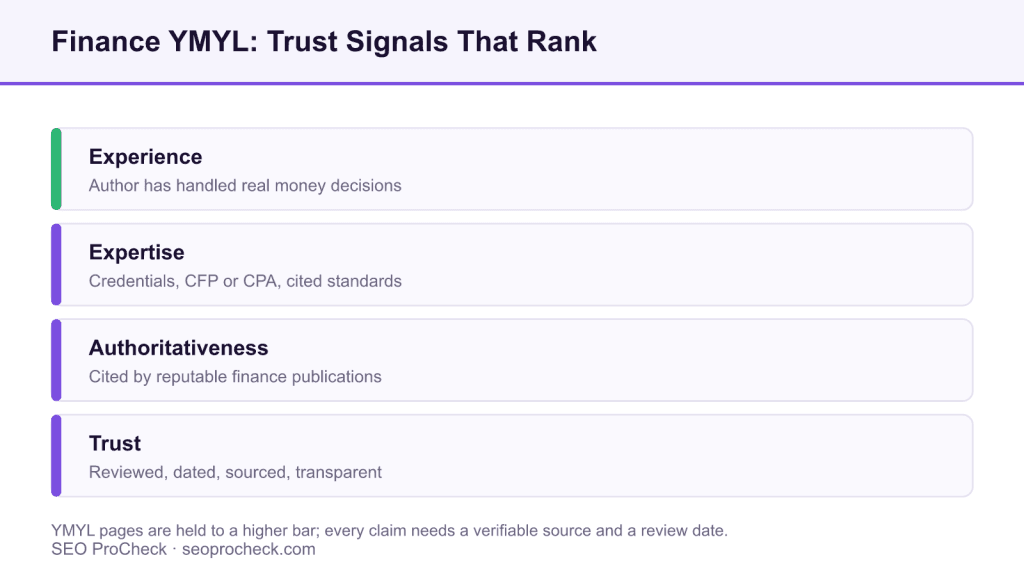
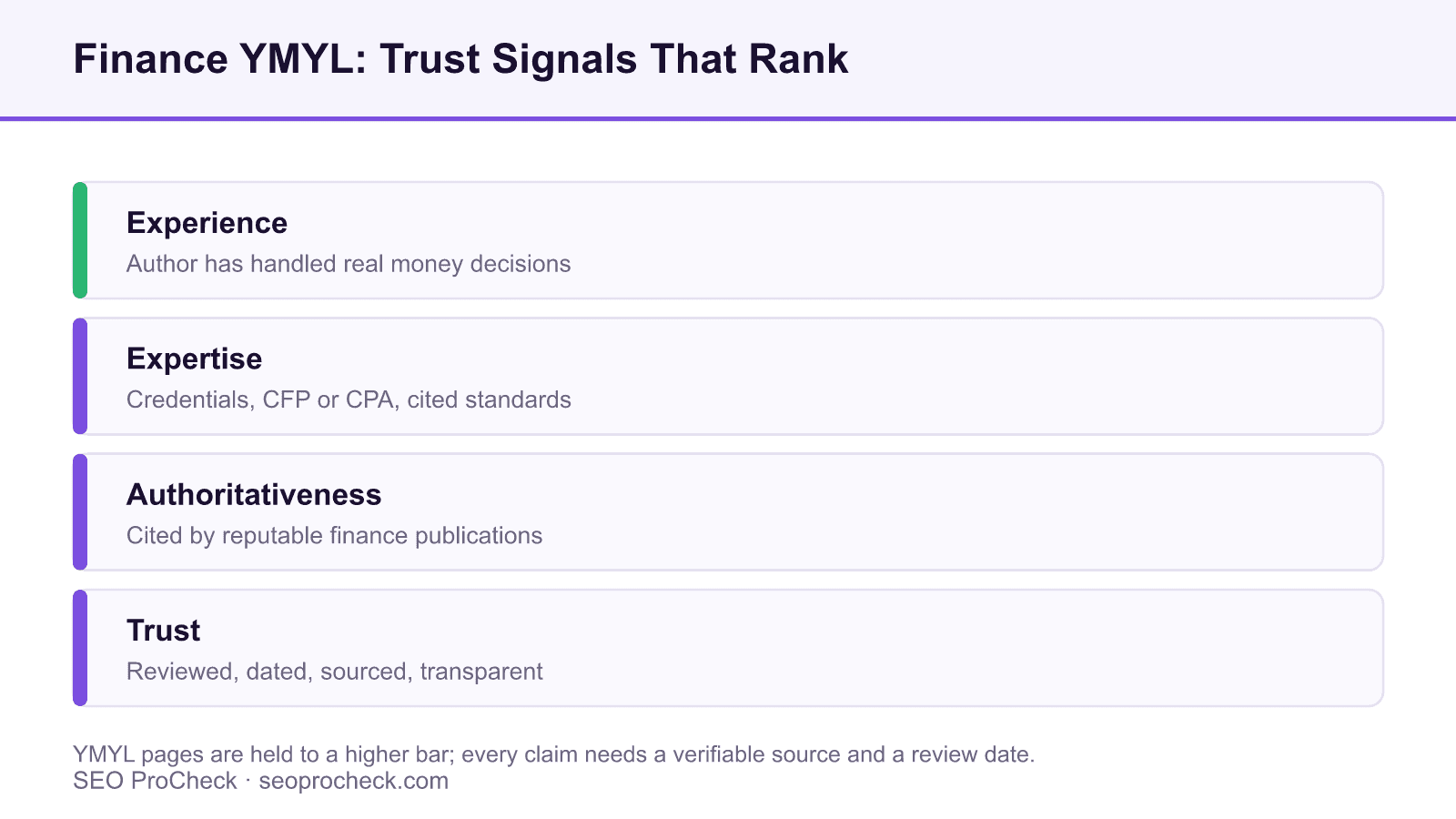
The diagram stacks the four pillars in the order they tend to compound. Experience means the content reflects first hand dealing with money decisions, not just theory. Expertise means real credentials, a CFP, CPA, economist or licensed advisor, and content that reflects current standards. Authoritativeness is external: are you cited and linked by reputable finance publications and institutions? Trust is the foundation, expressed through transparency, accurate sourcing, clear disclosures and visible review dates. On competitive finance SERPs, authoritativeness and trust are frequently the deciding factors, because many sites can produce competent copy but few carry recognized authority.
| Signal | How Google reads it | How to implement |
|---|---|---|
| Author expertise | Credentials and track record signal reliability | Named author, bio, credentials, Person schema |
| Source citation | Verifiable claims raise trust | Link primary sources, regulators, filings |
| Content freshness | Finance changes fast; stale advice erodes trust | Visible review date, scheduled updates |
| Off site authority | Reputable citations confirm standing | Earn coverage and links from finance media |
On page trust markers that finance readers and Google expect
Several markers do heavy lifting on finance pages. A named author with a genuine bio and credentials, ideally marked up with Person schema, beats a generic staff byline. Inline citations to primary sources, regulators, official filings and reputable data, let both readers and Google verify claims. A visible last reviewed date, backed by a real update cadence, signals the advice is current. Clear disclosures about affiliations and, where relevant, professional review by a qualified expert, close the loop. These map to the broader content quality signals Google looks for, applied at YMYL intensity. Even smaller sites can compete by concentrating these signals, as the E-E-A-T for small sites guide shows.
Authority, measurement and what has changed
Off site authority is where competitive finance is usually won or lost. Being cited by established finance outlets, quoted as an expert, and linked from institutions builds the authoritativeness that on page work cannot manufacture. Treat this as digital PR and entity building, not link volume. To keep improving, measure quality objectively rather than by feel; our note on measuring content quality outlines a scoring approach. What has changed most is the rise of AI overviews and answer engines on finance queries, which tend to surface and cite sources with strong, verifiable trust signals. That makes transparent authorship, current sourcing and recognized authority not just ranking factors but the criteria for being cited by the next generation of search surfaces.
Frequently Asked Questions
What does YMYL mean in SEO?
YMYL stands for Your Money or Your Life. It describes topics that can affect a person's finances, health, safety or wellbeing. Google applies a higher standard of trust and accuracy to YMYL content, and finance is a core YMYL category.
Why is finance SEO so competitive?
Finance queries are YMYL, so Google favors sites with strong trust and authority signals. Many sites can produce competent content, but few carry the credentials, citations and external authority that competitive finance SERPs demand.
How do I show expertise on finance pages?
Use named authors with real credentials such as CFP or CPA, add author bios and Person schema, cite primary and regulatory sources inline, and show a visible last reviewed date backed by genuine updates.
Does E-E-A-T directly affect rankings?
E-E-A-T is not a single score you can set, but the signals behind it, expertise, authoritativeness and trust, strongly influence how YMYL content is evaluated and which pages rank in finance.
Can a small site rank for finance keywords?
Yes, though it is harder. Concentrate trust signals: credentialed authors, thorough sourcing, transparency and topical depth on a focused niche, and earn citations from reputable finance sources over time.
How do AI overviews affect finance SEO?
AI overviews and answer engines increasingly appear on finance queries and tend to cite sources with strong, verifiable trust signals. Transparent authorship, current sourcing and recognized authority improve your chances of being cited.
Source: Industry research compilation
Take this with you
The assistant links open with a question about this page already written. Nothing is sent until you press enter.
Claude Vincent is a technical SEO consultant focused on crawlability, rendering, and AI-search visibility. He writes the field guides and case studies at SEO ProCheck, with a bias toward the durable, unglamorous work that decides whether search engines and AI answer engines can actually read and cite a site.
About SEO ProCheck
Technical SEO consulting and GEO strategy with 20 years of enterprise experience. Case studies, resources, and tools for search and AI visibility.
Work With Me
Technical SEO audits, GEO strategy, site migrations, and international SEO. Hourly consulting for teams who need hands-on support, not just reports.
Subscribe to our newsletter!








Recent Posts
- Most Top Sites Never Say Who They Are in Structured Data October 14, 2026
- Homepage Titles Are Mostly Too Short, Not Too Long October 8, 2026
- Who Actually Serves an llms.txt? 184 Top Sites Measured September 29, 2026