

AI Summary
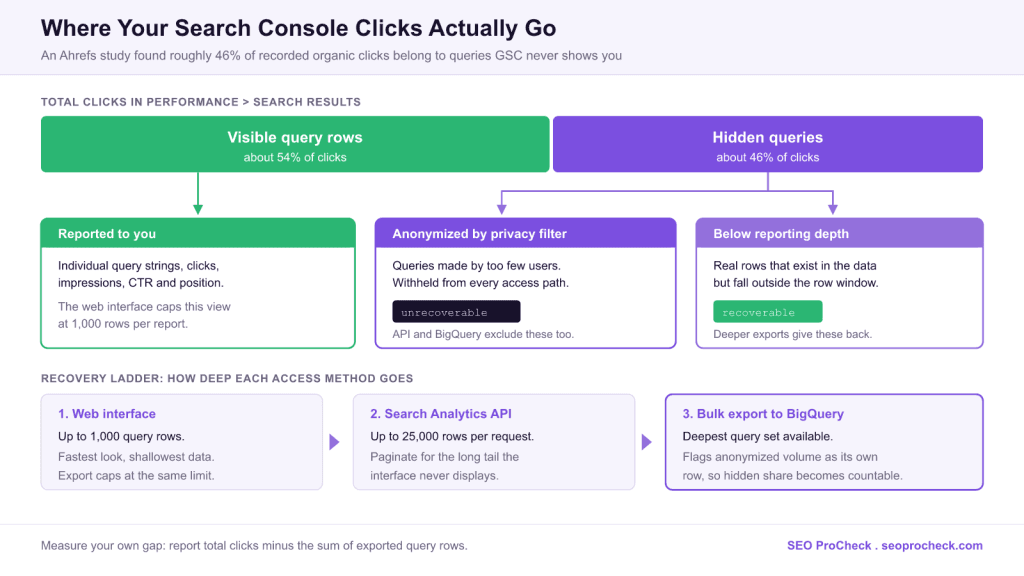
An Ahrefs study of Google Search Console data found that roughly 46% of recorded organic clicks belong to queries GSC never names, so query level analysis describes only about half your organic reality. The response is not a workaround but a reporting change: make the page your primary unit, measure your own hidden share, and state it openly.
- Two separate mechanisms hide queries: privacy anonymization, which no export recovers, and reporting depth limits, which deeper exports do recover.
- The web interface caps at 1,000 query rows. The Search Analytics API returns up to 25,000 rows per request with pagination.
- The BigQuery bulk export goes deepest and flags anonymized volume as its own aggregate, so your hidden share becomes a countable, trendable number.
- Page level totals are already complete: they include the clicks from hidden queries, which is why pages beat queries as a reporting unit.
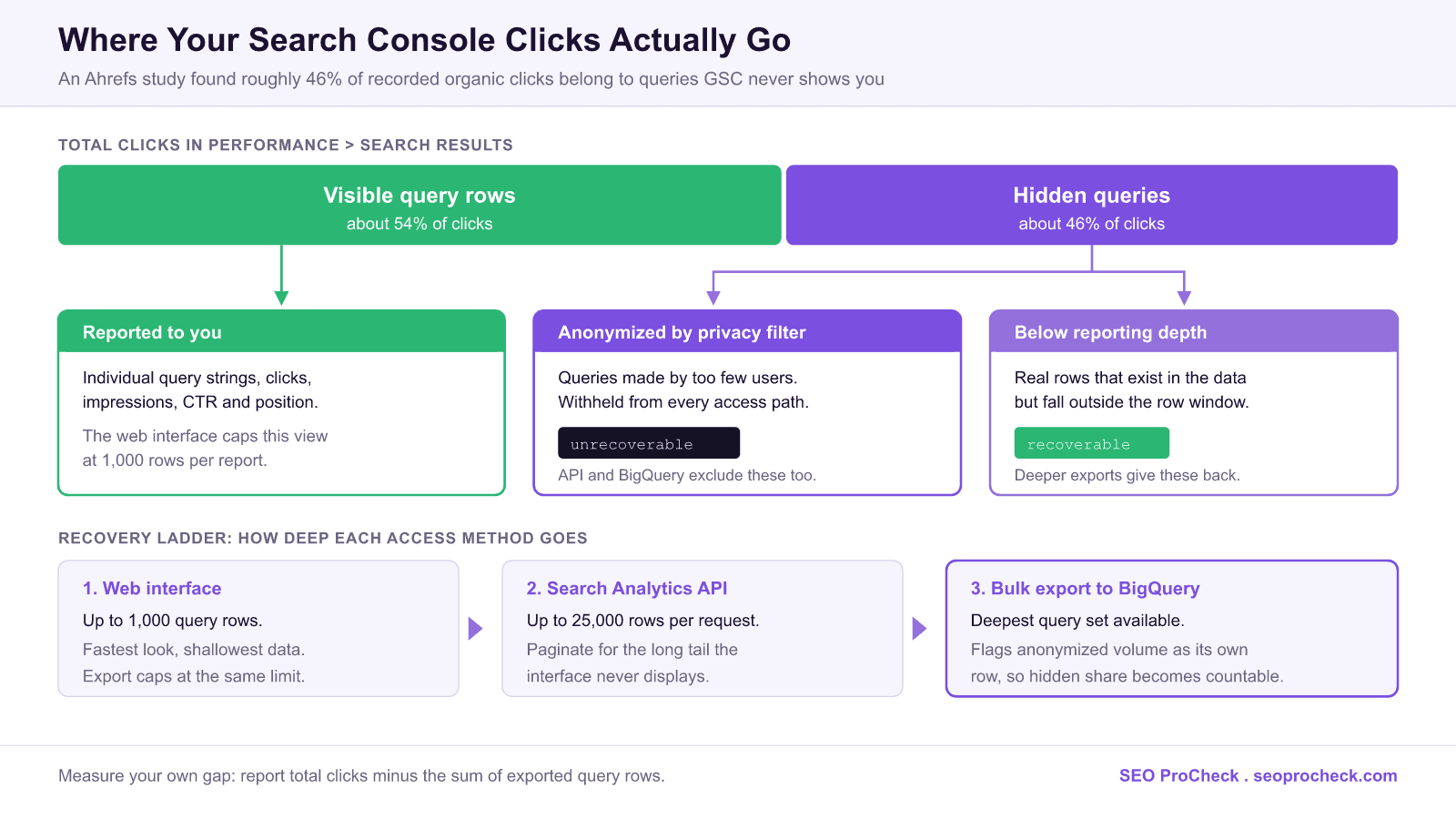
Quick answer: An Ahrefs study of Google Search Console data found that roughly 46% of recorded organic clicks belong to queries GSC never shows you: anonymized or below-threshold terms that appear in your totals but not in your query rows. The practical consequence: query-level GSC analysis describes only about half your organic reality, so page-level reporting, your own hidden-share measurement, and honest caveats in client reporting are not optional extras: they're the correct default.
Ahrefs analyzed Google Search Console data to quantify how much search traffic is attributed to "(not provided)" queries in GSC reporting. The study revealed that a substantial portion of organic clicks come from queries that GSC doesn't report, creating significant blind spots in keyword-level traffic analysis and attribution.
The Hidden Query Problem
Google Search Console aggregates low-volume queries and privacy-protected searches into hidden categories. The study found that approximately 46% of clicks come from queries not individually reported in GSC. This means nearly half of organic traffic cannot be attributed to specific keywords through GSC data alone, complicating ROI analysis and keyword strategy.
The hidden percentage varies by site and query profile. Sites targeting long-tail keywords with lower individual search volumes see more hidden traffic because each query contributes few impressions/clicks and falls below GSC's reporting thresholds. Sites focused on high-volume head terms see less hidden traffic because those queries consistently appear in reports.
You can verify this on your own property in about two minutes, and you should: your site's hidden share is what matters for your reporting, not the study's cross-site figure. In Performance > Search results, note the total clicks number at the top of the report, then export the Queries table (via the API or a connector, since the UI export caps at 1,000 rows) and sum the clicks column. The gap between the report total and the sum of visible query rows is your anonymized-and-hidden share. Long-tail-heavy content sites typically find a large gap; brand-dominated sites a much smaller one.
Why Queries Get Hidden
GSC hides queries for several reasons: privacy protection (Google anonymizes queries with few searchers), low volume (queries with minimal impressions may not appear), and aggregation (similar queries may be combined). The threshold for appearance isn't publicly documented and appears to vary. Even queries driving meaningful traffic may be hidden if they fall below thresholds.
Two distinct mechanisms are easy to conflate here. Anonymized queries are privacy-filtered: made by few enough users that Google withholds them entirely, and no export method recovers them. Row-limited queries are a tooling artifact: they exist in the data but fall outside the UI's 1,000-row window or your export depth, and those are recoverable. Mixing the two leads people either to overestimate what the API can give back or to give up on export depth that would genuinely help.
Working Around the Limitation
The study suggested approaches for better visibility into hidden traffic: use third-party rank tracking tools that can identify rankings you might not see in GSC, analyze landing page performance rather than query performance for pages serving long-tail queries, use GSC's API which may return more queries than the web interface for some properties.
Accept that perfect keyword attribution is impossible. Build strategies that account for unknown traffic rather than assuming GSC shows the complete picture. The hidden traffic is still valuable and should be factored into content strategy decisions, even without query-level visibility.
Here's how the recovery options compare in practice:
| Method | How | What it recovers | What it can't |
|---|---|---|---|
| Sum-vs-total check | Compare report total clicks vs. summed query-row clicks per period | Quantifies your own hidden share: the number to put in reports | Nothing itself; it's a measurement, not a recovery |
| Search Analytics API | Query with rowLimit up to 25,000 per request and paginate | Thousands of low-volume rows the UI never displays | Anonymized queries: the API excludes them too |
| Bulk Data Export to BigQuery | GSC Settings > Bulk data export, then query the export tables | The deepest available query set, plus an explicit anonymized-query aggregate row (flagged in the export), so hidden volume becomes a countable line item | Individual anonymized query strings: still withheld by design |
| Third-party rank tracking | Track a curated keyword set in any rank tracker | Position visibility on terms you chose, independent of GSC thresholds | Terms you didn't think to track: exactly where long-tail lives |
| Landing-page analysis | Analyze by Pages tab / GA4 landing pages instead of queries | Complete click accounting: page totals include hidden-query clicks | Query wording; you infer intent from the page, not the term |
If you run GSC reporting at any scale, the BigQuery bulk export is the standout option: it's free to enable (storage/query costs are typically trivial for a single site), it starts accumulating from activation day (it is not retroactive, so turn it on before you need it), and it's the only method that turns "hidden traffic" from an excuse into a measured, trendable number.
Strategic Implications
This data has important implications for reporting and analysis. Keyword-level ROI calculations undercount traffic for long-tail strategies. Page-level analysis provides more complete pictures than query-level analysis. When presenting SEO results to stakeholders, contextualize GSC data with the understanding that reported queries represent roughly half of actual organic visibility.
Three changes worth making to reporting practice on the back of this finding. First, make the page the primary reporting unit and queries the supporting detail: page totals are complete, query rows are a sample. Second, state the hidden share explicitly in recurring reports ("visible queries account for X% of clicks this period"); it inoculates you against the stakeholder who sums the keyword tab and asks why it doesn't match the traffic number. Third, stop treating "no visible query gained" as "the content did nothing": a refreshed page whose clicks rose while its visible query rows stayed flat almost certainly grew through hidden long-tail, which is evidence of success, not noise. The same logic cuts the other way: keyword-level ROI models silently undercount long-tail strategies and flatter head-term strategies, which biases content investment toward exactly the competitive terms where you have the least edge.
Frequently Asked Questions
Two reasons: privacy anonymization of rare queries (Google withholds terms searched by few enough users that they could identify someone) and reporting depth (the UI displays at most 1,000 rows per view). The first category is genuinely unrecoverable; the second is fixable with the API or the BigQuery bulk export.
Compare the total clicks figure at the top of Performance > Search results against the sum of clicks across all exported query rows for the same period and filters. For an exact, ongoing number, enable Bulk Data Export in GSC settings: the BigQuery tables flag anonymized-query volume as its own aggregate, so you can chart your hidden share over time.
It shows more rows (up to 25,000 per request with pagination, versus 1,000 in the UI), so it recovers the long tail that's merely below the interface's display depth. It does not return anonymized queries; those are excluded from every access method, including the API and BigQuery export, by design.
No: it's disproportionately long-tail, and long-tail queries are typically specific and high-intent. The clicks are real and often convert well; only the query wording is withheld. Treat it as unattributable, not low-quality, and evaluate it through landing-page performance and conversions instead of query reports.
Lead with page-level and sitewide metrics, which are complete; present query tables as an illustrative sample, not an accounting; and include the visible-vs-total share so the gap is expected rather than discovered. For long-tail-focused programs, argue ROI from landing-page conversions, not from summed keyword values: the keyword sum is structurally undercounted.
Not directly: no tool has access to Google's withheld query strings. What clickstream and index-based tools offer is a different sample: keyword databases and ranking observations that can surface terms you rank for but never thought to check in GSC. Useful for discovery, but their volume and traffic figures are estimates, so use them to find terms, then validate against your own GSC and analytics data.
Source: Ahrefs Blog
Claude Vincent is a technical SEO consultant focused on crawlability, rendering, and AI-search visibility. He writes the field guides and case studies at SEO ProCheck, with a bias toward the durable, unglamorous work that decides whether search engines and AI answer engines can actually read and cite a site.
About SEO ProCheck
Technical SEO consulting and GEO strategy with 20 years of enterprise experience. Case studies, resources, and tools for search and AI visibility.
Work With Me
Technical SEO audits, GEO strategy, site migrations, and international SEO. Hourly consulting for teams who need hands-on support, not just reports.
Subscribe to our newsletter!





Recent Posts
- Can AI Crawlers Actually Read Your Site? I Measured 400 of the Biggest September 5, 2026
- The Pre-Publish Quality Gate for AI-Assisted Content August 6, 2026
- AGENTS.md vs llms.txt vs llms-full.txt: Which Agent File Does What July 18, 2026