

AI Summary
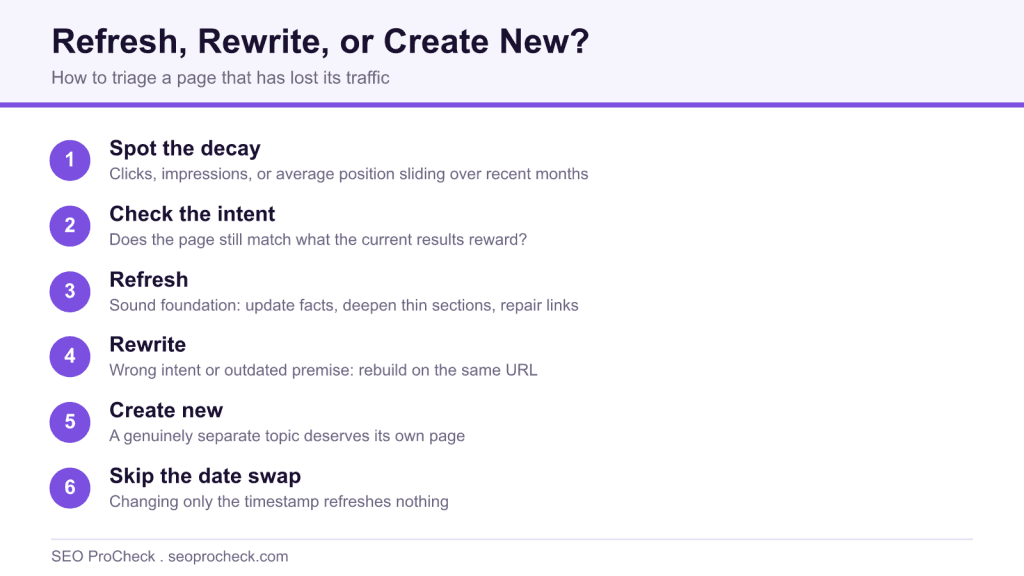
Content does not stay fresh on its own, so review your highest value pages on a recurring cadence and refresh the ones that are decaying. A real refresh updates facts, intent, depth, and internal links, not just the published date; when the foundation is broken, rewrite the URL or create a new page instead.
- Content decay is a slow slide in clicks, impressions, and position, not a single dramatic drop.
- Prioritize refreshes by the traffic and business value at stake, working down from the top.
- Changing only the published date refreshes nothing and can erode reader trust.
- Refresh when the foundation is sound, rewrite when the intent is wrong, create new for a separate topic.
TL;DR
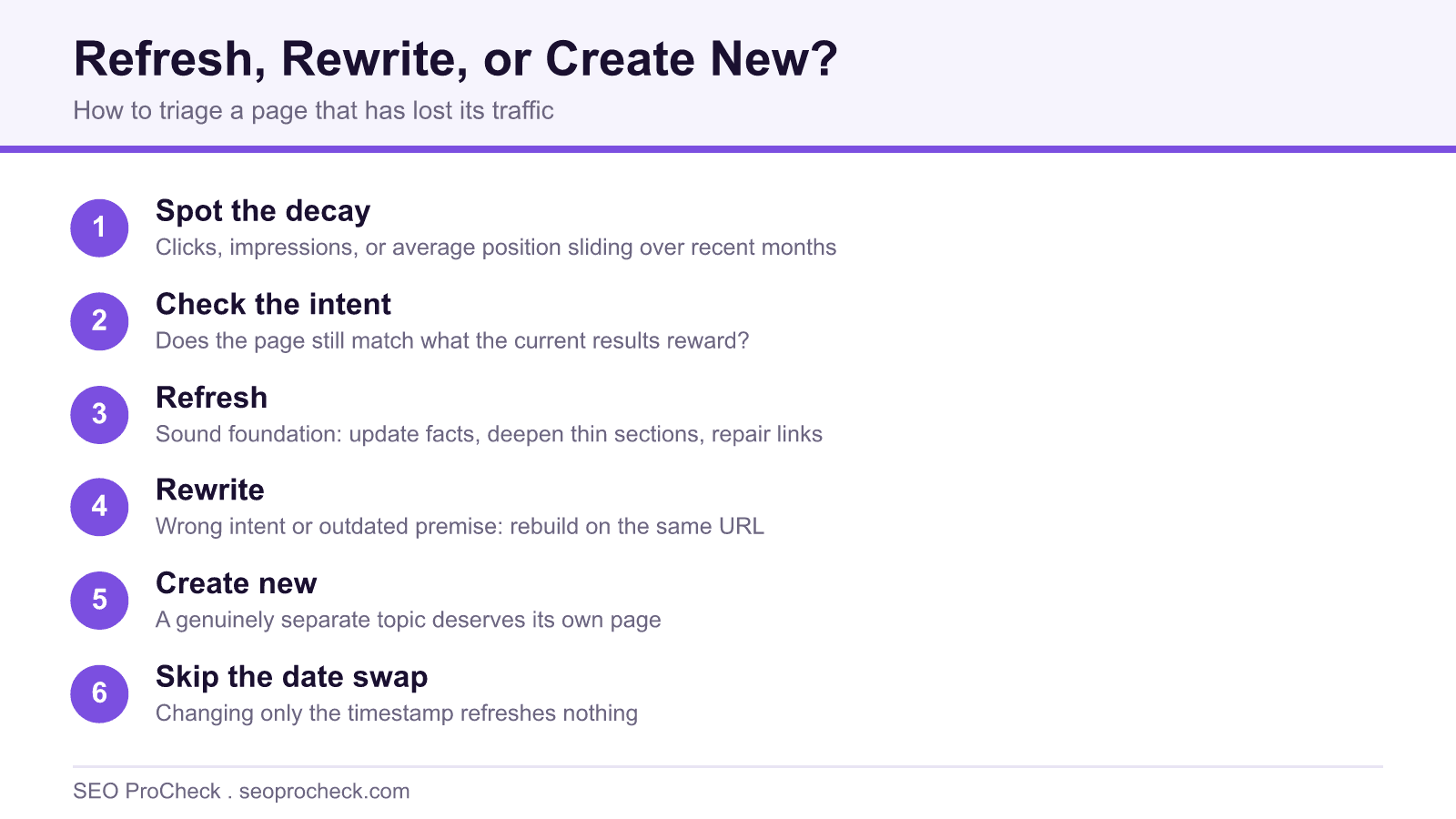
Content does not stay fresh on its own. Search results shift, facts age, and stronger pages move in, so traffic quietly erodes even when you change nothing. The fix is a deliberate refresh, not a date swap: re-check the query's intent, update facts and examples, deepen thin sections, and repair internal links. Review your highest-value pages on a sensible cadence and be honest about when a page needs a real rewrite or a fresh article instead.
Why content decays
Content decay is the slow loss of rankings, impressions, and clicks on a page that once performed well. It rarely arrives as a single dramatic drop. More often it is a gradual slide you only notice once a page that used to bring steady traffic has gone quiet. Several forces drive it, usually at once.
The search results themselves change. Google keeps reshaping what it shows for a query, and the mix of formats and features around your listing keeps moving, so a page written for one version of a result page can become a poor fit for the next without a single word of yours changing. Information also ages: prices, screenshots, recommended tools, and best practices all drift out of date, and a reader who hits advice referencing a workflow that no longer exists loses trust fast.
Competition arrives too. New pages get published, rivals expand their coverage, and the bar for a thorough answer rises, so standing still means falling behind. Freshness itself also carries weight for many queries, so the simple passage of time works against you.
How to spot refresh candidates
You cannot refresh everything, so the goal is to find pages where an update will pay off. Start with the data you have. Look for pages with a clear downward trend in clicks or impressions over recent months, and pages whose average position has slipped from the top of the results toward the bottom of the first page or beyond. A page sliding from a strong position is usually recoverable; a page that never ranked may have a deeper problem.
Next, read the page against the current results for its main query. Does it still match what searchers want, or has the dominant intent shifted toward a different format or angle? Is your coverage thin next to what now ranks, missing sections or specifics that competitors include? Strong structure helps here, and our guide on content structure for AI covers how to organize a page so both readers and machines can parse it. Finally, audit for staleness: outdated facts, dead links, deprecated features, and examples that no longer ring true are all signals. A useful filter: if a knowledgeable reader saw this page today, would anything make them doubt it?
What to update (and what not to)
A real refresh changes the substance of the page, not just its appearance. Start with the things that affect whether the page deserves to rank.
Worth doing
Re-verify every factual claim and update anything that changed. Replace stale examples and screenshots with current ones. Add the sections and depth the current results reward so the page answers the question more completely. Re-check intent and reshape the page if searchers now want something different. Repair and add internal links so the refreshed page connects to your other relevant material. Tighten the introduction and headings so the value is obvious in the first screen. Where structured data applies, confirm it still reflects the page; our article schema guide walks through getting that markup right.
Not worth doing
Changing the published date while leaving the body untouched fools no one and can erode trust if a reader notices the contradiction. Cosmetic edits, swapping synonyms, or padding word count without adding meaning do not address why a page declined. If the only thing you change is the date, you have not refreshed anything. The freshness signal should follow from real work, not substitute for it.
How often to review
There is no single correct interval, because pages age at different speeds. News and fast-moving topics go stale quickly; evergreen explainers hold up far longer. A practical approach is to review your library on a recurring cadence and triage rather than treat every page equally. Pull the pages showing decline, sort by the traffic and business value at stake, and work down from the top.
Prioritize pages that already earn meaningful traffic or sit close to visibility that would matter, because a small recovery on a high-value page beats a large recovery on a page nobody finds. Run frequent checks on your most important pages so problems surface early, and a slower sweep for the long tail. The cadence matters less than the discipline of actually looking; decay is invisible until you measure it.
Refresh, rewrite, or create new?
Refreshing assumes the page has a sound foundation worth building on. When the structure, angle, and core argument still hold, an update is the efficient move, and it preserves the history and links the page has accumulated. When the page targets the wrong intent, rests on an outdated premise, or would need so many changes that little of the original survives, a full rewrite of the same URL is the honest choice. When a genuinely separate topic deserves its own coverage, create a new page rather than stretching an existing one to cover ground it was never meant to address; forcing two intents onto one URL usually serves neither well.
Refresh, rewrite, or create new: a quick decision table
| Signal you see | What it means | Best move |
|---|---|---|
| Clicks and impressions sliding on a page that once ranked well | Ordinary content decay on a sound page | Refresh: update facts, deepen thin sections, repair links |
| The page targets the wrong intent or rests on an outdated premise | The foundation itself is broken | Rewrite the same URL, keeping its history and links |
| A separate subtopic keeps getting crammed onto the page | Two intents fighting over one URL | Create a new page built for that topic |
| Only the published date changed, the body untouched | No real update at all | Do nothing: that is not a refresh |
Frequently asked questions
Does updating the date alone help rankings?
No. A date change with no real updates does not make a page more useful, and search systems weigh the substance, not the timestamp. Treat the date as a reflection of genuine updates, not a lever to pull on its own.
How long after a refresh should I expect results?
It varies. Search systems need to recrawl and reassess the page, so give a refresh time to settle before judging it. Track the page afterward and compare its trend against where it was heading before you intervened.
Should I refresh pages that never ranked well?
Usually not first. A refresh works best on pages that earned visibility and then lost it. A page that never ranked often has a deeper problem with intent, competition, or fit, and may need a rethink or a new approach rather than an update.
What counts as a real refresh versus a fake one?
A real refresh changes the substance: verified facts, updated examples, added depth, repaired links, and a sharper introduction. A fake refresh swaps the date or shuffles synonyms and changes nothing a reader or a search engine would value.
How do I decide which pages to refresh first?
Pull the pages showing a downward trend, then sort by the traffic and business value at stake and work down from the top. A small recovery on a high value page beats a large recovery on a page nobody finds.
When should I create a new page instead of refreshing?
When a genuinely separate topic deserves its own coverage, publish a new page rather than stretching an existing one to cover ground it was never meant to address. Forcing two intents onto one URL usually serves neither well.
Not sure which pages to refresh first?
An advanced SEO audit pinpoints the decaying pages worth recovering, the intent mismatches holding others back, and the highest-value updates to make first, so your refresh effort goes where it actually moves the needle.
Claude Vincent is a technical SEO consultant focused on crawlability, rendering, and AI-search visibility. He writes the field guides and case studies at SEO ProCheck, with a bias toward the durable, unglamorous work that decides whether search engines and AI answer engines can actually read and cite a site.
About SEO ProCheck
Technical SEO consulting and GEO strategy with 20 years of enterprise experience. Case studies, resources, and tools for search and AI visibility.
Work With Me
Technical SEO audits, GEO strategy, site migrations, and international SEO. Hourly consulting for teams who need hands-on support, not just reports.
Subscribe to our newsletter!





Recent Posts
- Can AI Crawlers Actually Read Your Site? I Measured 400 of the Biggest September 5, 2026
- The Pre-Publish Quality Gate for AI-Assisted Content August 6, 2026
- AGENTS.md vs llms.txt vs llms-full.txt: Which Agent File Does What July 18, 2026