

AI Summary
Enterprise B2B content tends to rank when it goes deeper than B2C equivalents, proves genuine expertise and targets specific long tail queries that decision makers actually use. Depth, demonstrated E-E-A-T and selective gating, rather than volume alone, are what separate high performing enterprise content from underperforming efforts.
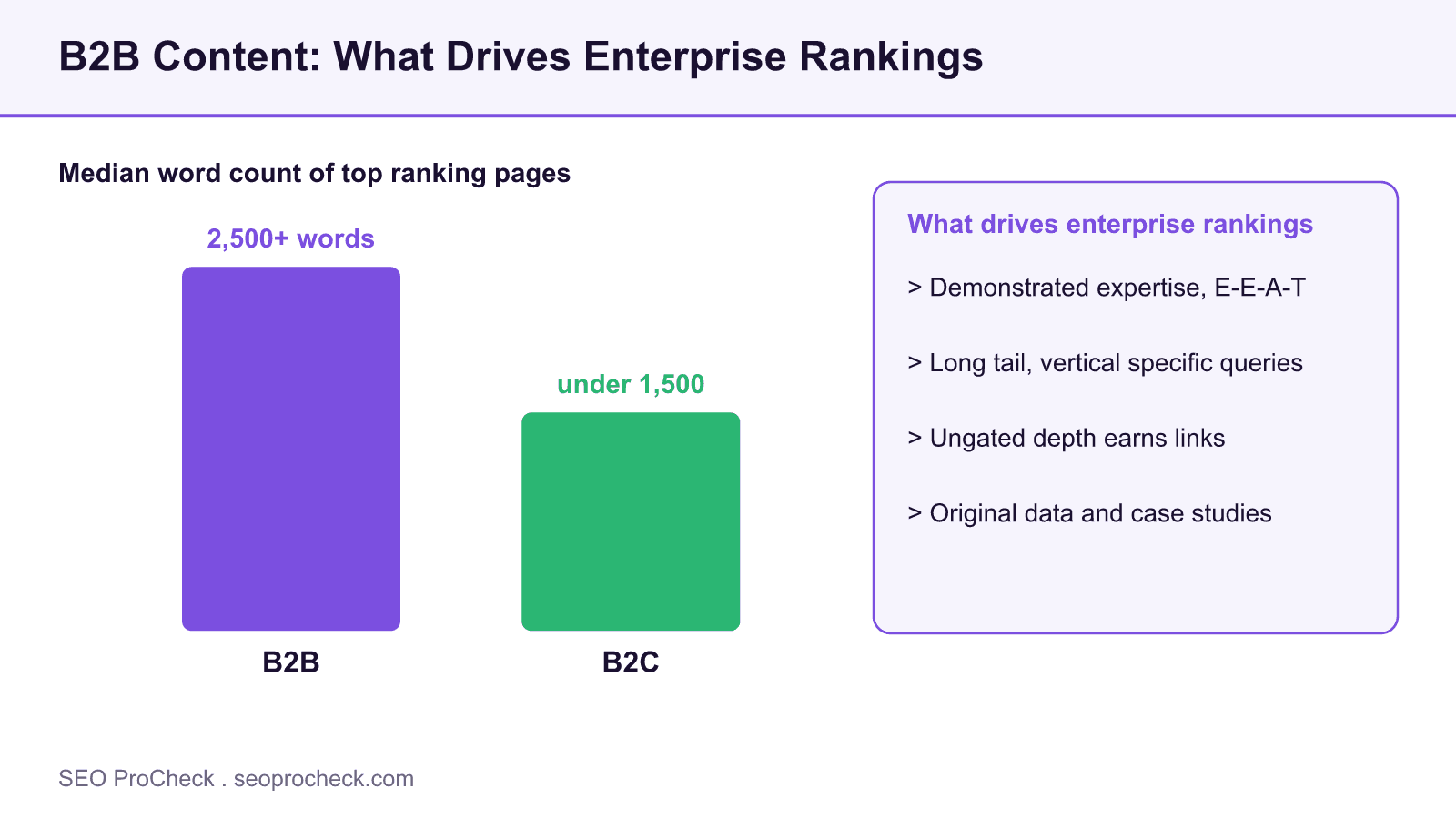
- Top ranking B2B pages average well over 2,500 words versus under 1,500 for many B2C topics.
- Author expertise, credentials and original insight correlate strongly with B2B performance.
- Ungated content earns more links and rankings, so gate only high value assets selectively.
- Specific, vertical long tail queries convert better than broad, high volume head terms.
Business to business search behaves differently from consumer search. The buyer is often a committee, the purchase is high consideration, and the questions are technical and specific. Content that wins in this environment reflects those realities: it is deeper, more expert and more precisely targeted than a typical consumer article. The research summarised here examined what actually distinguishes enterprise content that ranks and generates qualified pipeline from content that does neither.
Content depth requirements
B2B topics required substantially more content depth than B2C equivalents. Top ranking B2B content averaged 2,500 or more words compared to B2C averages under 1,500. Decision makers researching enterprise purchases expected comprehensive information addressing complex requirements. The point is not word count as a target in itself: length is a symptom of thoroughly covering a complicated topic. A page that answers the buyer question, the technical objections, the integration concerns and the total cost picture will naturally run long, and that completeness is what the ranking reflects.
Expertise demonstration
Content demonstrating genuine expertise through technical depth, case studies and original insights outperformed general overviews. Author expertise signals, including credentials and industry experience, correlated with B2B content performance. E-E-A-T requirements appeared stricter for high consideration purchases. In practice that means naming the author and showing why they are qualified, citing first hand experience and real deployments, and including specifics such as configurations, benchmarks and named scenarios that only a practitioner would know. Generic advice assembled from other articles reads as generic and tends to rank like it.
Gated versus ungated content
Ungated content accumulated more backlinks and rankings than gated equivalents. However, strategic gating of high value assets like original research still generated leads. The optimal approach combined ungated SEO content with selective gating for conversion focused assets. A useful rule is to let the content that is meant to rank and earn links stay open, and reserve the gate for a small number of genuinely high value assets, an original benchmark report or a detailed model, where the trade of contact details for the asset is fair.
Long tail focus
B2B success often came from targeting specific long tail queries that B2C focused competitors ignored. Industry specific terminology and niche use cases provided ranking opportunities with highly qualified intent. Building depth in specific verticals outperformed broad topic coverage. A single mid volume query like integration between two named enterprise systems can be worth more than a high volume generic term, because the searcher is deep in an evaluation and close to a decision.
Turning the findings into a workflow
These patterns combine into a repeatable approach. Start from the specific questions a qualified buyer asks, not from a keyword volume list. Assign the piece to someone with real expertise, or interview one, so the content carries first hand detail. Cover the topic completely enough that the buyer does not need another tab open, which is where the depth comes from. Keep the ranking assets ungated and reserve gating for a few standout resources. The result is a small set of deep, expert pages that behave like evergreen assets, a dynamic explored further in the evergreen content guide.
| Dimension | B2C tendency | Enterprise B2B tendency |
|---|---|---|
| Typical depth of top pages | Under 1,500 words | 2,500 or more words |
| Buyer | Individual, fast decision | Committee, long evaluation |
| Winning signal | Broad reach and freshness | Demonstrated expertise and completeness |
| Query focus | High volume head terms | Specific vertical long tail |
| Gating | Rare | Selective, for high value assets only |
Depth is only credible when it is genuine, and part of that credibility comes from how a page cites its sources, a factor examined in the study on outgoing links. If you are auditing an enterprise content library, a structured content review helps identify which pages are too thin to compete and which topics deserve the deep treatment.
Source: B2B content marketing research compiled
Frequently asked questions
Length should follow the complexity of the topic rather than a fixed target, but in practice top ranking enterprise pages often exceed 2,500 words because they cover technical requirements, objections and cost thoroughly. Aim for completeness, and the appropriate length follows.
Enterprise buyers evaluate high consideration purchases as a group and expect answers to complex, technical questions before they act. Content that addresses those requirements in full satisfies the searcher and signals the completeness that ranking systems reward.
Keep the content meant to rank and earn links ungated, since gating suppresses both. Reserve gates for a small number of genuinely high value assets, such as original research, where exchanging contact details for the asset is a fair trade.
Expertise and trust signals appear to matter more for high consideration purchases. Naming qualified authors, showing first hand experience, and including original insight and real case studies all correlate with stronger enterprise content performance.
Yes. Specific, vertical long tail queries carry highly qualified intent and less competition, so a mid volume term that names an exact use case or integration often produces more pipeline than a broad, high volume head term.
Prioritise depth and expertise on the pages closest to a buying decision: interview a practitioner, cover the topic completely, keep it ungated and target the specific queries your buyers use. A content audit helps you find which pages to upgrade first.
Want a page that actually earns the click?
Thin, templated pages get suppressed. A focused review finds the gaps and turns them into content that ranks and converts.
Take this with you
The assistant links open with a question about this page already written. Nothing is sent until you press enter.
Claude Vincent is a technical SEO consultant focused on crawlability, rendering, and AI-search visibility. He writes the field guides and case studies at SEO ProCheck, with a bias toward the durable, unglamorous work that decides whether search engines and AI answer engines can actually read and cite a site.
About SEO ProCheck
Technical SEO consulting and GEO strategy with 20 years of enterprise experience. Case studies, resources, and tools for search and AI visibility.
Work With Me
Technical SEO audits, GEO strategy, site migrations, and international SEO. Hourly consulting for teams who need hands-on support, not just reports.
Subscribe to our newsletter!








Recent Posts
- Most Top Sites Never Say Who They Are in Structured Data October 14, 2026
- Homepage Titles Are Mostly Too Short, Not Too Long October 8, 2026
- Who Actually Serves an llms.txt? 184 Top Sites Measured September 29, 2026