

AI Summary
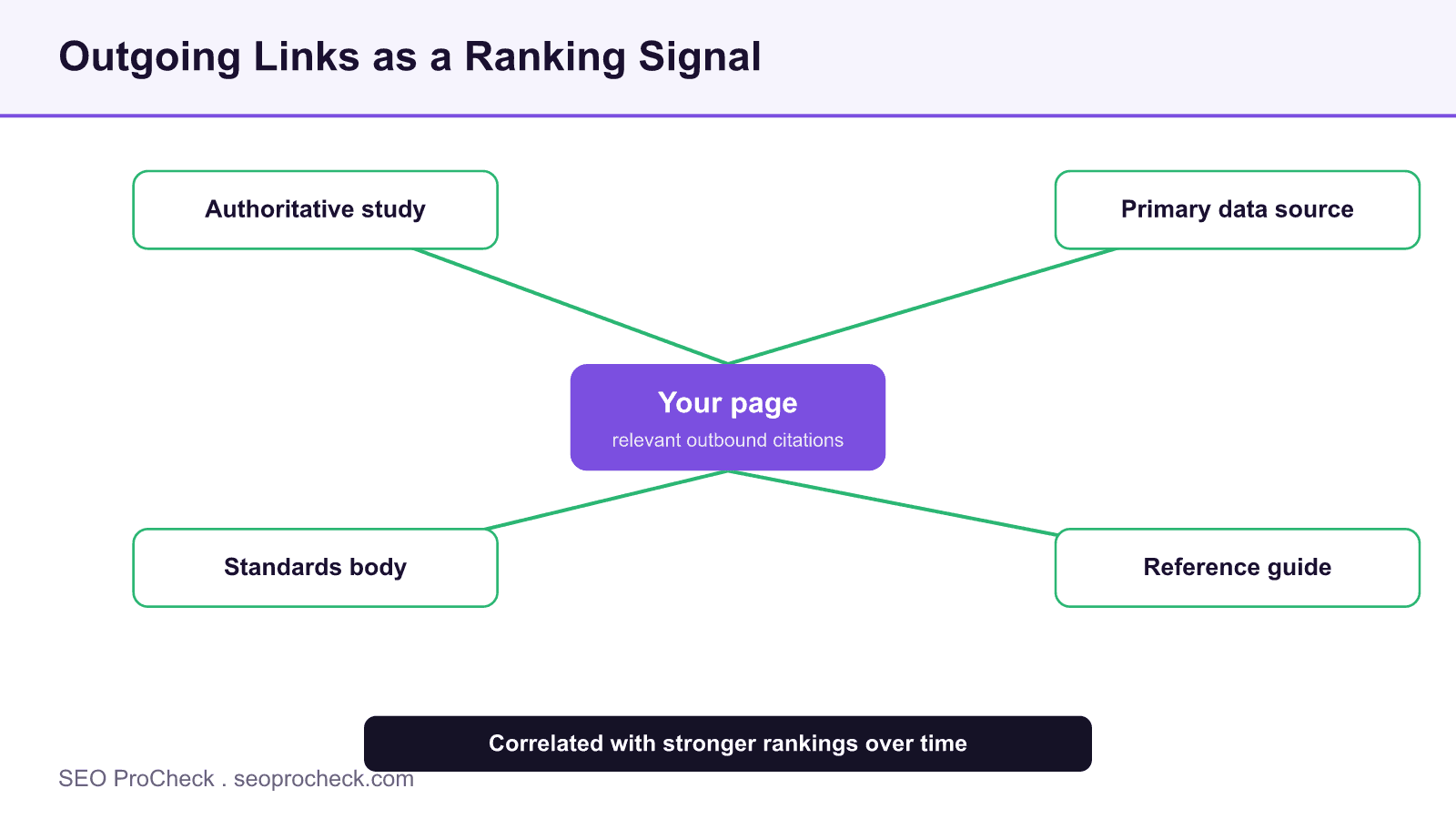
A long term experiment found that adding relevant outbound links to authoritative sources was associated with better rankings for the linking page, supporting the idea that thoughtful outbound linking is a positive signal, not a leak of authority. The practical takeaway is to cite credible, on topic sources naturally, not to hoard links out of a myth that they drain your page.
- The study reported that pages linking out to authority ranked better than those that did not.
- Relevance and quality of the destination matter more than the raw number of links.
- Outbound citations support trust and E-E-A-T by showing your claims are sourced.
- Link naturally within context; do not stuff links or point to low quality pages.
A persistent myth in SEO is that linking out drains authority from your page, so you should keep visitors and link equity locked in. The experiment summarised here tested that belief directly over a long period and found the opposite pattern: pages that linked out to relevant, authoritative sources tended to rank better than comparable pages that did not. It is a correlation from a controlled test rather than a guarantee, but it lines up with how trustworthy content actually behaves.
Why outbound links can be a positive signal
Good content cites its sources. When you make a factual claim and link to the study, the standards document or the primary data behind it, you are doing what a credible author does, and you are giving both readers and search engines a way to verify the claim. That behaviour is part of trust and expertise. Linking to authoritative, on topic pages also helps engines understand your page by the company it keeps: a page about a technical standard that references the standards body sits in a clearer neighbourhood than one that cites nothing.
The authority drain worry misunderstands how this works. Sending readers to a genuinely useful source does not hollow out your page; it makes your page a better answer, and a better answer is what earns the ranking. The same instinct toward credible sourcing shows up in enterprise content research, where demonstrated expertise and citations correlate with performance.
How to link out well
| Do | Avoid |
|---|---|
| Link to authoritative, on topic sources that support a specific claim | Linking to low quality or irrelevant pages to pad the count |
| Place links naturally in context where they add value | Stuffing many links into one paragraph or a dumped list |
| Use descriptive anchor text that describes the destination | Generic anchors like click here or read more everywhere |
| Cite primary sources, studies, standards and original data | Chaining through thin aggregators instead of the source |
| Open the door to sources you genuinely used | Adding links purely to game a perceived signal |
The theme is relevance and honesty. A handful of well chosen citations to strong sources does more than a dozen tangential links. Anchor text should describe what the reader will find, which helps users and gives engines context, and the destination should be the real source rather than an aggregator that merely repeats it.
Where outbound links fit alongside other signals
Outbound linking is a supporting signal, not a primary lever. It will not rescue thin content or overcome a weak backlink profile, but on a solid page it reinforces trust and topical clarity. Think of it as part of the same credibility system as author expertise, accurate information and clean structure. It pairs naturally with strong internal linking too: cite authoritative external sources for your claims, and link internally to your own evergreen cornerstone pages so readers and crawlers can move through your topic cluster.
One practical caution: keep an eye on link health. Outbound links to sources that later disappear become broken links, which is a minor but real quality issue. Periodically checking that your citations still resolve, alongside the rest of your content maintenance, keeps the trust signal intact rather than letting it rot.
What has changed since this experiment
The rise of E-E-A-T as an explicit quality theme and the growth of answer engines have made credible sourcing more important, not less. AI Overviews and chat based search lean heavily on content that cites verifiable sources, and pages that reference primary data are easier to trust and to quote. The experiment predates those developments, yet its lesson has aged well: cite good sources because it makes your content genuinely better, and the ranking behaviour tends to follow.
Source: https://www.rebootonline.com/blog/long-term-outgoing-link-experiment/
Frequently asked questions
A long term experiment found that linking out to relevant, authoritative sources was associated with better rankings, so thoughtful outbound links tend to help. They support trust and topical clarity, provided the destinations are credible and genuinely relevant.
That is a myth. Sending readers to a useful, authoritative source makes your page a more complete answer rather than hollowing it out. The evidence points to careful outbound linking being a positive rather than a leak.
There is no fixed number. Link to as many credible sources as your claims genuinely require and no more, since relevance and quality matter far more than count. A few strong citations beat a dozen tangential ones.
Use normal followed links for genuine editorial citations to sources you trust. Reserve nofollow or sponsored attributes for paid, untrusted or user generated links, in line with how those attributes are intended to be used.
Authoritative, on topic pages that directly support a specific claim, ideally primary sources such as studies, standards bodies and original data rather than thin aggregators. Descriptive anchor text that names the destination completes the picture.
Yes, increasingly. Answer engines and AI Overviews favour content that cites verifiable sources, so pages that reference primary data are easier to trust and to quote. Credible sourcing has become more valuable as these features have grown.
Want a page that actually earns the click?
Thin, templated pages get suppressed. A focused review finds the gaps and turns them into content that ranks and converts.
Claude Vincent is a technical SEO consultant focused on crawlability, rendering, and AI-search visibility. He writes the field guides and case studies at SEO ProCheck, with a bias toward the durable, unglamorous work that decides whether search engines and AI answer engines can actually read and cite a site.
About SEO ProCheck
Technical SEO consulting and GEO strategy with 20 years of enterprise experience. Case studies, resources, and tools for search and AI visibility.
Work With Me
Technical SEO audits, GEO strategy, site migrations, and international SEO. Hourly consulting for teams who need hands-on support, not just reports.
Subscribe to our newsletter!







Recent Posts
- Can AI Crawlers Actually Read Your Site? I Measured 400 of the Biggest September 5, 2026
- The Pre-Publish Quality Gate for AI-Assisted Content August 6, 2026
- AGENTS.md vs llms.txt vs llms-full.txt: Which Agent File Does What July 18, 2026