

AI Summary
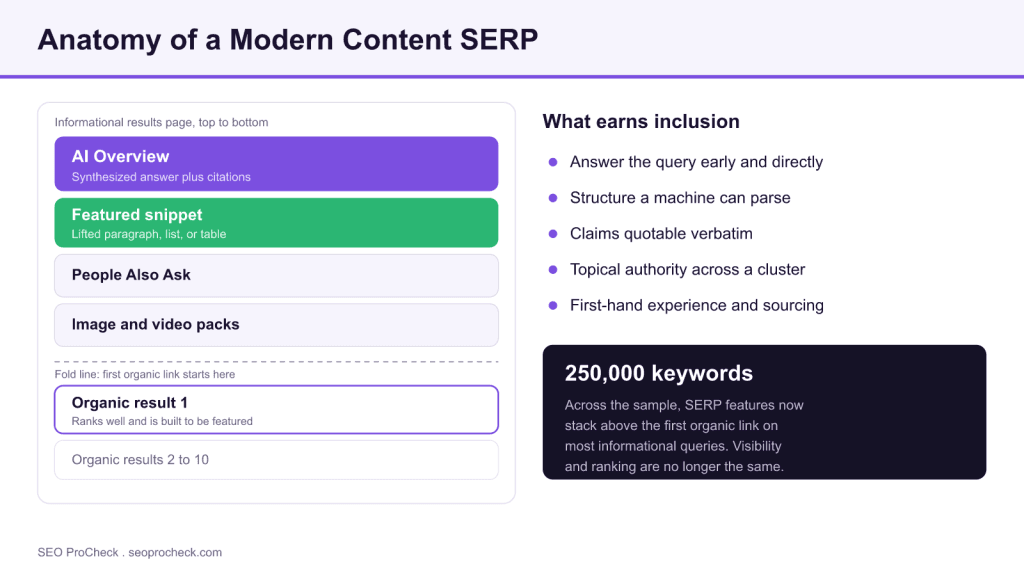
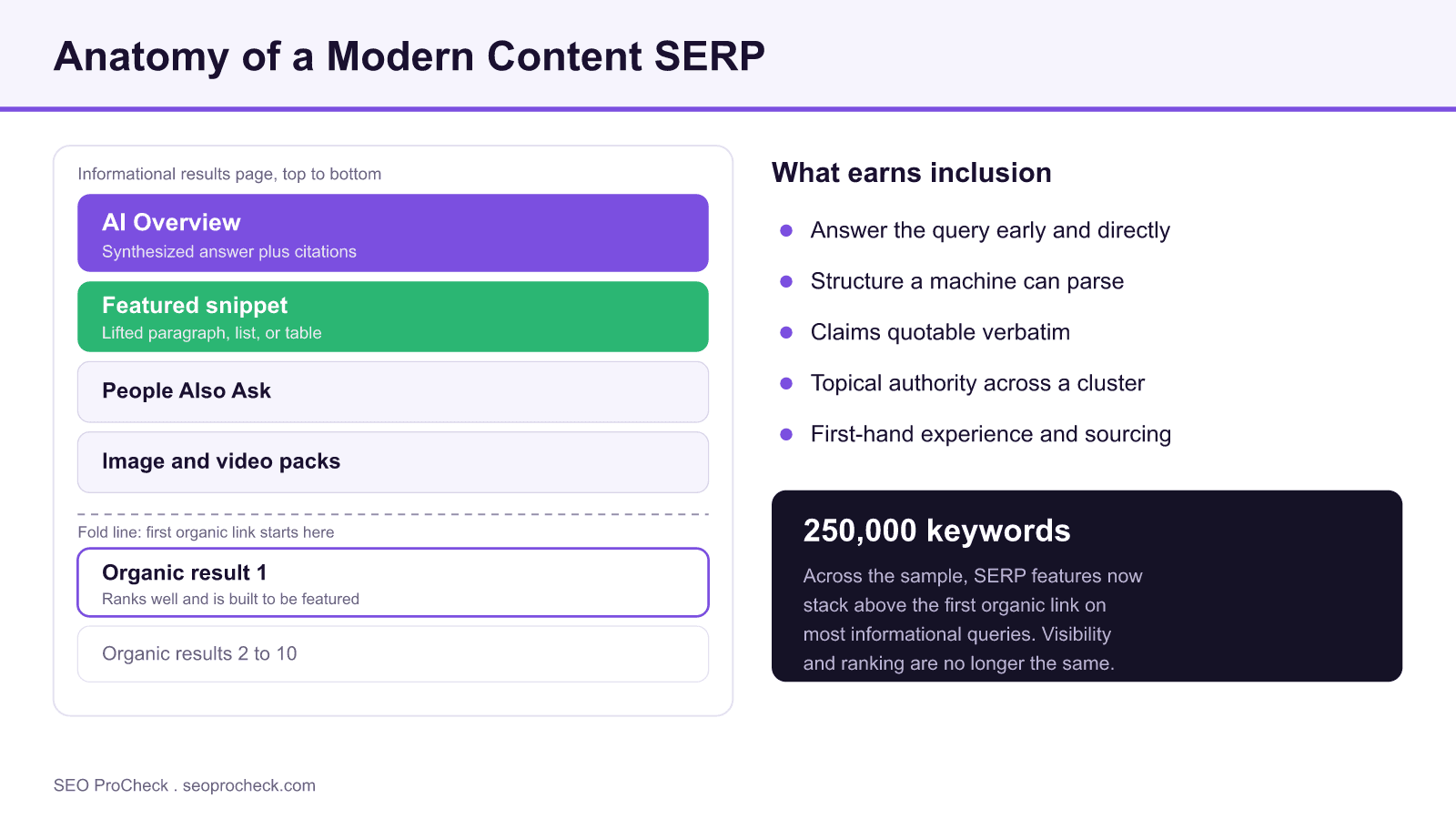
Across 250,000 keywords, the content SERP stacks AI Overviews, snippets, and People Also Ask boxes above the first organic link, so ranking no longer guarantees visibility. Pages win by being built for inclusion: answer the query early, structure it for machines, and make claims quotable enough for a feature to lift.
- Features now answer many informational queries before a user reaches organic results.
- Being cited by an AI Overview can build authority even without a click.
- Direct answers, clean structure, and topical authority decide inclusion.
- Choose your battles: one line answers leak clicks, depth and judgment retain them.
If you publish content to earn organic traffic, the surface you compete for has changed shape. The ranking battle still matters, but it now happens inside a results page crowded with features built to satisfy intent immediately. Knowing what that page looks like, and what content survives it, is the first step toward a strategy that still earns clicks.
What the content SERP looks like today
Run an informational query today and you rarely land on a clean list of links. You meet a layered experience. A featured snippet may sit at the top, lifting a paragraph, list, or table out of a ranking page. Below or beside it, People Also Ask boxes expand into a branching set of related questions. Image packs, video carousels, and increasingly an AI Overview occupy the space above the fold, each one nudging the first true organic result further down.
The practical effect is that visibility and ranking are no longer the same thing. A page can hold a strong organic position and still sit beneath several features that absorb attention. The question is not only "do I rank" but "do I appear inside the features users see first." The content SERP rewards pages that can be reused by these features, not just indexed by the crawler.
What wins informational queries
The content that performs here shares recognizable traits. It answers the actual question early and directly, then earns the reader's time with depth that goes beyond the snippet. It is organized so a machine can parse it: clear headings that map to sub-questions, short answer paragraphs, lists and tables where the format fits, and definitions stated plainly enough to be lifted verbatim.
Topical authority also carries weight. Pages that sit within a well-developed cluster of related content tend to outperform isolated articles, because they signal genuine coverage rather than a single opportunistic post. Demonstrable experience and credible sourcing matter for the same reason: search systems and AI models both lean toward content that shows first-hand knowledge and verifiable claims. Thin pages that restate the obvious are exactly what featured snippets and AI Overviews are designed to replace.
How AI Overviews change the picture
AI Overviews and People Also Ask both synthesize answers from multiple sources, and that changes the value of being on the page. Instead of competing only for a click, you compete to be one of the sources the system trusts and cites. A page can influence the answer a user reads even when the user never visits it, which is both a risk and an opportunity.
The risk is clear: an overview that fully answers a simple question can reduce clicks to the pages beneath it. The opportunity is that citation builds visibility and authority, and complex or high-stakes questions still send users looking for the depth and trust a short synthesis cannot provide. The content most likely to be cited is structured, specific, and quotable, with claims a model can extract without ambiguity. Our guidance on optimizing for AI Overview citations goes deeper on what earns inclusion.
What it means for your strategy
The shift is from chasing rankings to earning inclusion. That starts with depth: shallow content gets summarized away, while comprehensive pages give both readers and AI systems a reason to engage. Structure is the second lever. Content built with a clear hierarchy, direct answers, and scannable formatting is easier to feature, easier to cite, and easier to trust. Our breakdown of content structure for AI covers the formatting patterns that help.
Being citable is the third lever: state claims plainly, back them with evidence, and make your expertise visible on the page. It also means choosing your battles. Queries an overview answers in one line will leak clicks no matter how well you write, so the durable wins come from questions where readers need more than a summary and comparison, judgment, or genuine experience is the point.
SERP features and how to earn a place in each
Each feature lifts a different shape of content from the page. The practical move is to give every feature the exact format it prefers, so one well built page can qualify for several at once.
| SERP feature | What it lifts from a page | How to earn a place in it |
|---|---|---|
| AI Overview | A synthesized answer drawn from several sources | State the answer plainly and back claims with evidence a model can extract |
| Featured snippet | One paragraph, list, or table that answers directly | Place a 40 to 55 word answer right under a question style heading |
| People Also Ask | Short answers to adjacent questions | Add H2 or H3 headings phrased as the follow up questions |
| Image and video pack | Labeled visuals and thumbnails | Publish original diagrams and charts with descriptive alt text and file names |
| Organic result | The full page for readers who want depth | Cover the topic comprehensively within a linked content cluster |
FAQ
Yes. Organic results remain the destination for users who want depth, and they are the pool features draw from. Ranking well is now the entry requirement for being featured, not a separate goal.
Both, in that order on the page. Lead with a direct, quotable answer that a feature can lift, then continue with the depth that keeps a real reader engaged and signals genuine authority.
No. Overviews are assembled from content, so the underlying pages remain essential. They shift the value toward being a trusted, citable source rather than removing the role of content.
Aim for roughly 40 to 55 words placed directly beneath a heading that mirrors the question. That length fits most featured snippet boxes and gives an AI Overview a clean, self contained claim to quote.
Often, yes. A clear comparison table gives a featured snippet a ready made structure to lift, and it gives an AI Overview discrete facts it can cite. Tables also make a page easier for readers to scan, which supports engagement.
Ranking is your organic position in the list. Visibility is whether a user actually sees you, which now depends on appearing inside the features stacked above the organic results. A page can rank first and still sit below an AI Overview, a snippet, and a People Also Ask block.
If your pages rank but rarely get featured or cited, the structure and depth may be holding them back. An advanced SEO audit shows exactly where your content competes for inclusion and where it gets summarized away.
Claude Vincent is a technical SEO consultant focused on crawlability, rendering, and AI-search visibility. He writes the field guides and case studies at SEO ProCheck, with a bias toward the durable, unglamorous work that decides whether search engines and AI answer engines can actually read and cite a site.
About SEO ProCheck
Technical SEO consulting and GEO strategy with 20 years of enterprise experience. Case studies, resources, and tools for search and AI visibility.
Work With Me
Technical SEO audits, GEO strategy, site migrations, and international SEO. Hourly consulting for teams who need hands-on support, not just reports.
Subscribe to our newsletter!







Recent Posts
- Can AI Crawlers Actually Read Your Site? I Measured 400 of the Biggest September 5, 2026
- The Pre-Publish Quality Gate for AI-Assisted Content August 6, 2026
- AGENTS.md vs llms.txt vs llms-full.txt: Which Agent File Does What July 18, 2026