

AI Summary
Knowledge graph entity linking connects the people, products and concepts on your pages to established entries in public knowledge bases like Wikipedia and Wikidata. Doing this with schema sameAs and consistent references gives AI systems an unambiguous identity to attach your content to.
- Element code TE-011: content not connected to knowledge graph entities.
- Use schema.org sameAs to point your entity at authoritative profiles.
- Disambiguation is the real goal: help machines know which John Smith or which Apple you mean.
- Strong entity links improve how AI systems associate, trust and cite your brand.
Quick Reference
Element Code: TE-011
Issue: Content not connected to knowledge graph entities
Impact: Weaker entity associations
Fix: Link content to established knowledge graph entities
Detection: Entity analysis
What Is This Issue?
Connecting your content to established knowledge graph entities (Wikipedia, Wikidata, etc.) strengthens entity associations.
Why This Matters for Your Website
Knowledge graph connections help AI systems understand entity context and relationships.
How to Fix This Issue
- Identify entities: People, places, concepts in content
- Link to sources: Wikipedia, official sites
- Use sameAs schema: Connect to knowledge bases
Tools for Detection
- Entity analysis: Identify entity opportunities
AI Search and GEO Considerations
Knowledge graph connections provide explicit entity signals to AI systems.
TL;DR (The Simple Version)
Link your content to established knowledge graph entities using schema sameAs and references to authoritative sources.
What entity linking really solves
The core problem AI systems face with your content is ambiguity. Is "Apple" the company or the fruit? Which "Michael Jordan," the basketball player or the statistics professor? Knowledge graph entity linking removes that ambiguity by tying the names on your pages to specific, unique entries in public knowledge bases. Once a machine knows exactly which entity you mean, it can attach your facts to the right node and reason about them with far more confidence. See the underlying concept in our knowledge graph and entity lexicon entries.
The main mechanism: sameAs
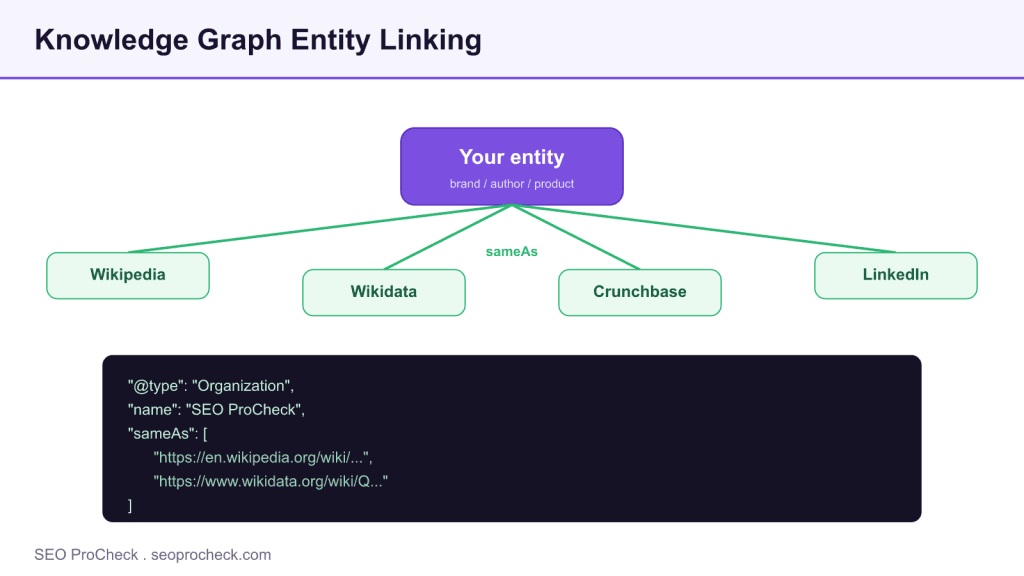
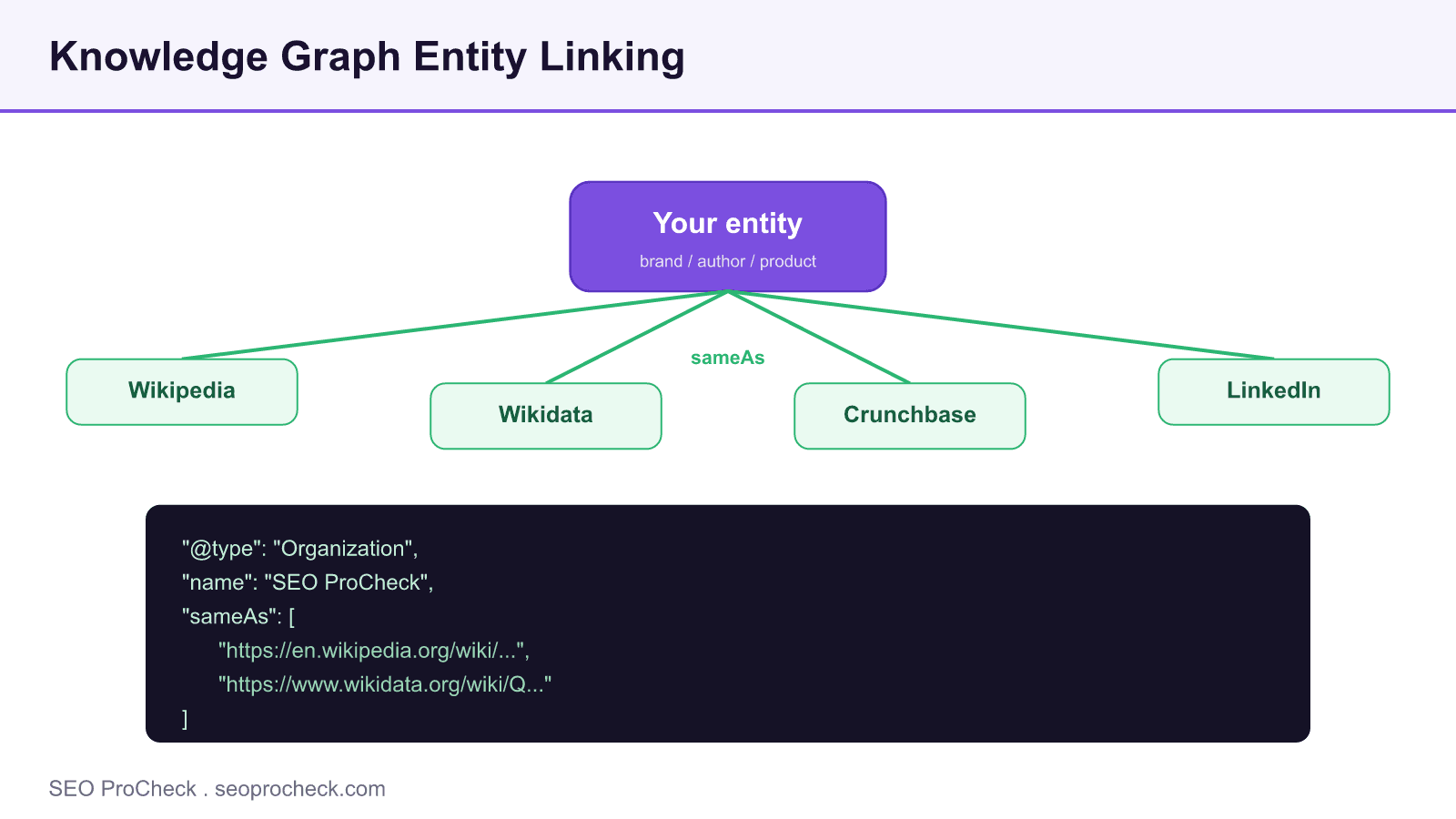
The most direct signal is the schema.org sameAs property. Inside your structured data, sameAs points your entity at its canonical profiles elsewhere: a Wikipedia article, a Wikidata Q-number, an official site, a LinkedIn or Crunchbase page. The diagram above shows exactly this pattern. A minimal example for an organization:
{
  "@context": "https://schema.org",
  "@type": "Organization",
  "name": "SEO ProCheck",
  "url": "https://seoprocheck.com/",
  "sameAs": [
    "https://www.wikidata.org/wiki/Q...",
    "https://www.linkedin.com/company/..."
  ]
}
The same idea applies to a Person (link an author to their Wikidata, ORCID or LinkedIn) and to a Product or Brand. You are giving the machine a set of already-trusted addresses for the thing you are describing.
| Entity type | Authoritative targets for sameAs | Why it helps |
|---|---|---|
| Organization / brand | Wikidata, Crunchbase, LinkedIn, official site | Disambiguates your company from similarly named ones |
| Person / author | Wikidata, ORCID, LinkedIn, Muck Rack | Ties expertise and bylines to a verified identity |
| Product | Wikidata, manufacturer page, GTIN databases | Connects reviews and specs to one canonical product |
| Place | Wikidata, GeoNames, Google Maps place | Fixes location ambiguity for local and travel content |
Beyond sameAs: in-content signals
Schema is the explicit channel, but AI systems also read prose. Linking the first mention of an important entity to its authoritative source (a Wikipedia article, an official page) reinforces the association in plain HTML. Consistent naming matters too: pick one canonical form of your brand or product name and use it, rather than three variants that a machine has to reconcile. Entity work pairs naturally with AI-driven internal link optimization: entities tell machines who and what, internal links tell them how your coverage fits together.
How to implement it step by step
- Inventory your key entities. List the people, brands, products and places that matter on your important pages.
- Find their canonical IDs. Locate each entity on Wikidata and any relevant authority; record the URL or Q-number.
- Add sameAs to schema. Include the authoritative URLs in your Organization, Person or Product markup.
- Link first mentions in content. Where natural, link the first reference of an entity to its authoritative page.
- Validate. Run the page through a structured-data validator and confirm the entity resolves cleanly.
Common mistakes
- Pointing sameAs at the wrong entity. A near-name match can actively mislead. Verify the Wikidata item is truly yours.
- Only marking up the homepage. Author and product entities deserve their own markup on the pages that feature them.
- Inconsistent names across the site. Variant spellings fracture the signal you are trying to consolidate.
- Expecting instant results. Entity recognition builds as signals accumulate across the web, not overnight.
FAQ
What is knowledge graph entity linking in simple terms?
It is the practice of connecting the names on your pages to their exact entries in public databases like Wikipedia and Wikidata, so machines know precisely which person, brand or thing you mean and can attach your information to the right identity.
Do I need a Wikipedia page to benefit?
No. Wikidata is more accessible and often the better anchor. You can also use LinkedIn, Crunchbase, ORCID and your own official pages in sameAs. A Wikipedia article helps but is not a prerequisite.
What is the difference between an entity and a keyword?
A keyword is a string of text; an entity is a real-world thing with an identity that persists across languages and phrasings. Search and AI systems increasingly reason about entities, which is why linking to them is more durable than chasing exact-match keywords.
How does sameAs actually help AI systems?
It gives the model a set of trusted, canonical references for your entity, which resolves ambiguity and lets it merge your facts with what it already knows about that node in its knowledge graph. That improves how confidently it can associate and cite you.
Can entity linking hurt me if done wrong?
Pointing sameAs at the wrong entity can confuse systems or associate you with the wrong identity, so accuracy matters. Done carefully with verified IDs, the risk is low and the upside is clearer machine understanding.
How do I find my Wikidata identifier?
Search your brand, product or name on wikidata.org. If an item exists, its Q-number and URL are your reference; if none exists and you are notable enough, you or the community can create one following Wikidata's notability rules.
Take this with you
The assistant links open with a question about this page already written. Nothing is sent until you press enter.
Claude Vincent is a technical SEO consultant focused on crawlability, rendering, and AI-search visibility. He writes the field guides and case studies at SEO ProCheck, with a bias toward the durable, unglamorous work that decides whether search engines and AI answer engines can actually read and cite a site.
About SEO ProCheck
Technical SEO consulting and GEO strategy with 20 years of enterprise experience. Case studies, resources, and tools for search and AI visibility.
Work With Me
Technical SEO audits, GEO strategy, site migrations, and international SEO. Hourly consulting for teams who need hands-on support, not just reports.
Subscribe to our newsletter!








Recent Posts
- Most Top Sites Never Say Who They Are in Structured Data October 14, 2026
- Homepage Titles Are Mostly Too Short, Not Too Long October 8, 2026
- Who Actually Serves an llms.txt? 184 Top Sites Measured September 29, 2026