AI Summary
Multilingual content coverage measures whether your key content exists in the languages your audience and AI systems actually query in. Serving only one language leaves international visibility, in both classic search and AI answers, on the table.
- Element code HR-007: content not available in target language markets.
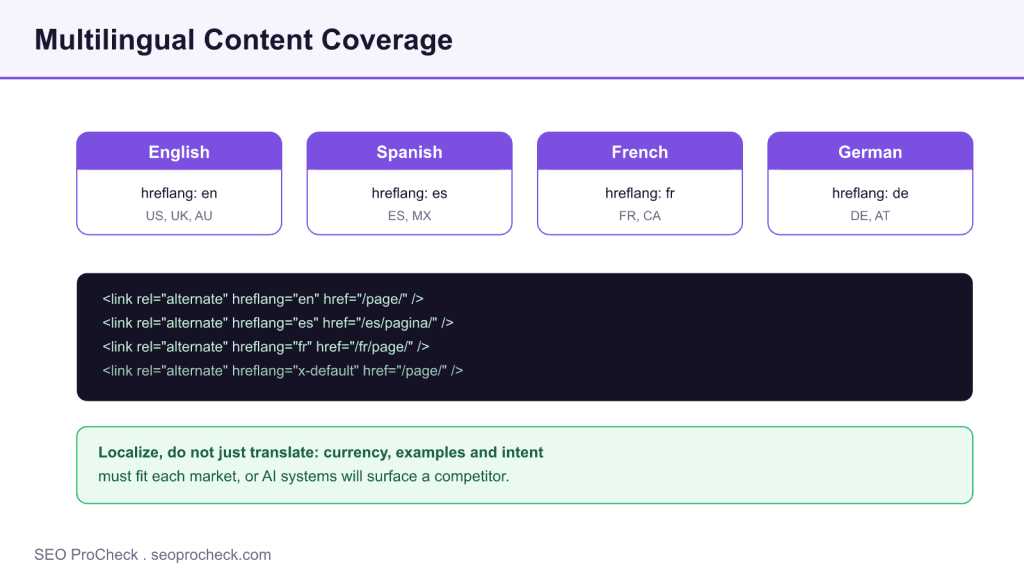
- Localize, do not just translate: currency, examples and intent must fit each market.
- Implement hreflang so engines serve the right language version and avoid duplicate confusion.
- AI systems answer in many languages, so native-language content widens where you can be cited.
Quick Reference
Element Code: HR-007
Issue: Content not available in target language markets
Impact: Missing international AI visibility
Fix: Expand content to cover target languages
Detection: Content audit, market analysis
What Is This Issue?
AI systems serve global audiences. Content in only one language misses significant international visibility.
Why This Matters for Your Website
International content expands potential audience and AI visibility across markets.
How to Fix This Issue
- Identify markets: Where is your audience?
- Translate key content: High-value pages first
- Localize properly: Not just translation
- Implement hreflang: Proper language targeting
Tools for Detection
- Market analysis: Identify language opportunities
AI Search and GEO Considerations
AI systems serve queries in many languages. Multilingual content expands AI visibility.
TL;DR (The Simple Version)
Expand key content into target languages with proper localization and hreflang implementation.
What multilingual coverage really means
Multilingual content coverage is the share of your important content that exists in the languages your audience actually uses. If your buyers search in Spanish, French and German but your site speaks only English, you are invisible for those queries in both classic search and AI answers. The check (element HR-007) flags that gap so you can decide, market by market, where translated and localized content is worth the investment.
Translation is not localization
The most common failure is treating this as a translation task. Word-for-word translation produces text that is technically correct and culturally wrong: prices in the wrong currency, examples that make no sense locally, idioms that land awkwardly, and search intent that does not match how people in that market actually phrase things. Localization adapts all of that. A page localized for Mexico is not the same as one for Spain, even though both are Spanish, because the queries, currency, examples and expectations differ.
hreflang: telling engines which version to serve
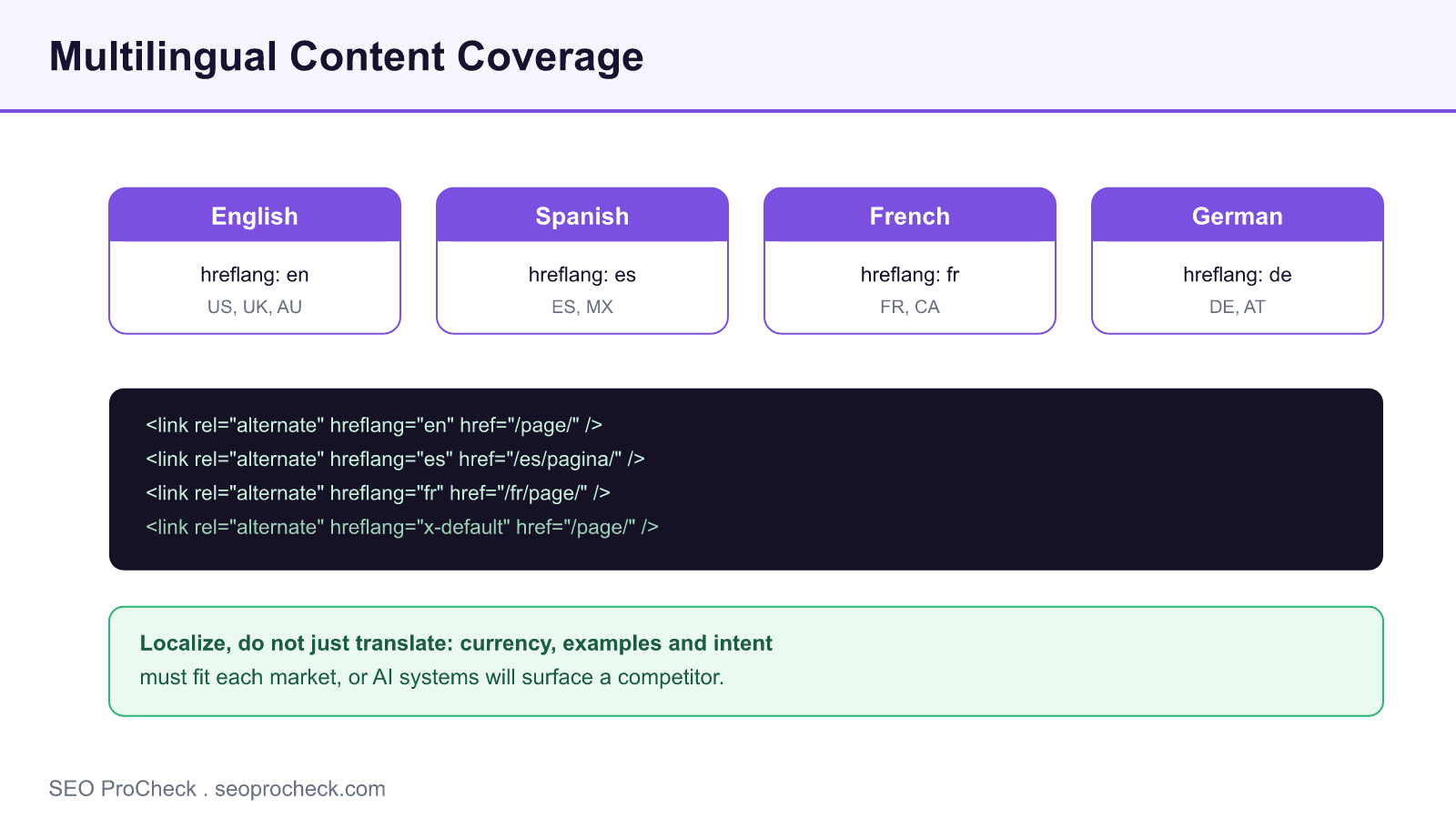
Once you have multiple language versions, you must tell search engines how they relate, or they may treat them as duplicates or serve the wrong one. That is the job of hreflang annotations, shown in the diagram above. Each version lists itself and its siblings, plus an x-default fallback:
<link rel="alternate" hreflang="en" href="https://example.com/page/" />
<link rel="alternate" hreflang="es" href="https://example.com/es/pagina/" />
<link rel="alternate" hreflang="fr" href="https://example.com/fr/page/" />
<link rel="alternate" hreflang="x-default" href="https://example.com/page/" />
The annotations must be reciprocal: if the English page points to the Spanish one, the Spanish page must point back. Get more detail in our hreflang lexicon entry.
| Decision | Question to answer | Signal to use |
|---|---|---|
| Which languages | Where does demand and revenue potential exist? | Analytics by country, market research, competitor coverage |
| Which pages first | What are your highest-value, highest-intent pages? | Conversion data, revenue per page |
| Translate or localize | How different is the market's intent and context? | Local keyword research, cultural review |
| Language vs region | Do you need es alone or es-MX and es-ES? | Whether currency, law or examples differ by region |
Why AI systems reward multilingual coverage
AI answer engines respond to queries in dozens of languages, and they prefer to ground an answer in content written natively in that language. If a user asks a question in French and your only relevant material is in English, a competitor with a native French page is the more natural source to cite. Broad, well-localized coverage widens the set of queries where you can be retrieved and credited, which is central to generative engine optimization. It also pairs with knowledge graph entity linking: a well-defined entity is recognizable across languages.
How to expand coverage without breaking things
- Identify target markets. Use analytics and demand data to find where a translated presence would pay off.
- Prioritize high-value pages. Localize your best-converting content first rather than the whole site at once.
- Localize, do not just translate. Adapt currency, examples, intent and tone for each market, ideally with native review.
- Implement hreflang correctly. Reciprocal annotations plus an x-default, validated with a testing tool.
- Measure per market. Track rankings, traffic and citations by language so you know which expansions earned their keep.
Common mistakes
- Machine translation with no review. Raw output reads as untrustworthy and can misstate facts. Have a native speaker review anything that matters.
- Broken or one-way hreflang. Missing return links or wrong codes cause engines to ignore the annotations entirely.
- Auto-redirecting by IP. Forcing a language based on location frustrates users and can block crawlers. Offer a choice instead.
- Translating low-value pages first. Start where intent and revenue are highest, not with whatever is easiest.
FAQ
What is multilingual content coverage?
It is the extent to which your key content is available in the languages your audience searches in. Strong coverage means your important pages exist, properly localized, in each target language rather than only in your original one.
What is the difference between translation and localization?
Translation converts words from one language to another; localization adapts the whole experience, including currency, examples, intent, tone and cultural context, so the page feels native to that market. Localization is what actually performs in search and AI answers.
Do I need hreflang for a multilingual site?
Yes, in almost all cases. hreflang tells search engines which language or regional version to serve and prevents them from treating your versions as duplicates. Without it, the wrong version can rank in the wrong market.
Should I use subdirectories or separate domains for languages?
Subdirectories such as /es/ are the most common and easiest to maintain and consolidate authority. Subdomains and separate country domains are valid for larger operations with distinct local teams, but they spread authority and add overhead.
Does multilingual content help with AI search?
Yes. AI answer engines serve queries in many languages and prefer to cite content written natively in the query language. Broad, well-localized coverage increases the range of questions for which you can be retrieved and credited.
Which pages should I translate first?
Start with your highest-value, highest-intent pages: the ones that convert or that answer the questions your target market most often asks. Prove the return on a focused set before scaling coverage across the whole site.
Claude Vincent is a technical SEO consultant focused on crawlability, rendering, and AI-search visibility. He writes the field guides and case studies at SEO ProCheck, with a bias toward the durable, unglamorous work that decides whether search engines and AI answer engines can actually read and cite a site.
About SEO ProCheck
Technical SEO consulting and GEO strategy with 20 years of enterprise experience. Case studies, resources, and tools for search and AI visibility.
Work With Me
Technical SEO audits, GEO strategy, site migrations, and international SEO. Hourly consulting for teams who need hands-on support, not just reports.
Subscribe to our newsletter!