

Is Google AMP Worth It? Three Real-World Case Studies | State of Digital
- April 13, 2017
- Uncategorized
AI Summary
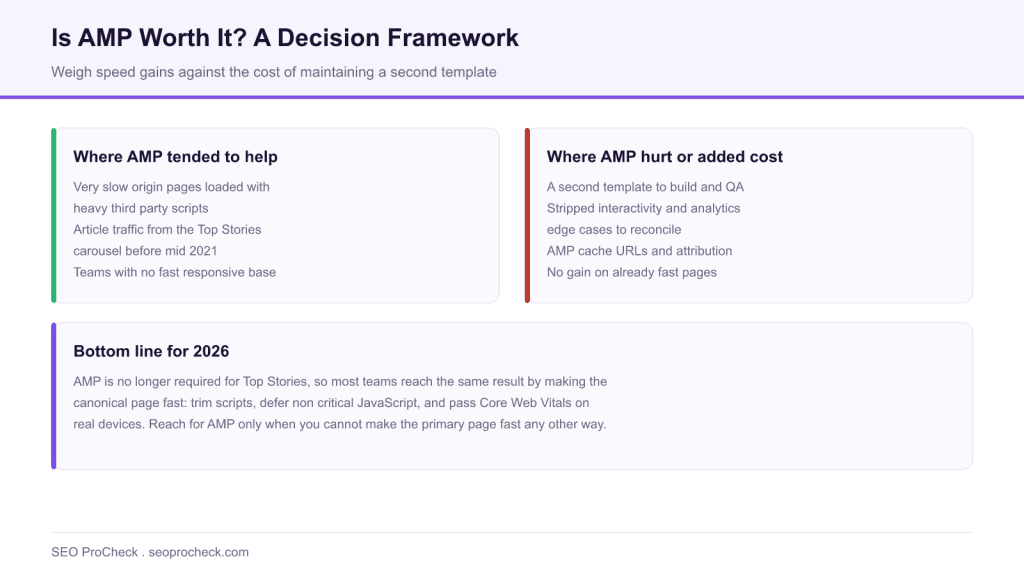
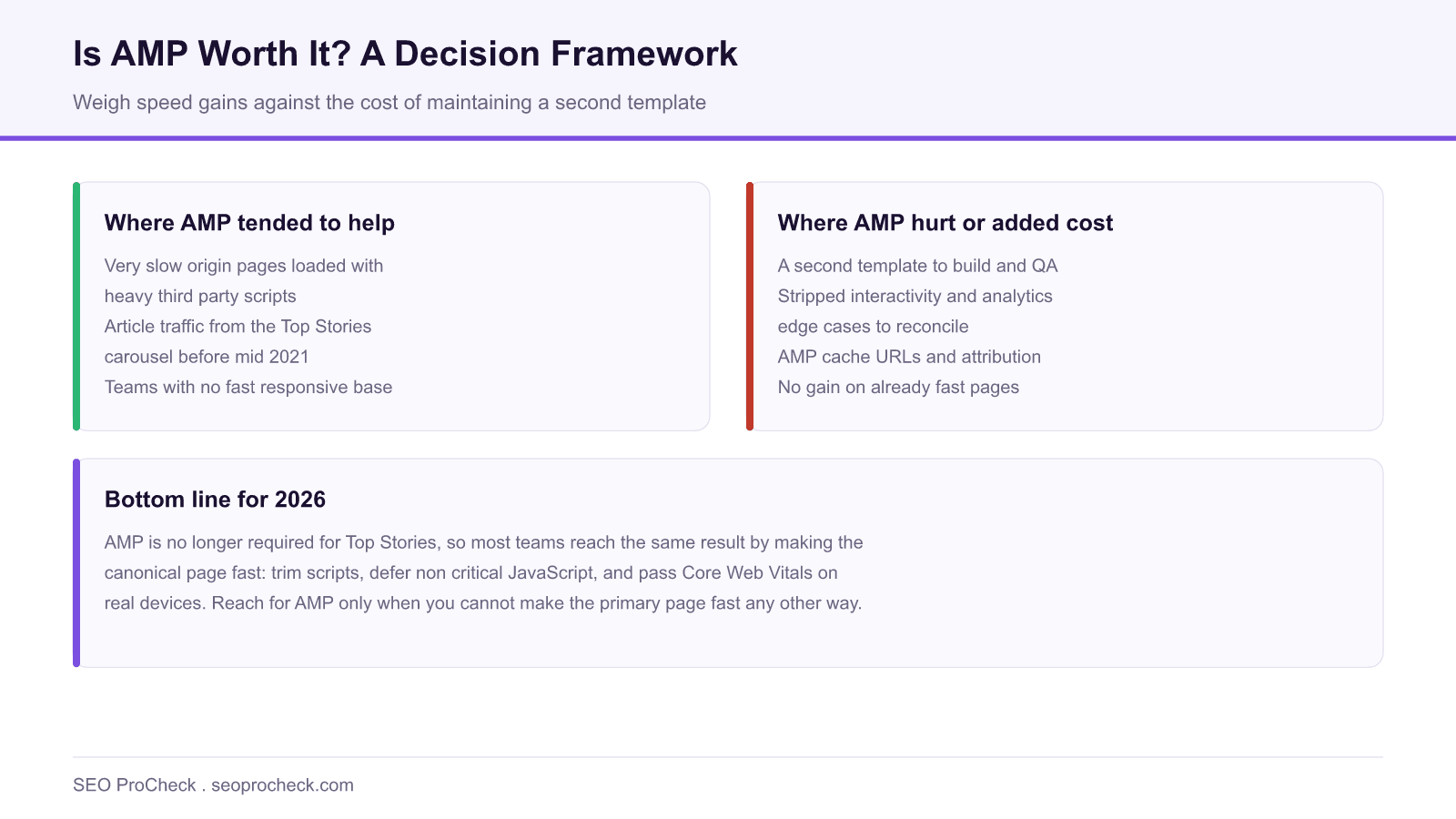
AMP could speed up very slow pages and, before mid 2021, was the entry ticket to the Top Stories carousel, but it costs you a second template to build and maintain. In 2026 the same speed and the same eligibility are available from a fast canonical page, so for most teams AMP is no longer worth the overhead.
- AMP has not been required for Top Stories since the 2021 page experience rollout.
- The real benefit was a strict performance budget, which you can reproduce on a normal page.
- The real cost was a parallel template with stripped interactivity and analytics edge cases.
- Decide by measuring your canonical page Core Web Vitals before you build anything.
This SEO case study documents a successful optimization initiative, providing actionable insights for practitioners. The documented approach demonstrates how strategic SEO implementation drives measurable results.
Initial Situation
Understanding the starting point is essential context for evaluating any case study. This documentation covers the initial challenges, competitive position, and business objectives that shaped the SEO strategy.
Strategy and Approach
The strategic approach combined multiple SEO disciplines to address identified opportunities. Key decisions around prioritization and resource allocation provide a template for similar initiatives.
Implementation
Moving from strategy to execution required specific technical implementations, content development, and process changes. This case study documents the practical steps that translated strategy into action.
Results and Learnings
The outcomes demonstrate effectiveness through measurable improvements in rankings, traffic, and business metrics. Analysis of successes and challenges provides learning value for practitioners.
Case studies like this contribute to the SEO knowledge base, helping practitioners learn from documented real-world experiences.
Source: https://www.stateofdigital.com/google-amp-case-studies/
Practitioner notes on the AMP question
The honest answer to whether AMP is worth it depends almost entirely on how fast your normal pages already are. AMP works by forcing a strict budget: a capped amount of custom CSS, no author written blocking JavaScript, images with explicit dimensions, and delivery from a preloading cache. Those constraints are exactly why AMP pages felt instant. The catch is that you can impose the same discipline on your own template without adopting the AMP framework at all.
If you want the AMP result without AMP, the moves are concrete: keep critical CSS small and inline it, defer or remove non critical JavaScript, set width and height on images so the layout does not shift, use system fonts or preload a single web font, and preconnect to the few origins you truly need. That is most of what the AMP validator enforces, applied by hand to the page you already rank. The article on how this site stays fast walks through the same budget in practice, and speeding up WordPress covers the plugin and hosting side.
The cost side is easy to underestimate. A second template means every new feature, tracking tag, and design change has to be built and tested twice, and AMP strips or sandboxes the interactivity and analytics that marketing teams rely on. Attribution also gets messy because traffic can land on an AMP cache URL rather than your own domain. For a publisher with a genuinely slow origin and no engineering time to fix it, AMP was a reasonable shortcut. For a team that can make the canonical page fast, it is duplicated work.
What has changed since these case studies
The decisive change is the page experience update, which rolled out in 2021. After it, AMP stopped being a requirement for the Top Stories carousel, so the single biggest reason publishers adopted AMP disappeared. Google has since wound down parts of the AMP tooling and now points to Core Web Vitals as the thing that actually matters. Read older AMP case studies with that in mind: a traffic lift attributed to AMP in 2018 may have come from carousel placement that no longer depends on AMP at all.
AMP versus a fast canonical page
| Dimension | AMP | Fast canonical page |
|---|---|---|
| Performance budget | Enforced by the framework | Enforced by your own discipline |
| Top Stories eligibility | No longer required | Fully eligible since 2021 |
| Interactivity | Restricted to AMP components | Unrestricted |
| Analytics | Works with caveats on cache URLs | Standard, on your own domain |
| Maintenance | A second template to keep in sync | One template |
| Best fit | Slow origin, no time to fix it | Almost everyone else |
Render blocking resources are the usual reason a canonical page cannot match AMP speed, so if your page is slow start there. The render blocking explainer shows how to find and defer the offenders.
Frequently asked questions
Is AMP still required for Google Top Stories?
No. Since the page experience update completed in 2021, any sufficiently fast page can appear in Top Stories. AMP no longer gates that placement, which removed the main reason many publishers adopted it.
Does AMP improve SEO rankings on its own?
AMP is not a direct ranking factor. Its benefit was speed and, historically, carousel eligibility. Since you can get both from a fast canonical page, AMP itself gives no ranking advantage that good performance work does not.
Can I get AMP level speed without using AMP?
Yes. Inline critical CSS, defer or drop non critical JavaScript, set image dimensions, limit fonts, and preconnect to essential origins. That reproduces most of what the AMP specification enforces on your own template.
Will removing AMP hurt my rankings?
Not if the canonical page you keep is fast and passes Core Web Vitals. Map any AMP URLs to their canonical equivalents with redirects, keep the content identical, and monitor Search Console through the transition.
Is AMP effectively dead?
AMP still works and validates, but its strategic reason for existing has faded. Most new projects skip it and invest the same effort in making the primary page fast, which is more flexible and easier to maintain.
How do I migrate off AMP safely?
Make sure your canonical pages are fast first, then redirect AMP URLs to their canonical versions, remove AMP specific tags, and verify the pages still pass Core Web Vitals. Watch impressions and clicks in Search Console for a few weeks to confirm a clean transition.
Claude Vincent is a technical SEO consultant focused on crawlability, rendering, and AI-search visibility. He writes the field guides and case studies at SEO ProCheck, with a bias toward the durable, unglamorous work that decides whether search engines and AI answer engines can actually read and cite a site.
About SEO ProCheck
Technical SEO consulting and GEO strategy with 20 years of enterprise experience. Case studies, resources, and tools for search and AI visibility.
Work With Me
Technical SEO audits, GEO strategy, site migrations, and international SEO. Hourly consulting for teams who need hands-on support, not just reports.
Subscribe to our newsletter!







Recent Posts
- Can AI Crawlers Actually Read Your Site? I Measured 400 of the Biggest September 5, 2026
- The Pre-Publish Quality Gate for AI-Assisted Content August 6, 2026
- AGENTS.md vs llms.txt vs llms-full.txt: Which Agent File Does What July 18, 2026