

AI Summary
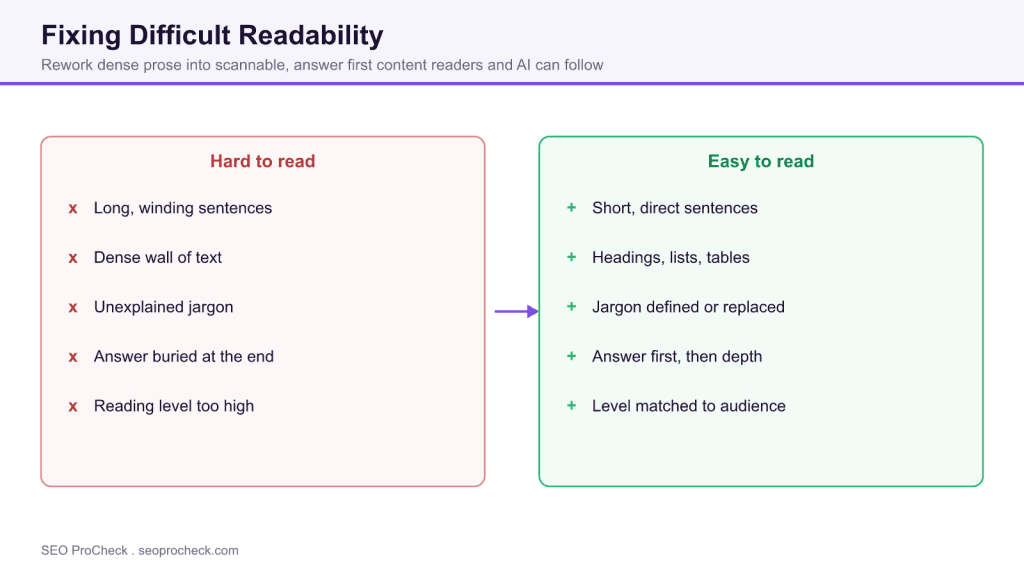
Difficult readability means your content scores poorly on clarity: long sentences, dense paragraphs, and jargon above your audience's level. Fix it by shortening sentences, adding scannable structure, defining jargon, and leading with the answer so both readers and AI systems can follow and cite you.
- Aim for short sentences, roughly 15 to 20 words on average, and short paragraphs of 2 to 4 sentences.
- Use headings, lists, and tables so the page is scannable rather than a wall of text.
- Define or replace jargon: write to be understood, not to impress.
- Lead with the answer, then add depth, so the key point is never buried.
- Element Code: CQ
- Issue: See below
- Impact: Quality / trust / clarity
- Fix: See steps
- Detection: Crawler, manual review
What this issue means
Your content scores poorly on readability, long sentences, dense paragraphs, jargon, or a reading level well above your audience. Readability tools (Flesch, etc.) flag it, but the real test is whether a real reader can follow it easily.
Why it matters
Hard-to-read content increases bounce and reduces time on page, the engagement signals that correlate with rankings. It also makes your content harder for AI systems to summarize and cite cleanly. Clarity is a competitive advantage, especially for technical topics.
How to fix it
- Shorten sentences and break up dense paragraphs.
- Use headings, lists, and tables to create scannable structure.
- Define jargon or replace it with plainer language where you can.
- Lead with the answer, then add depth, do not bury it.
- Match the reading level to your actual audience, not to sound impressive.
For a more severe version of this issue, see Readability Very Difficult.
Want a second set of eyes on your content quality?
Content quality is half of technical SEO. See how an advanced SEO audit works
How readability is scored
Most tools lean on two formulas. Flesch Reading Ease returns a score from 0 to 100, where higher is easier; 60 to 70 is comfortable for a general audience. Flesch Kincaid Grade Level maps the same inputs to a US school grade, so a score of 8 means an eighth grader could follow it. Both formulas reward shorter sentences and shorter words, which is why the fixes below move the numbers reliably. Yoast, Rank Math, and the Hemingway editor all surface these scores as you write.
Concrete fixes with a before and after
The fastest wins come from splitting long sentences and cutting jargon. For example, a hard sentence:
"In order to facilitate optimal comprehension, it is advisable that practitioners endeavor to minimize the utilization of superfluous terminology."
rewrites cleanly to:
"To help readers understand, cut jargon you do not need."
Same meaning, half the words, several grade levels easier. Apply that pattern across a page and the readability score climbs on its own.
Why AI systems care about readability
Clear structure is not only a human courtesy. AI Overviews and assistants break a page into chunks, then extract and quote the passages that answer a query most cleanly. Short sentences, descriptive headings, and answer first paragraphs make your content easy to segment and cite. Dense prose buries the very sentence a model would otherwise quote. Readability and featured snippet eligibility are increasingly the same discipline.
Readability targets and tools
| Signal | Target | Where to check it |
|---|---|---|
| Flesch Reading Ease | 60 to 70 for a general audience | Yoast, Rank Math, Hemingway |
| Average sentence length | About 15 to 20 words | Hemingway editor |
| Paragraph length | 2 to 4 sentences | Manual review |
| Jargon and passive voice | Minimize, define on first use | Hemingway highlights both |
A quick editing pass
Before you publish, run one focused pass: split every sentence longer than about 25 words, break any paragraph taller than four lines, convert dense explanations into lists or tables, and move the direct answer to the top of each section. Then read it aloud. If you stumble, your reader will too. Cleaner writing also lifts the on page signals that support click through rate once visitors arrive.
Frequently Asked Questions
What does difficult readability mean?
It means your content scores poorly on clarity formulas because of long sentences, dense paragraphs, and jargon above your audience's reading level. Readability tools flag it, but the real test is whether a typical reader can follow it easily.
What is a good readability score?
For a general audience, aim for a Flesch Reading Ease of about 60 to 70, which maps to roughly an eighth grade reading level. Technical audiences can tolerate lower, but clarity still helps comprehension and citation.
How do I improve readability quickly?
Split long sentences, break dense paragraphs, add headings and lists, define or remove jargon, and lead with the answer. These four moves raise the score and, more importantly, make the page easier to actually read.
Does readability affect SEO?
Not as a direct ranking factor, but readable content lowers bounce and raises time on page, the engagement signals that correlate with rankings. It also makes your content easier for AI systems to summarize and cite.
Why do AI systems prefer readable content?
AI Overviews and assistants split a page into chunks and quote the passages that answer a query most cleanly. Short sentences, clear headings, and answer first paragraphs make your content easy to extract and cite; dense prose hides the sentence a model would quote.
Which tools measure readability?
Yoast and Rank Math score readability inside WordPress, and the Hemingway editor highlights long sentences, passive voice, and hard words. All of them lean on the Flesch formulas, so improving one score usually improves the others.
Take this with you
The assistant links open with a question about this page already written. Nothing is sent until you press enter.
Claude Vincent is a technical SEO consultant focused on crawlability, rendering, and AI-search visibility. He writes the field guides and case studies at SEO ProCheck, with a bias toward the durable, unglamorous work that decides whether search engines and AI answer engines can actually read and cite a site.
About SEO ProCheck
Technical SEO consulting and GEO strategy with 20 years of enterprise experience. Case studies, resources, and tools for search and AI visibility.
Work With Me
Technical SEO audits, GEO strategy, site migrations, and international SEO. Hourly consulting for teams who need hands-on support, not just reports.
Subscribe to our newsletter!








Recent Posts
- Most Top Sites Never Say Who They Are in Structured Data October 14, 2026
- Homepage Titles Are Mostly Too Short, Not Too Long October 8, 2026
- Who Actually Serves an llms.txt? 184 Top Sites Measured September 29, 2026