

AI Summary
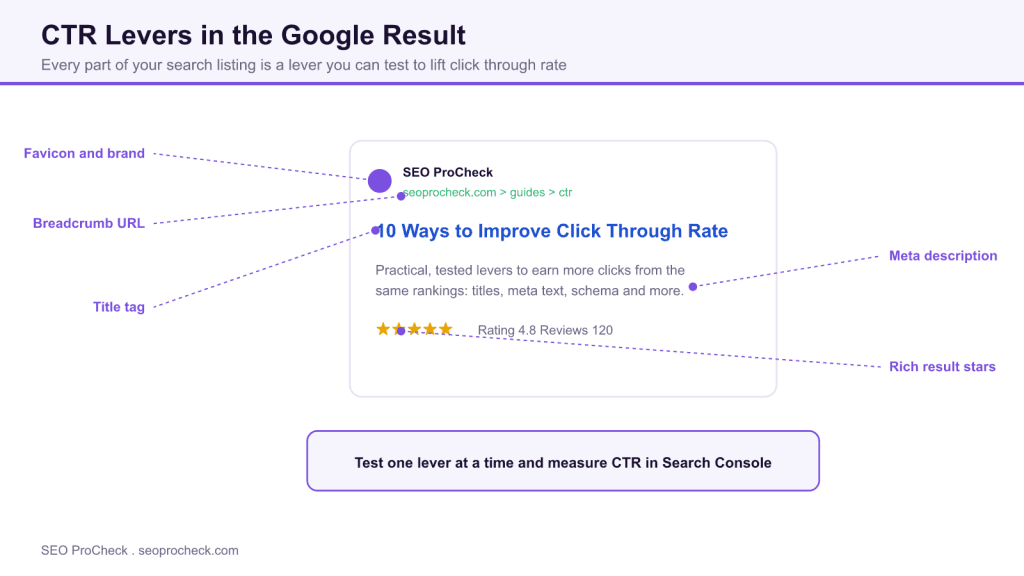
Click through rate is the share of searchers who click your result after seeing it, and you can lift it without changing rank by improving the parts of the listing they see. The highest impact levers are the title tag, the meta description, the URL or breadcrumb, and rich results earned with structured data.
- Find low CTR, high impression queries in Search Console, then rewrite those listings first.
- Front load the primary keyword and a clear benefit in the title tag, kept near 50 to 60 characters.
- Write meta descriptions that promise a specific answer, around 140 to 160 characters.
- Earn rich results such as review, FAQ, and breadcrumb with valid schema to occupy more space.

Understanding CTR
CTR represents a significant aspect of SEO strategy that practitioners need to understand thoroughly. As search algorithms evolve and user behavior changes, staying current with best practices in this area becomes increasingly important. This guide provides comprehensive coverage of the key concepts and actionable recommendations.
Strategic Importance
The role of ctr in overall SEO success cannot be understated. It influences multiple ranking factors and affects user experience. Sites that excel in this area typically see better organic performance across key metrics. Understanding the strategic implications helps prioritize efforts and allocate resources effectively.
Implementation Approach
Effective implementation requires a systematic approach. Begin with thorough assessment of your current state. Identify gaps and opportunities through analysis. Develop an action plan with clear priorities. Execute methodically while monitoring for issues. Iterate based on results and industry changes.
Best Practices
Industry best practices have evolved through collective experience and testing. Following established guidelines helps avoid common pitfalls and accelerates results. However, best practices should be adapted to your specific situation rather than applied blindly. Test and measure to confirm what works for your site.
Future Considerations
The landscape continues to evolve with new technologies and algorithm updates. Stay informed about developments that may affect your strategy. Build flexibility into your approach to accommodate changes. Focus on fundamentals that provide long-term value rather than short-term tactics that may become obsolete.
10 ways to improve click through rate
- Mine Search Console. Sort the Performance report by impressions, then find queries where CTR is well below the average for that position. Those listings are your fastest wins.
- Rewrite the title tag. Lead with the primary keyword and a clear benefit, and keep it near 50 to 60 characters so it is not truncated.
- Add specifics to the title. Honest numbers, a bracketed qualifier such as [2026 guide], or the current year can lift clicks when they are accurate.
- Write a compelling meta description. About 140 to 160 characters that promise a specific answer and end with a light call to action.
- Match search intent. The snippet must deliver what the query wants. Overpromising raises clicks briefly, then bounce, which erodes the gain.
- Clean up the URL. A short, readable slug and a clear breadcrumb trail signal relevance and look trustworthy in the result.
- Earn rich results. Add valid structured data for review, FAQ, HowTo, or breadcrumb so your listing takes up more of the page.
- Mirror the query wording. Use the searcher's phrasing in the title and description so Google bolds the match and the listing feels on target.
- Strengthen the brand. A recognizable brand name and a crisp favicon lift clicks, because searchers gravitate to names they trust.
- Test and iterate. Change one element, wait two to four weeks, and compare CTR in Search Console before and after.
How to measure CTR properly
In Search Console, CTR is clicks divided by impressions for a query or page. Do not judge a listing against a flat benchmark; judge it against the typical CTR for its average position, because rank one earns far more clicks than rank eight. The opportunity is any page with high impressions and a CTR below what its position should return. Fix those listings first, then re measure after the change has had time to settle.
Levers in the search result
| SERP element | Lever you control | Quick win |
|---|---|---|
| Title tag | Keyword plus benefit, near 50 to 60 characters | Rewrite low CTR titles first |
| Meta description | A specific promise, 140 to 160 characters | Add a clear call to action |
| URL and breadcrumb | Short, readable slug | Expose a clean breadcrumb trail |
| Rich results | Structured data | Add FAQ or review schema |
Keep the promise on the page
A higher CTR only helps if the page delivers. If searchers click and bounce because the content does not match the snippet, you lose the gain and can hurt the listing over time. Make sure the page answers the query fast and reads cleanly; the same clarity that wins clicks also keeps them, which is why readability and CTR reinforce each other. Structured, direct answers also improve your odds of winning a featured snippet, which can lift clicks further.
What has changed since
AI Overviews now compress the classic result set on many queries, pushing the ten blue links down and reducing clicks even for strong positions. Two responses matter in 2026: earn a citation inside the AI Overview by answering clearly and being quotable, and build a distinctive brand listing so searchers still recognize and choose you below the fold. When you edit robots or indexing directives while restructuring pages, confirm the syntax against the meta robots and X-Robots-Tag reference so you do not hide a page you meant to promote.
Frequently Asked Questions
What is click through rate in SEO?
Click through rate, or CTR, is the percentage of searchers who click your result after seeing it in the search results. In Search Console it is clicks divided by impressions for a query or page, and it reflects how compelling your listing is.
How can I improve CTR without ranking higher?
Improve the parts of the listing searchers see: rewrite the title tag with a keyword and benefit, write a specific meta description, clean up the URL and breadcrumb, and earn rich results with structured data. These lift clicks at the same rank.
What is a good CTR?
There is no universal number, because CTR depends heavily on position. Judge each listing against the typical CTR for its average rank in Search Console, and treat any high impression page with a below expected CTR as an opportunity.
How long should a title tag and meta description be?
Keep the title tag near 50 to 60 characters and the meta description around 140 to 160 characters so neither is truncated in the result. Front load the keyword and benefit in the title and make a specific promise in the description.
Do rich results improve CTR?
Often yes. Valid structured data can add review stars, FAQ dropdowns, or breadcrumbs to your listing, which takes up more of the page and draws the eye. The effect depends on the query, but a richer listing generally earns more clicks.
Do AI Overviews lower click through rate?
They can. AI Overviews push the standard results down and answer some queries directly, reducing clicks even for strong positions. The response is to be quotable enough to earn a citation and to build a recognizable brand listing searchers still choose.
Claude Vincent is a technical SEO consultant focused on crawlability, rendering, and AI-search visibility. He writes the field guides and case studies at SEO ProCheck, with a bias toward the durable, unglamorous work that decides whether search engines and AI answer engines can actually read and cite a site.
About SEO ProCheck
Technical SEO consulting and GEO strategy with 20 years of enterprise experience. Case studies, resources, and tools for search and AI visibility.
Work With Me
Technical SEO audits, GEO strategy, site migrations, and international SEO. Hourly consulting for teams who need hands-on support, not just reports.
Subscribe to our newsletter!







Recent Posts
- Can AI Crawlers Actually Read Your Site? I Measured 400 of the Biggest September 5, 2026
- The Pre-Publish Quality Gate for AI-Assisted Content August 6, 2026
- AGENTS.md vs llms.txt vs llms-full.txt: Which Agent File Does What July 18, 2026