

AI Summary
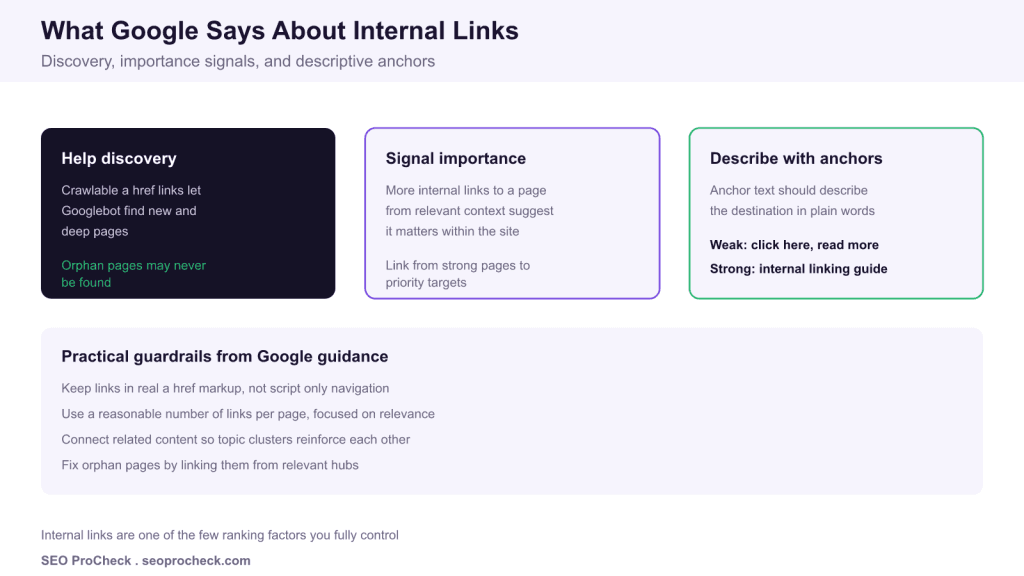
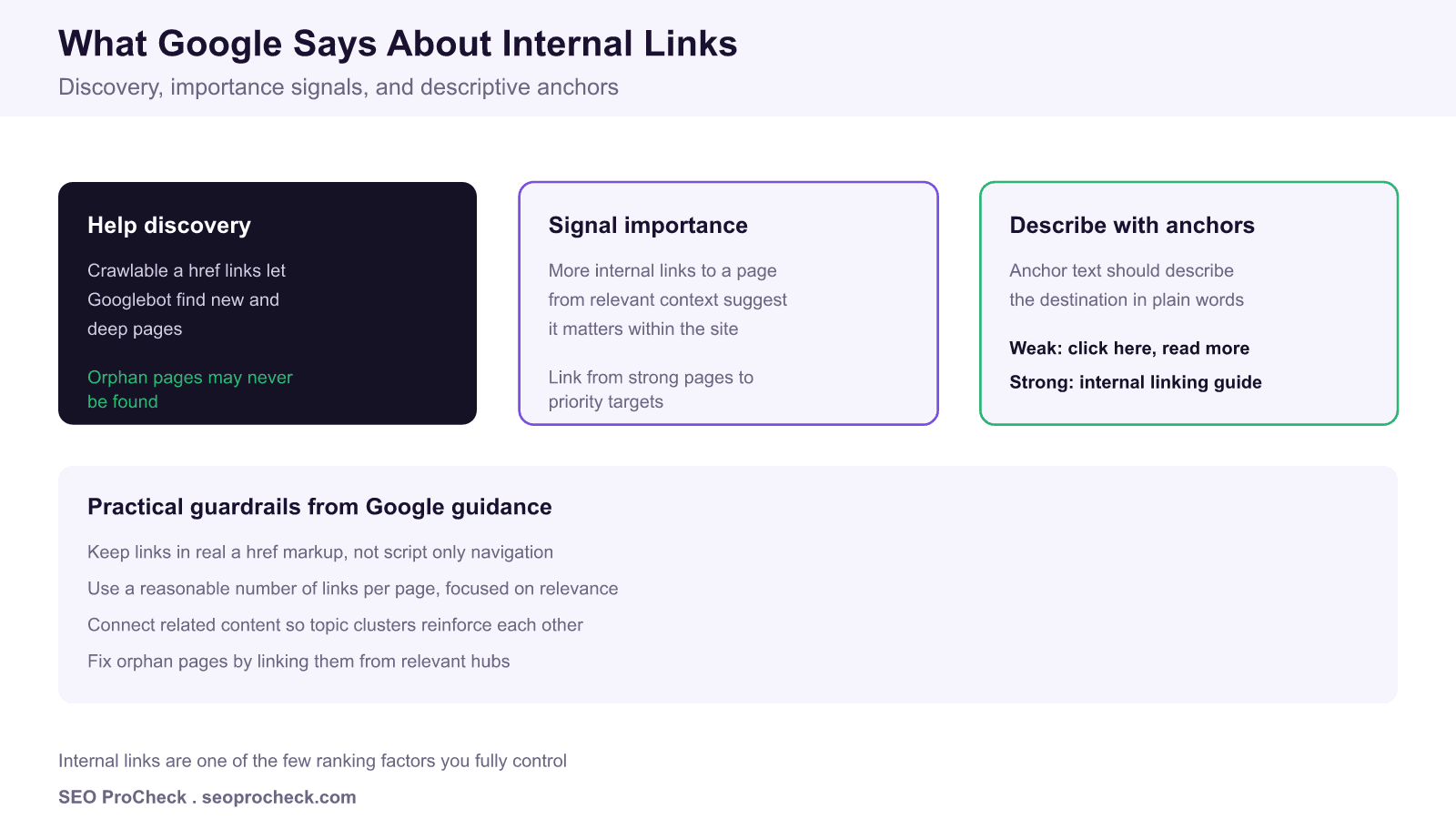
Google says internal links help search engines discover pages, understand which pages a site treats as important, and interpret a page through its anchor text. Use crawlable a href links, descriptive anchors, a reasonable link count, and connect related content so no valuable page is orphaned.
- Internal links drive both discovery and importance signals.
- Descriptive anchor text beats generic click here or read more.
- Links must be real a href markup, not script only navigation.
- Orphan pages need links from relevant hubs to be found.
Search Engine Journal summarised Google guidance on improving SEO through internal links. This page keeps the source reference and adds a practitioner reading of what the advice means in practice, with the exact anchor and markup patterns to use. If you want the hands on process rather than the principles, see our companion guide on how to use internal linking for SEO.
The two jobs internal links do
Google frames internal links around two functions. First, discovery: crawlable links let Googlebot find new and deep pages that would otherwise be hard to reach. Second, importance: when many relevant pages link to a target, Google reads that as a signal the page matters within the site. Both jobs are within your control, which is what makes internal linking such a dependable lever.
Write anchors that describe the destination
Google recommends descriptive anchor text. The anchor is a compact label for the page it points to, so it should read like a plain description of the destination.
| Weak anchor | Stronger anchor | Why it helps |
|---|---|---|
| click here | internal linking best practices | Describes the destination topic |
| read more | how crawl budget works on large sites | Sets user and crawler expectation |
| this page | Product schema implementation guide | Reinforces the target keyword context |
Keep links crawlable
For Google to follow a link, it needs a real anchor element with an href attribute:
<a href="https://example.com/guide/internal-links">internal linking guide</a>
Menus and buttons wired only through JavaScript click handlers, with no underlying href, may not be discovered. When a page must be found and consolidated into your architecture, give it a genuine link in the HTML.
Use a reasonable number, focused on relevance
Google does not publish a hard cap, but it advises against stuffing pages with links that serve no one. Prioritise links that connect genuinely related content, so topic clusters reinforce each other and authority flows toward the pages you most want to rank. A handful of relevant, well placed links outperforms a wall of navigational clutter.
Find and fix orphan pages
- Crawl the site and compare crawled URLs against your sitemap and analytics to spot pages with no internal links in.
- Identify the most relevant hub or category page for each orphan.
- Add a contextual link with descriptive anchor text from that hub to the orphan.
- Recrawl and confirm the page is now reachable within a few clicks of the homepage.
Go further with our internal linking complete guide, the 15 internal linking best practices, and anchor text best practices.
Frequently asked questions
What does Google say internal links do?
Google describes internal links as helping search engines discover pages and understand which pages a site considers important. Links from many relevant places within a site signal that a page matters, and descriptive anchor text helps Google understand what the linked page is about.
How many internal links should a page have?
Google advises a reasonable number rather than a fixed count. Focus on links that genuinely help users navigate to related content, and avoid stuffing a page with links that add no value.
Does anchor text matter for internal links?
Yes. Google recommends descriptive anchor text that tells users and crawlers what the destination covers. Generic anchors like click here or read more waste an easy opportunity to add context.
What is an orphan page and why is it a problem?
An orphan page has no internal links pointing to it. Google may struggle to discover it through normal crawling, so it can go unindexed. Linking orphan pages from relevant hubs fixes this.
Do internal links need to be real HTML links?
Yes. Google follows links in crawlable a href markup with an href attribute. Navigation built only in JavaScript events, without a real href, may not be followed reliably.
Are internal links a ranking factor I control?
Internal linking is one of the few on site signals you fully control. Unlike backlinks, you decide the structure, anchors, and which priority pages receive support from your strongest pages.
Source: https://www.searchenginejournal.com/google-shares-tips-to-improve-seo-through-internal-links/522797/
Take this with you
The assistant links open with a question about this page already written. Nothing is sent until you press enter.
Claude Vincent is a technical SEO consultant focused on crawlability, rendering, and AI-search visibility. He writes the field guides and case studies at SEO ProCheck, with a bias toward the durable, unglamorous work that decides whether search engines and AI answer engines can actually read and cite a site.
About SEO ProCheck
Technical SEO consulting and GEO strategy with 20 years of enterprise experience. Case studies, resources, and tools for search and AI visibility.
Work With Me
Technical SEO audits, GEO strategy, site migrations, and international SEO. Hourly consulting for teams who need hands-on support, not just reports.
Subscribe to our newsletter!






Recent Posts
- Finding a Competitor's Sitemap, and Turning It Into a Change Log September 15, 2026
- AI Crawler User Agents: The Current Names, and Which Ones Sites Actually Block September 9, 2026
- Can AI Crawlers Actually Read Your Site? I Measured 400 of the Biggest September 5, 2026