AI Summary
What is semantic search? Semantic search is how modern search engines interpret the meaning and intent behind a query rather than matching its literal keywords: understanding that "how tall is the Eiffel Tower" and "Eiffel Tower height" want the same fact, and that "jaguar speed" probably means the animal unless your history says otherwise. It matters for SEO because rankings are earned by satisfying intents and covering topics, not by repeating query strings, and because the same meaning-based retrieval now powers AI answer engines deciding which pages to cite.
- Semantic search resolves a query to entities and an intent, so a page can rank for phrasings it never contains.
- Coverage of one intent beats repetition of a keyword: thin pages fail semantically even when the target phrase appears often.
- Splitting a single intent across near-duplicate pages causes cannibalization. Consolidate into one page that owns it.
- AI answer engines run on the same retrieval layer, but they select passages to cite, so an uncited source gets nothing.
Semantic Search: What It Is and Why It Matters for SEO provides valuable insights for SEO practitioners. This resource examines approaches and considerations that can improve organic search performance.
Key Concepts
Understanding the fundamental principles behind this topic helps inform strategic decisions. Whether optimizing for traditional search or emerging AI platforms, foundational concepts remain relevant. This resource covers the essential knowledge practitioners need.
In practice, semantic search is three distinct stages, and a page can fail at any one of them independently:
- Query understanding. The engine resolves ambiguous terms to entities, classifies intent, and often rewrites or expands the query before retrieval even begins. This stage is why you rank for phrasings that appear nowhere on the page, and why an exact-match phrase can still fail to rank.
- Retrieval. Candidate documents are pulled by meaning, using embeddings alongside classic term matching rather than instead of it. Lexical signals still contribute; they simply stopped being sufficient on their own.
- Ranking and passage selection. Candidates are ordered, then specific passages are chosen for snippets, People Also Ask, and AI answers. Passage selection is what turns a well-structured section into a visible result.
The value of separating the stages is diagnostic. When a page underperforms, work out which stage it failed at before rewriting anything, because the fixes point in opposite directions:
| Symptom in Search Console | Stage that failed | What actually fixes it |
|---|---|---|
| No impressions for any phrasing | Indexation or retrieval | Check indexing status, internal links, and crawlability before touching the copy |
| Impressions for one exact phrase only | Query understanding | Broaden entity and synonym coverage; the page currently reads as a string match |
| Impressions across many phrasings, weak positions | Intent fit | Compare your page format against what ranks; the format may be wrong for the intent |
| Impressions on questions, almost no clicks | Passage selection | Add question-shaped headings with direct, self-contained answers underneath |
| Two of your URLs alternating for one query | Site architecture | Consolidate into a single page that owns the intent and redirect the weaker URL |
Implementation Considerations
Moving from concept to execution requires understanding practical constraints and opportunities. Different situations call for different approaches. This resource provides guidance for applying concepts in real-world contexts.
Three habits carry most of the weight when you write for meaning rather than for strings:
- Write the answer before the context. Lead each section with a self-contained sentence that resolves its heading, then expand underneath. Passage-level extraction rewards sections that still make sense when lifted out of the page.
- Name entities the way the knowledge graph does. Use the canonical name on first mention, then the shorthand. An ambiguous noun with no disambiguating neighbour nearby forces the engine to guess, and it will sometimes guess wrong.
- State relationships explicitly. "X is a type of Y used for Z" is plain prose and excellent machine-readable text. Structured data then restates the same relationships in a form that does not depend on parsing your sentences correctly.
Consolidation is the other half of the job. If two pages target the same intent with different phrasings, they compete for the same retrieval slot and split whatever authority they have between them. Merge them, redirect the weaker URL, and let one page own the intent outright.
Measuring Impact
SEO efforts require measurement to demonstrate value and guide optimization. Identifying appropriate metrics, establishing baselines, and tracking progress enables data-driven improvement. This resource addresses how to evaluate success.
Semantic performance shows up in specific places, and a single keyword ranking is not one of them:
- Query diversity per page. Filter Search Console to one page and count distinct queries. A page earning impressions across many phrasings of one intent is being understood. A page earning them for one exact string is not.
- Impressions without clicks on question queries. This usually means you are being retrieved but losing passage selection, which is a formatting problem far more often than a content problem.
- Cannibalization over time. When two of your URLs alternate for the same query across weeks, the engine cannot decide which one owns the intent. That is an architecture failure, not normal fluctuation.
Track these per intent cluster rather than per keyword. The unit semantic search operates on is the intent, so that is the unit worth reporting on.
This resource contributes to the knowledge base SEO practitioners need for effective optimization in an evolving search landscape.
The Building Blocks: Entities, Intent, and Context
Three concepts do most of the work in semantic search, and each has a direct optimization consequence:
- Entities. Search engines resolve words to things (people, places, products, concepts) connected in a knowledge graph. "Apple" is disambiguated to the company or the fruit by surrounding context. For SEOs this means clarity beats cleverness: name entities consistently, relate them explicitly ("X is a Y used for Z"), and reinforce identity with JSON-LD structured data so machines don't have to guess what your page is about.
- Intent matching. Queries are classified by what the searcher is trying to do: learn, compare, buy, reach a site. The SERP itself reveals the verdict: if a query returns guides, a product page will not rank for it no matter how optimized. Auditing intent fit page-by-page routinely explains "we rank nowhere despite great content" mysteries.
- Context and query rewriting. Milestones like Hummingbird (2013), RankBrain (2015), BERT (2019), and MUM reflect a steady progression: from matching strings, to embedding queries and documents as vectors of meaning, to understanding prepositions and negations in natural-language questions. Modern systems also rewrite and expand queries behind the scenes, which is why pages rank for hundreds of phrasings they never contain verbatim.
What Semantic Search Changes About Everyday SEO Work
Practically, optimizing for meaning rather than strings shifts several habits:
- From keyword density to coverage. A page about espresso machines is expected to address grind size, pressure, milk frothing, the sub-topics a knowledgeable treatment would include. Thin pages fail semantically even when the target phrase appears often; comprehensiveness within one intent is the win condition.
- From one-keyword-one-page to intent clustering. Dozens of phrasings collapse into a single intent that one strong page should own. Splitting them into near-duplicate pages creates cannibalization; the modern architecture is topic clusters where each page owns a distinct intent, including the conversational phrasings covered in long-tail keyword research.
- From guessing questions to answering them where they're asked. Question-shaped headings with concise, self-contained answers align with how semantic systems extract passages, the mechanism behind featured snippets and People Also Ask boxes.
- From anchor-text tricks to meaningful linking. Internal links now function as semantic statements about how topics relate; descriptive anchors and hub-and-spoke structures help engines map your site's topical territory.
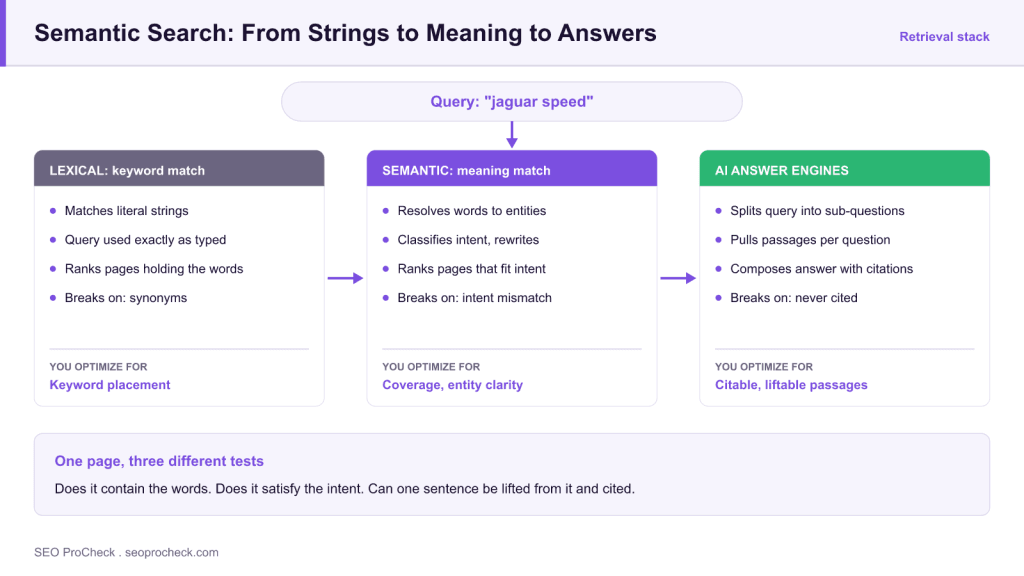
Lexical vs. Semantic vs. AI Answer Engines
| Dimension | Lexical (keyword) search | Semantic search | AI answer engines (2026) |
|---|---|---|---|
| Matches on | Literal strings, proximity | Meaning: entities, intent, embeddings | Meaning + synthesis across sources |
| Query handling | As typed | Interpreted, rewritten, disambiguated | Decomposed into sub-questions (query fan-out) |
| Unit of relevance | Page contains the words | Page satisfies the intent | Passage supports a claim in the answer |
| Output | Ranked links | Ranked links + features (snippets, PAA) | Composed answer with citations |
| Optimization lever | Keyword placement | Topic coverage, entity clarity, intent fit | Citable claims, extractable passages, source authority |
| Failure mode | Synonym miss | Intent mismatch | Not selected as a source at all |
How AI Answer Engines Extend Semantic Search
Since this piece was written, the semantic stack gained a new top layer. AI Overviews, ChatGPT, Perplexity, and Claude do not just rank meaning-matched documents: they retrieve semantically relevant passages, then compose an answer and cite a handful of sources. Two consequences follow. First, the retrieval step is semantic search taken further: systems fan a question out into multiple sub-queries and pull passages per sub-question, so pages that answer one thing crisply and completely are more usable than pages that gesture at many things. Second, selection is harsher than ranking: position eight on a SERP still gets some clicks, but an uncited source gets nothing. The optimizations are continuous with semantic SEO, not separate from it: unambiguous entities, verifiable and clearly-stated facts, answer-first structure, and machine-readable markup all raise the odds of being quoted, and the specifics are covered in our guide to earning citations in Claude and other AI assistants. Everything you did for semantic search was, it turns out, also preparation for answer engines.
Frequently Asked Questions
What is semantic search in simple terms?
It is search that understands what you mean instead of matching the exact words you typed: recognizing synonyms, resolving ambiguous names to specific things, and reading the intent behind a question.
How is semantic search different from keyword search?
Keyword search retrieves documents containing the query's literal terms; semantic search maps both queries and documents into representations of meaning, so a page can rank for phrasings it never uses and fail to rank despite containing the exact phrase, if it misses the intent.
What are entities in SEO?
Entities are the uniquely identifiable things (people, organizations, places, products, concepts) that search engines track in knowledge graphs. Entity-aware SEO means being unambiguous about which things your page discusses and how they relate, reinforced with structured data.
How do I optimize content for semantic search?
Match the page format to the query's dominant intent, cover the sub-topics a competent treatment implies, use question-shaped headings with direct answers, name entities consistently, add relevant JSON-LD, and interlink topically related pages with descriptive anchors. Avoid splitting one intent across multiple thin pages.
Do keywords still matter in semantic search?
Yes, differently. Keywords remain the observable evidence of demand and the vocabulary of your audience, so research still starts there. What has died is mechanical repetition: use natural phrasing and synonyms, and think of keywords as labels for intents rather than strings to reach a density.
Is semantic search the same as AI search?
They are layers of one stack. Semantic search is the meaning-based understanding and retrieval layer; AI search adds generation on top: retrieving semantically, then composing an answer with citations. Optimizing for the first is the prerequisite for appearing in the second.
Claude Vincent is a technical SEO consultant focused on crawlability, rendering, and AI-search visibility. He writes the field guides and case studies at SEO ProCheck, with a bias toward the durable, unglamorous work that decides whether search engines and AI answer engines can actually read and cite a site.
About SEO ProCheck
Technical SEO consulting and GEO strategy with 20 years of enterprise experience. Case studies, resources, and tools for search and AI visibility.
Work With Me
Technical SEO audits, GEO strategy, site migrations, and international SEO. Hourly consulting for teams who need hands-on support, not just reports.
Subscribe to our newsletter!