

AI Summary
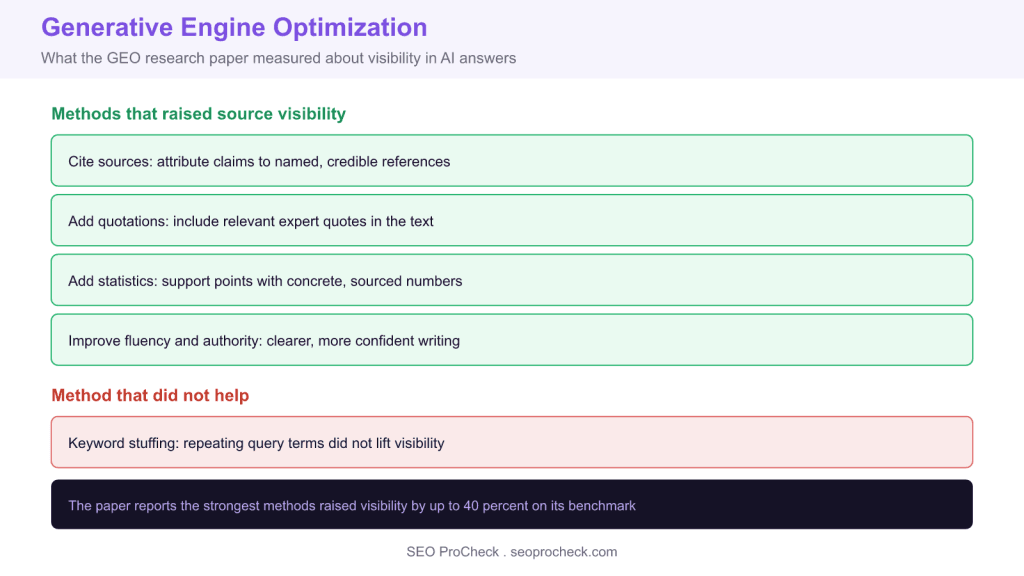
Generative engine optimization, or GEO, is shaping content so AI answer engines surface and cite it, and the source paper measured which edits work. Citing sources, adding quotations, supporting claims with statistics, and writing more clearly all raised source visibility, while keyword stuffing did not, and the paper reports the strongest methods lifted visibility by up to 40 percent on its benchmark.
- GEO was formalized in the linked research paper, which built a benchmark to test content edits.
- Effective methods: cite sources, add quotations, add sourced statistics, improve fluency and authority.
- Keyword stuffing showed no lift, which separates GEO from old school tactics.
- GEO sits on top of technical SEO: solid SEO earns candidacy, GEO earns the citation.
Generative Engine Optimization, or GEO, is the practice of shaping content so that AI answer engines are more likely to surface and cite it. The term was formalized in the research paper linked as the source, which introduced a benchmark and tested a range of content edits to see which ones increased a source visibility inside generated answers. The value of the study is that it moves the conversation past opinion: it measured specific tactics against a standard set of queries and reported which levers actually moved visibility.
What the paper actually did
The authors built a benchmark of diverse queries paired with a generative engine, then applied controlled edits to candidate source pages and measured how each edit changed that source presence in the generated response. Because a generative answer blends and attributes multiple sources, the researchers defined visibility metrics that account for how prominently and how often a source is used, not just whether it ranks. This lets them compare tactics on a like for like basis rather than relying on anecdote.
Which methods raised visibility
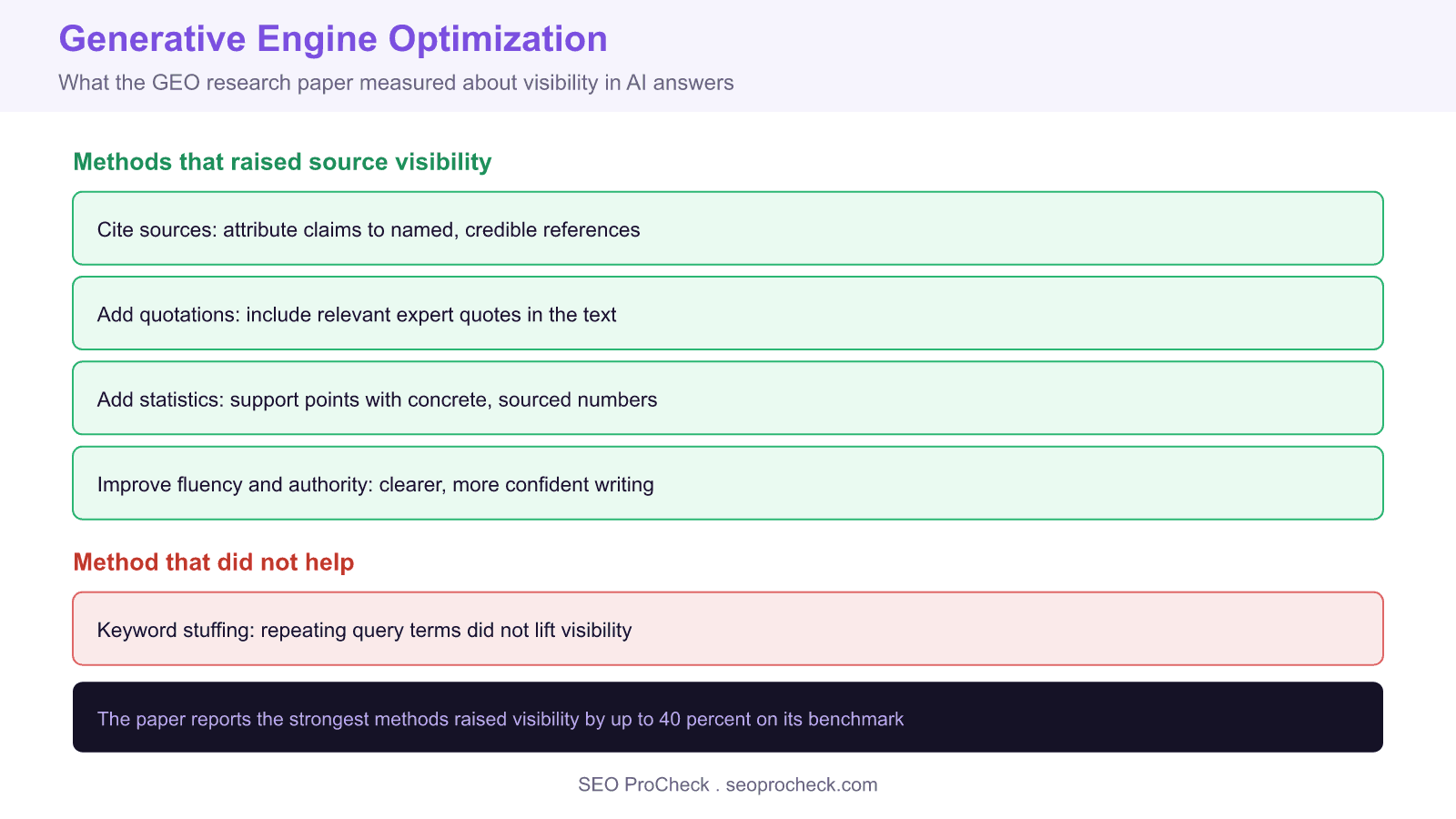
The edits that helped clustered around credibility and clarity. Citing sources, adding relevant quotations, and supporting claims with concrete statistics all increased how often and how prominently a page was used in answers. Improving the fluency and authority of the writing helped as well. The headline result reported in the paper is that the strongest of these methods raised visibility by up to 40 percent on its benchmark, a figure worth attributing to the study rather than treating as a universal guarantee. The through line is intuitive: generative engines prefer sources that read as trustworthy and well supported.
Which method did not help
Keyword stuffing, the classic move of repeating the query terms to signal relevance, did not lift visibility in the study. This matters because it separates GEO from the worst habits of old school SEO. A generative engine is not counting term frequency the way an early ranking algorithm might have; it is assessing whether a passage credibly answers the question. Padding text with repeated keywords adds no credibility and can make writing worse, which is the opposite of what the effective methods reward.
Turning the findings into edits
The research maps cleanly onto page level work. For any page you want cited, attach a named source and date to each statistic, add a relevant expert quotation where it genuinely strengthens a point, and tighten the prose so the key claims are stated plainly and confidently. Keep claims verifiable, because an unsupported or fabricated statistic undermines the exact credibility signal the study found to be valuable. Pair these edits with clean structure, headings phrased as questions, and schema, so the machine readable layer agrees with the visible text.
Before: Our tool speeds up audits a lot.
After:  In our 2025 benchmark of 50 sites, the audit
        step dropped from 41 minutes to 12 minutes,
        a 71 percent reduction (source: internal test log).
Where GEO fits alongside classic SEO
GEO does not replace search engine optimization, it sits on top of it. Your page still needs to be crawlable, fast, and technically sound to be a candidate at all, because most answer engines retrieve from a search index before they generate. The GEO layer then decides, among the retrieved candidates, which sources are credible and quotable enough to feature. Treat the two as a stack: solid technical SEO earns you into the candidate pool, and GEO style credibility edits improve your odds of being the cited source.
GEO method categories and how to apply them
| Method category | Direction of effect | Practical edit |
|---|---|---|
| Cite sources | Raised visibility | Link claims to named references |
| Add quotations | Raised visibility | Include real, relevant expert quotes |
| Add statistics | Raised visibility | Support points with sourced numbers |
| Improve fluency and authority | Raised visibility | State key claims clearly and plainly |
| Keyword stuffing | No lift found | Do not repeat query terms for their own sake |
Related reading
- How to optimize content so LLMs cite it
- What researchers found about ranking in AI search
- Strengthen the machine readable layer with structured data
Frequently asked questions
What is generative engine optimization?
Generative engine optimization, or GEO, is the practice of shaping content so AI answer engines are more likely to use and cite it in their generated responses. It was formalized in the research paper linked as the source, which built a benchmark and tested which content edits actually increased a source visibility in answers.
How is GEO different from SEO?
SEO gets your page into the candidate pool by making it crawlable, fast, and relevant. GEO then improves the odds that, among retrieved candidates, the answer engine chooses your page as a cited source. GEO emphasizes credibility signals such as citations, quotations, and statistics rather than ranking factors alone.
What tactics did the GEO paper find effective?
The study found that citing sources, adding relevant quotations, supporting claims with statistics, and improving the fluency and authority of the writing all increased source visibility in generated answers. The paper reports the strongest methods raised visibility by up to 40 percent on its benchmark.
Does keyword stuffing help in AI search?
No. The GEO study found that repeating query keywords did not lift a source visibility in generated answers. Generative engines assess whether a passage credibly answers the question, so padding text with keywords adds no credibility and can make the writing worse.
Can I trust the 40 percent figure?
Treat it as a result from a specific benchmark rather than a universal promise. The paper reports up to a 40 percent improvement in visibility for its strongest methods on the queries and engine it tested. Your own gains will vary by topic, competition, and engine, but the direction of the findings is a reliable guide.
Should I fabricate statistics to sound credible?
Never. The methods that worked rely on genuine, verifiable support. A fabricated statistic undermines the exact credibility signal GEO rewards and can cause an engine to distrust your page. Always attribute real data to a named source and date.
Source: https://arxiv.org/abs/2311.09735
Claude Vincent is a technical SEO consultant focused on crawlability, rendering, and AI-search visibility. He writes the field guides and case studies at SEO ProCheck, with a bias toward the durable, unglamorous work that decides whether search engines and AI answer engines can actually read and cite a site.
About SEO ProCheck
Technical SEO consulting and GEO strategy with 20 years of enterprise experience. Case studies, resources, and tools for search and AI visibility.
Work With Me
Technical SEO audits, GEO strategy, site migrations, and international SEO. Hourly consulting for teams who need hands-on support, not just reports.
Subscribe to our newsletter!





Recent Posts
- Can AI Crawlers Actually Read Your Site? I Measured 400 of the Biggest September 5, 2026
- The Pre-Publish Quality Gate for AI-Assisted Content August 6, 2026
- AGENTS.md vs llms.txt vs llms-full.txt: Which Agent File Does What July 18, 2026