

Google's Danny Sullivan Provides 5-Step Plan To Diagnose Ranking Drops
- February 23, 2024
- General
AI Summary
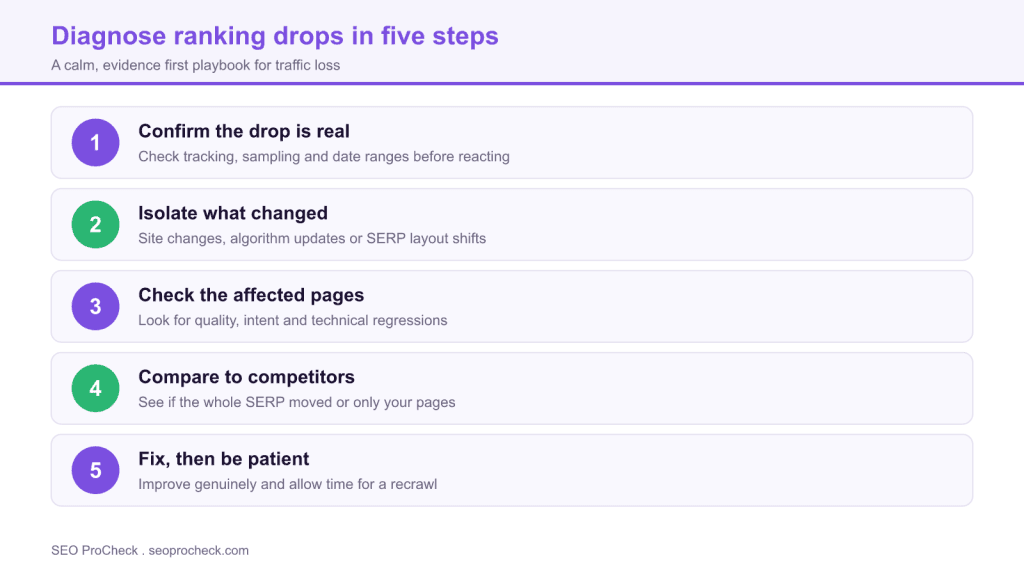
When rankings drop, the worst move is to react before you understand what happened. This guide keeps the original Search Engine Journal reference to Danny Sullivan of Google and adds a calm, evidence first version of a five step plan to diagnose ranking drops, from confirming the drop is real to fixing genuinely and waiting for a recrawl.
- Confirm the drop is real before reacting: check tracking, sampling and date ranges.
- Isolate what changed: your site, an algorithm update or the SERP layout.
- Compare against competitors to see whether the whole result set moved or only you.
- Fix genuinely, then allow time for recrawl, because rushed changes make diagnosis harder.

Google's Danny Sullivan Provides 5-Step Plan To Diagnose Ranking Drops provides valuable insights for SEO practitioners. This resource examines approaches and considerations that can improve organic search performance.
Panic is the real risk when rankings fall
A traffic dip triggers pressure to do something immediately. That instinct causes more harm than the drop itself, because rushed changes destroy your ability to diagnose the cause. Google spokespeople, including Danny Sullivan, have repeatedly pointed people toward a calm, systematic check rather than a scramble, and the plan below follows that spirit.
The five step diagnosis
1. Confirm the drop is real
Before anything else, rule out measurement error. Check for analytics tracking changes, data sampling, timezone issues and the exact date range. A surprising number of emergencies are reporting artifacts, not real losses.
2. Isolate what changed
List what moved in the window: a site deployment, a content change, a known algorithm update or a shift in the search results layout. Line up your traffic timeline against these events to narrow the cause.
3. Check the affected pages
Look at the specific pages that lost visibility. Search for quality regressions, intent mismatch, accidental noindex or canonical errors, and broken elements. If a directive looks wrong, the meta robots and x robots tag reference shows exactly what each value does.
4. Compare to competitors
Search the affected queries and see who rose. If the entire result set reshuffled, you are likely looking at an algorithm update or shifting intent rather than a site specific bug. This context stops you from fixing the wrong thing, a trap tied to the myths that mislead marketers.
5. Fix genuinely, then be patient
Make real improvements aimed at the diagnosed cause, then give search engines time to recrawl and reassess. Recovery is rarely instant, and stacking more changes on top only muddies the next diagnosis.
A quick triage checklist
When the alert comes in, run a fast triage before opening a deep investigation. Confirm the tracking code still fires and the date range is correct. Check Search Console coverage for a spike in excluded or noindexed pages. Look at server logs or uptime history for errors during the window. Compare impressions against clicks to see whether visibility fell or only click rate did, since an AI overview can cut clicks without touching your position. Finally, glance at the affected queries in a fresh browser to see whether the whole result set changed. Ten minutes of triage often points straight at the cause, and it prevents the expensive mistake of rebuilding a page that was never the problem. Only after triage should you commit to a full diagnosis and a fix.
Ranking drop patterns and first checks
| Drop pattern | Likely cause | First check |
|---|---|---|
| Sudden sitewide drop | Technical or penalty issue | Check noindex, robots, server errors and manual actions |
| Gradual sitewide decline | Algorithm or quality shift | Line up traffic against known update dates |
| A few pages only | Page level quality or intent | Review those pages for regressions and mismatch |
| Whole SERP reshuffled | Algorithm update or intent shift | Compare who rose across the affected queries |
| Drop after a deploy | Site change or broken template | Audit the release for SEO regressions |
What has changed about diagnosing ranking drops
The five step logic is timeless, but the environment added new causes to check. Ranking loss today can come from AI overviews absorbing clicks even when your position holds, so review impressions and clicks separately before assuming a rank drop. Google also runs more frequent core and spam updates, so aligning your timeline with update dates matters more. The steady advice remains: confirm the drop is real, isolate the cause, and improve genuinely rather than chasing a quick reversal.
Key Concepts
Understanding the fundamental principles behind this topic helps inform strategic decisions. Whether optimizing for traditional search or emerging AI platforms, foundational concepts remain relevant. This resource covers the essential knowledge practitioners need.
Implementation Considerations
Moving from concept to execution requires understanding practical constraints and opportunities. Different situations call for different approaches. This resource provides guidance for applying concepts in real-world contexts.
Measuring Impact
SEO efforts require measurement to demonstrate value and guide optimization. Identifying appropriate metrics, establishing baselines, and tracking progress enables data-driven improvement. This resource addresses how to evaluate success.
This resource contributes to the knowledge base SEO practitioners need for effective optimization in an evolving search landscape.
Frequently asked questions
What is the first thing to do when rankings drop?
Confirm the drop is real. Rule out analytics tracking changes, data sampling, timezone issues and the wrong date range before you change anything on the site.
How do I know if an algorithm update caused my drop?
Line up your traffic timeline with known update dates and check whether the whole search result set reshuffled. If many sites moved, an update or intent shift is the likely cause.
Should I make changes immediately after a ranking drop?
No. Rushed changes destroy your ability to diagnose the cause. Diagnose first, then make targeted, genuine improvements aimed at the specific problem you found.
How long does it take to recover rankings?
It varies. Search engines need time to recrawl and reassess, so recovery is rarely instant, and stacking more changes on top only slows a clear read on progress.
Can AI overviews cause what looks like a ranking drop?
Yes. AI answers can absorb clicks even when your position holds, so review impressions and clicks separately before concluding that your ranking itself fell.
What if only a few pages dropped?
Focus on those pages. Look for quality regressions, intent mismatch, accidental noindex or canonical errors and broken elements rather than assuming a sitewide problem.
Take this with you
The assistant links open with a question about this page already written. Nothing is sent until you press enter.
Claude Vincent is a technical SEO consultant focused on crawlability, rendering, and AI-search visibility. He writes the field guides and case studies at SEO ProCheck, with a bias toward the durable, unglamorous work that decides whether search engines and AI answer engines can actually read and cite a site.
About SEO ProCheck
Technical SEO consulting and GEO strategy with 20 years of enterprise experience. Case studies, resources, and tools for search and AI visibility.
Work With Me
Technical SEO audits, GEO strategy, site migrations, and international SEO. Hourly consulting for teams who need hands-on support, not just reports.
Subscribe to our newsletter!








Recent Posts
- Most Top Sites Never Say Who They Are in Structured Data October 14, 2026
- Homepage Titles Are Mostly Too Short, Not Too Long October 8, 2026
- Who Actually Serves an llms.txt? 184 Top Sites Measured September 29, 2026