

Whether Google manipulated AMP or not, it’s a great time to reassess using it
- November 19, 2021
- General
AI Summary
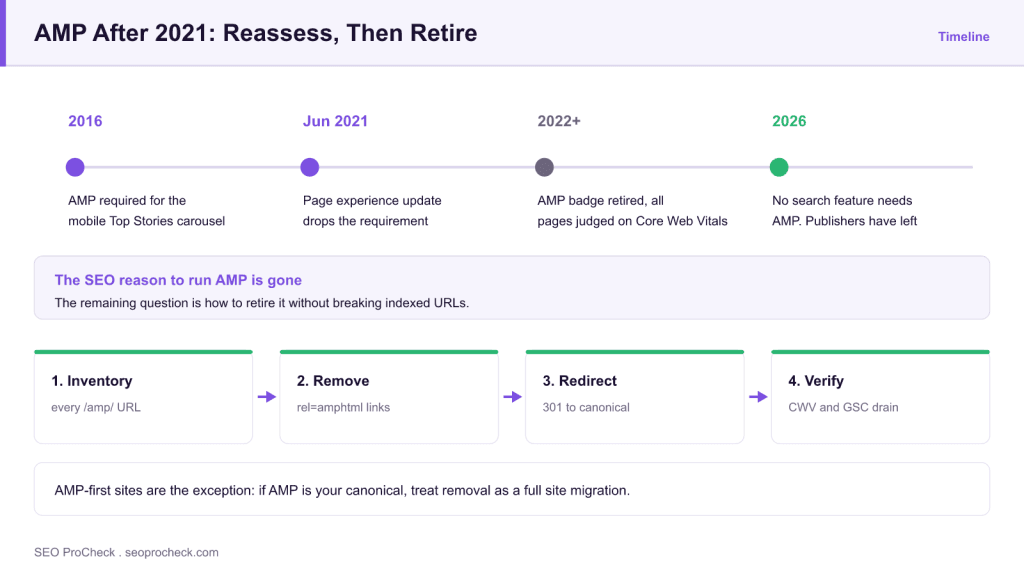
Should you still use AMP? For almost every site in 2026, no. Google dropped AMP as a requirement for Top Stories with the June 2021 page experience update, retired the AMP badge, and now evaluates all pages on the same Core Web Vitals footing, which removed the only compelling SEO reason AMP ever had. Most major publishers have since dismantled their AMP pages. If you still serve AMP today, the practical question is not whether to adopt it but how to retire it without breaking indexed URLs.
- The June 2021 page experience update removed the AMP requirement for Top Stories, which was the load-bearing SEO reason to run AMP.
- AMP pages get no ranking preference. Speed counts through Core Web Vitals, measured identically for every page.
- Paired AMP setups carry duplicate maintenance and split analytics for no remaining search benefit.
- Retire by removing the
rel="amphtml"links first, then 301-redirecting every AMP URL to its canonical.
Whether Google manipulated AMP or not, it’s a great time to reassess using it provides valuable insights for SEO practitioners. This resource examines approaches and considerations that can improve organic search performance.
Key Concepts
Understanding the fundamental principles behind this topic helps inform strategic decisions. Whether optimizing for traditional search or emerging AI platforms, foundational concepts remain relevant. This resource covers the essential knowledge practitioners need.
Much of the confusion around retiring AMP comes from treating it as one thing, when sites actually run it in three different arrangements. The right decision differs for each:
- Paired AMP. A canonical HTML page plus a separate AMP version, linked with
rel="amphtml", with the AMP page canonicalising back to the original. This is the common publisher setup, and the one with the clearest case for retirement, because you are maintaining two templates to serve one page. - AMP first, or AMP only. The AMP document is the canonical page. Nothing is duplicated, so there is no duplication cost to remove, and moving off it is a template and URL migration rather than a cleanup.
- AMP as a component library. Some sites use individual AMP components inside otherwise ordinary pages. This has no search implications in either direction.
Establish which of the three you have before planning anything. The retirement sequence in this article applies to paired AMP; an AMP-first site should be scoped and resourced as a migration.
Implementation Considerations
Moving from concept to execution requires understanding practical constraints and opportunities. Different situations call for different approaches. This resource provides guidance for applying concepts in real-world contexts.
Before removing anything, gather the inputs that make the redirect map safe:
- A complete list of live AMP URLs, assembled from a crawl, from your CMS, and from server logs. The logs matter because they surface AMP URLs still receiving traffic from old links and caches that a crawl of your current site will never find.
- The inbound links pointing at AMP URLs. These are the reason to redirect rather than let them 404, and they tell you which URLs deserve individual verification afterwards.
- A mapping from every AMP URL to its canonical equivalent, checked for the cases where the canonical no longer exists. Those need a decision, not a lazy redirect to the homepage.
- A performance check on the canonical templates, because pages that were only ever tested in AMP form sometimes carry performance debt that AMP was masking.
Remove the rel="amphtml" references first, or at the same time as the redirects go live. Redirecting AMP URLs while the canonical pages still advertise them sends a contradictory signal for as long as both states coexist.
Measuring Impact
SEO efforts require measurement to demonstrate value and guide optimization. Identifying appropriate metrics, establishing baselines, and tracking progress enables data-driven improvement. This resource addresses how to evaluate success.
Watch four things for roughly a month after the retirement lands:
- Impressions and clicks migrating rather than disappearing. Compare the combined AMP plus canonical total before the change against the canonical total afterwards. A genuine transfer looks flat in aggregate; a loss does not.
- Crawl errors on the old AMP paths. Any 404s appearing here are gaps in the redirect map, and they are cheapest to fix while those URLs still carry equity.
- Core Web Vitals on the canonical templates, in field data, since those pages are now absorbing the mobile traffic that used to land on AMP.
- The Search Console AMP report draining toward zero, which confirms Google has processed the removal rather than merely stopped reporting on it.
Keep the redirects permanently. AMP URLs live a long time in third-party links, cached shares, and messaging apps, and a redirect costs nothing to leave in place.
This resource contributes to the knowledge base SEO practitioners need for effective optimization in an evolving search landscape.
The Context Behind the Article
The Search Engine Land piece linked below was written in 2021, when unredacted filings in the state attorneys general antitrust suit against Google alleged, among other things, that Google had deliberately disadvantaged non-AMP pages to drive publisher adoption. Google disputed the characterization, and this page takes no position on the legal claims. But the article’s core argument stood on its own regardless of how the litigation played out: the incentives that pushed publishers into AMP were evaporating, and it was time to re-run the cost-benefit math. That call turned out to be exactly right.
What’s Changed Since: The Ecosystem’s Retreat From AMP
- The Top Stories requirement ended (June 2021). The page experience update opened the mobile Top Stories carousel to any page meeting Google News content policies, AMP or not. This was the single load-bearing reason most publishers had adopted AMP.
- The AMP badge and prioritization disappeared. Google stopped showing the lightning-bolt AMP badge in results and stopped treating AMP as a special class of result; ranking benefit now flows through Core Web Vitals, measured identically for all pages.
- Publishers left in numbers. In the years following, a long list of major news organizations dismantled their AMP implementations after finding traffic held steady or improved without them, while regaining full control of their ad stacks, analytics, and page experience.
- The distribution side thinned out. Platforms that once auto-linked to AMP versions moved back to canonical URLs, and the AMP cache-URL user experience (Google-hosted URLs in the address bar) that publishers always disliked became a pure liability with no offsetting reach benefit.
- Modern frameworks closed the speed gap. AMP’s original pitch was enforced performance discipline. Today the same outcomes (instant loading, restricted JavaScript, prioritized above-the-fold rendering) are achievable on canonical pages, and verified with field data rather than AMP validation. See our explainer on field vs. lab data for how that verification actually works.
Decision Table: Keep, Retire, or Never Adopt
| Your situation | Recommendation | Why |
|---|---|---|
| Considering AMP for a new site | Don’t adopt | No search feature requires it; effort is better spent on Core Web Vitals for canonical pages |
| Running paired AMP + canonical pages | Retire deliberately | Duplicate maintenance, split analytics, and cache-URL confusion with no remaining ranking benefit |
| AMP-first / AMP-only site (AMP is the canonical) | Keep or migrate carefully | Valid AMP that is your canonical page is just fast HTML; migrating means a full URL/template migration, so plan it like one |
| Email templates using AMP for Email | Separate decision | AMP for Email is an unrelated technology with its own (niche) ecosystem; the search-side retreat doesn’t apply |
How to Retire AMP Without Breaking Things
AMP URLs are indexed, cached, and linked. Turning the plugin off overnight creates thousands of 404s. The clean sequence:
- Inventory the AMP URLs (typically
/amp/suffixes or?ampparameters) from your CMS, logs, and a crawl. - Remove the
<link rel="amphtml">tags from canonical pages so Google stops discovering the paired versions. - 301-redirect every AMP URL to its canonical equivalent. This is the step that preserves equity from any links pointing at AMP URLs and clears the Google AMP cache correctly over time.
- Verify no canonical or robots conflicts remain: a common failure is an AMP canonical pointing at a URL that is itself blocked or redirected; our check on AMP canonicals pointing to disallowed URLs covers that pattern.
- Confirm the canonical pages pass Core Web Vitals on real-user data. AMP was masking performance debt for some sites; make sure the page users now land on is actually fast.
- Monitor Search Console for a few weeks: the AMP report should drain to zero while impressions transfer to canonical URLs. Treat the whole exercise with the same rigor as any site migration.
Frequently Asked Questions
Is AMP dead in 2026?
As an SEO requirement, yes. The open-source AMP framework still exists and valid AMP pages still index like any HTML, but no Google search feature requires AMP anymore, and the publisher ecosystem has largely moved off it.
Do AMP pages rank better than regular pages?
No. Since June 2021, AMP receives no preferential treatment. Speed matters through Core Web Vitals, which are measured the same way for every page, and a fast canonical page and a fast AMP page are equals in ranking terms.
Will removing AMP hurt my traffic?
Done correctly (amphtml links removed, AMP URLs 301-redirected, canonical pages fast), the widely reported publisher experience is neutral to positive. The risk sits entirely in sloppy execution: 404ing indexed AMP URLs or landing users on a slow canonical page.
Do I still need AMP for Google Top Stories or Google News?
No. Top Stories eligibility depends on content policies and quality, not AMP. This has been true since the 2021 page experience rollout.
What did the “Google manipulated AMP” claims refer to?
Allegations in the state attorneys general antitrust litigation that Google engineered advantages for AMP pages (and disadvantages for non-AMP ads) to push publisher adoption. Google disputed the claims. Whatever their merit, they accelerated an exodus that the removal of the Top Stories requirement had already begun.
What should replace AMP in a performance strategy?
Field-verified Core Web Vitals on your canonical pages: optimize LCP with server response and image priority work, INP by cutting JavaScript, CLS with reserved layout space, then verify against CrUX real-user data rather than lab scores alone.
Claude Vincent is a technical SEO consultant focused on crawlability, rendering, and AI-search visibility. He writes the field guides and case studies at SEO ProCheck, with a bias toward the durable, unglamorous work that decides whether search engines and AI answer engines can actually read and cite a site.
About SEO ProCheck
Technical SEO consulting and GEO strategy with 20 years of enterprise experience. Case studies, resources, and tools for search and AI visibility.
Work With Me
Technical SEO audits, GEO strategy, site migrations, and international SEO. Hourly consulting for teams who need hands-on support, not just reports.
Subscribe to our newsletter!







Recent Posts
- Can AI Crawlers Actually Read Your Site? I Measured 400 of the Biggest September 5, 2026
- The Pre-Publish Quality Gate for AI-Assisted Content August 6, 2026
- AGENTS.md vs llms.txt vs llms-full.txt: Which Agent File Does What July 18, 2026