

AI Summary
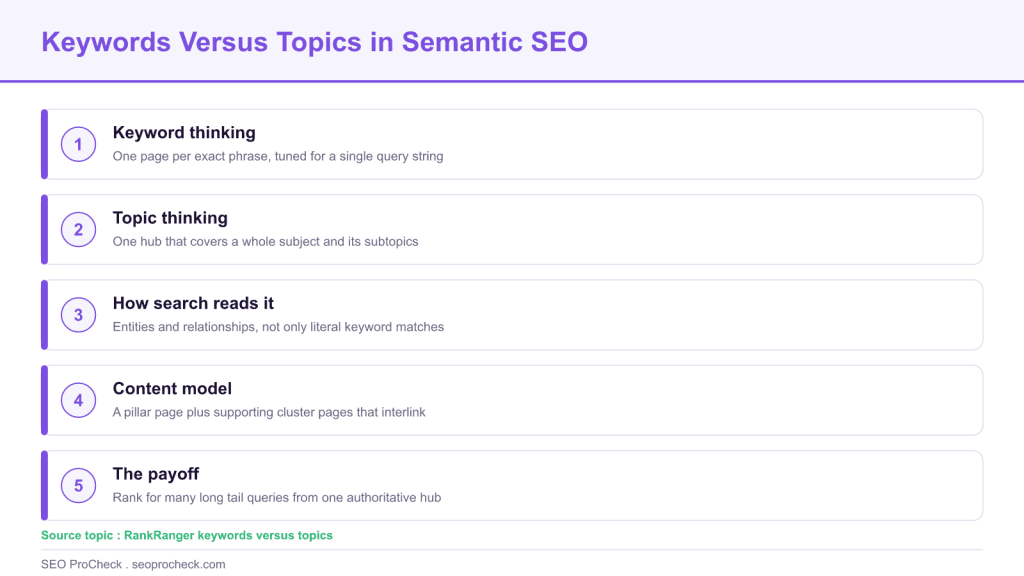
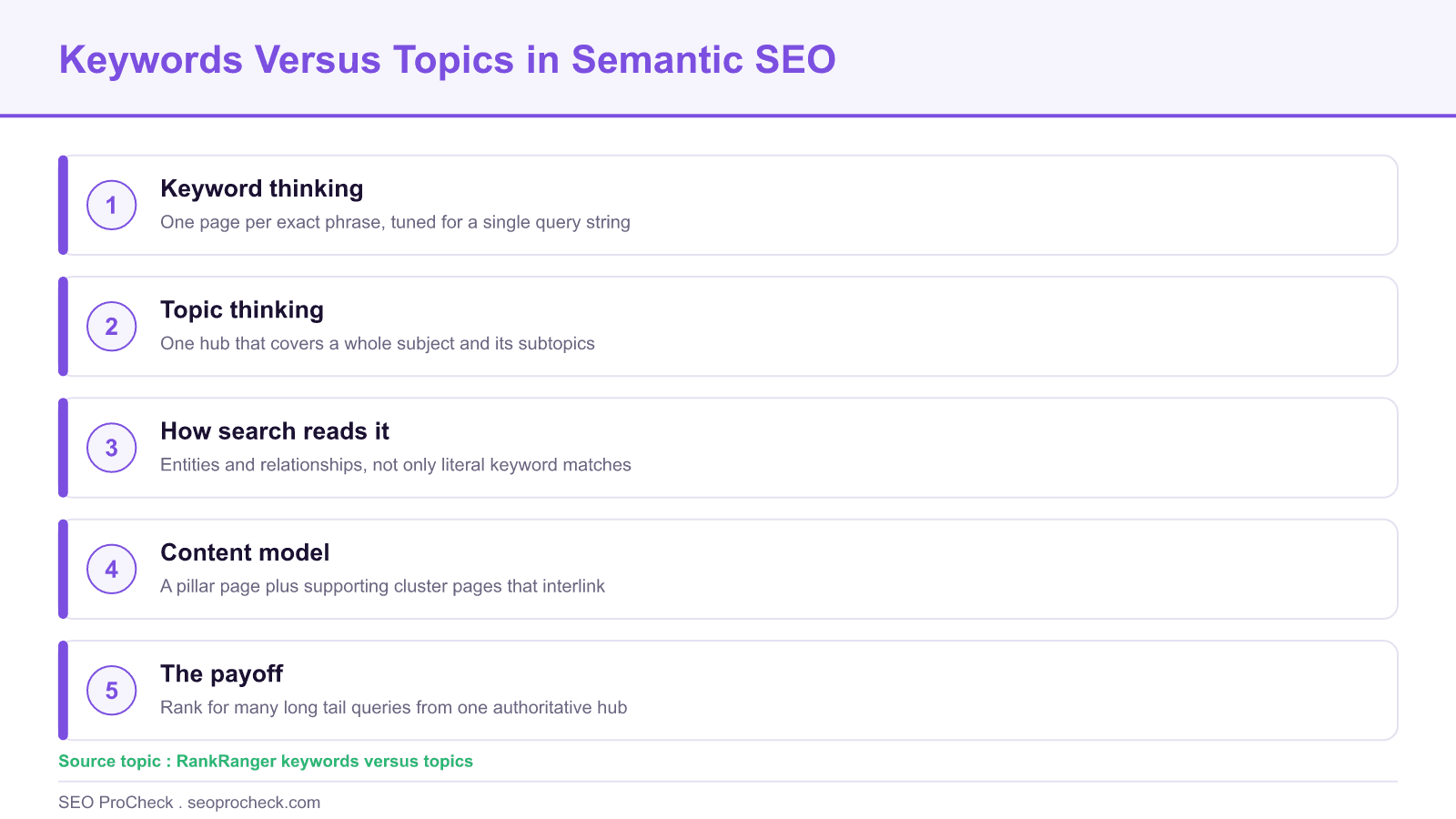
Keywords versus topics is the shift from optimizing one page for one exact phrase to building one authoritative hub that covers an entire subject. Modern search reads entities and relationships, not just literal strings, so a pillar page supported by interlinked cluster pages ranks for far more queries than isolated keyword pages.
- Keyword thinking builds one page per phrase, topic thinking builds one hub per subject.
- Search engines now map entities and relationships, not only exact keyword matches.
- A pillar page plus interlinked cluster pages is the practical topic model.
- Covering a topic fully lets one hub rank for many long tail variations.
For years SEO meant finding a keyword, building a page for it, and repeating the phrase enough times to rank. Search engines have moved on. They now understand language as a web of entities, the people, places, products, and concepts a page is about, and the relationships between them. That change is why topic based content beats keyword by keyword content, and it is the heart of semantic SEO.
Keywords and topics compared
| Dimension | Keyword approach | Topic approach |
|---|---|---|
| Unit of content | One page per exact phrase | One hub covering a subject |
| What it targets | A single query string | An entity and its subtopics |
| Structure | Standalone pages | Pillar page plus cluster pages |
| Risk | Thin, overlapping, cannibalizing pages | Needs planning and depth |
| Payoff | Ranks for a narrow set of terms | Ranks for many related queries |
The keyword approach tends to spawn many thin pages that compete with each other, a pattern that also invites keyword stuffing as writers force the phrase in. The topic approach consolidates that value into one strong page and its supporting network.
How to build a topic cluster
- Pick the pillar. Choose a broad subject you can own, broad enough to support many subtopics but focused enough to be coherent.
- Map the subtopics. List the questions and angles a reader explores within that subject. Grounding this in real user intent mapping keeps the cluster aligned with demand.
- Write the pillar page as a comprehensive overview that links out to each subtopic.
- Create cluster pages that each answer one subtopic in depth and link back to the pillar.
- Interlink deliberately so the pillar and clusters reinforce each other and pass authority around the topic.
Answering subtopic questions clearly and directly also improves your odds of winning a featured snippet, since those pull from concise, well structured answers.
Do keywords still matter
Yes, but their role changed. Keywords are now research inputs and validation, not the organizing unit of your content. You still study the exact phrases people type to understand demand and language, then you group them into topics and intents and build content around those. Think of keywords as the map and topics as the territory. A recurring content audit helps you spot thin keyword pages that should be merged into a stronger topic hub.
What has changed since this guide
Entity based understanding has only deepened. Google now leans on large language models and knowledge graphs, and generative answer engines quote sources that demonstrate genuine topical depth. That rewards comprehensive hubs even more than before and further penalizes shallow single keyword pages. The keyword versus topic framing in the source below has become the mainstream way to plan content.
Related content strategy principles
Content strategy determines what you create, why, and how it serves both users and business objectives. This resource examines approaches for developing content that performs well in search while delivering genuine value.
Understanding User Intent
Effective content addresses what users actually need when they search. Analyzing search intent, understanding user questions, and mapping content to the user journey ensures content serves real needs. Intent alignment has become as important as keyword targeting.
Quality and Comprehensiveness
Search engines increasingly reward comprehensive, authoritative content over thin pages targeting specific keywords. Building topical depth through thorough coverage of subjects establishes expertise. Quality signals including E-E-A-T factors influence how content is evaluated.
Content Lifecycle Management
Content requires ongoing maintenance to remain competitive. Regular audits identify content needing updates, consolidation, or removal. Fresh, accurate content maintains rankings while outdated content decays. Building content refresh into ongoing processes sustains performance.
This resource provides strategic guidance for content programs that drive sustainable organic growth.
Source: https://www.rankranger.com/blog/keywords-vs-topics
Frequently Asked Questions
What is the difference between keywords and topics in SEO
Keyword based SEO builds a separate page for each exact phrase, while topic based SEO builds one authoritative hub covering a whole subject and its subtopics. Search engines now understand entities and relationships, so a well covered topic ranks for many related queries. Topics reduce the thin, overlapping pages that keyword by keyword targeting creates.
Do keywords still matter for SEO
Yes, but as research inputs rather than the organizing unit. You study the exact phrases people search to learn demand and language, then group them into topics and intents and build content around those. Keywords guide the content, topics structure it.
What is a topic cluster
A topic cluster is a content model with one broad pillar page and several cluster pages that each cover a subtopic in depth. The cluster pages link back to the pillar and the pillar links out to them. This interlinked structure signals topical authority and spreads ranking value across the group.
What is semantic SEO
Semantic SEO is optimizing for meaning and entities rather than literal keyword strings. It focuses on covering a subject thoroughly, clarifying the entities involved, and answering related questions. The goal is to match what search engines understand a query to mean, not just the words in it.
Is keyword research obsolete
No. Keyword research is still essential for understanding what people want and how they phrase it. What changed is that you now cluster those keywords into topics and intents instead of making one thin page per phrase. The research feeds the topic plan.
How does topic based content help with AI search
Generative engines favor sources that show real depth on a subject, so a comprehensive hub is more likely to be cited than a shallow single keyword page. Covering related subtopics and questions gives an answer engine more it can trust and quote. Topical depth now supports both classic rankings and AI citations.
Claude Vincent is a technical SEO consultant focused on crawlability, rendering, and AI-search visibility. He writes the field guides and case studies at SEO ProCheck, with a bias toward the durable, unglamorous work that decides whether search engines and AI answer engines can actually read and cite a site.
About SEO ProCheck
Technical SEO consulting and GEO strategy with 20 years of enterprise experience. Case studies, resources, and tools for search and AI visibility.
Work With Me
Technical SEO audits, GEO strategy, site migrations, and international SEO. Hourly consulting for teams who need hands-on support, not just reports.
Subscribe to our newsletter!







Recent Posts
- Can AI Crawlers Actually Read Your Site? I Measured 400 of the Biggest September 5, 2026
- The Pre-Publish Quality Gate for AI-Assisted Content August 6, 2026
- AGENTS.md vs llms.txt vs llms-full.txt: Which Agent File Does What July 18, 2026