

AI Summary
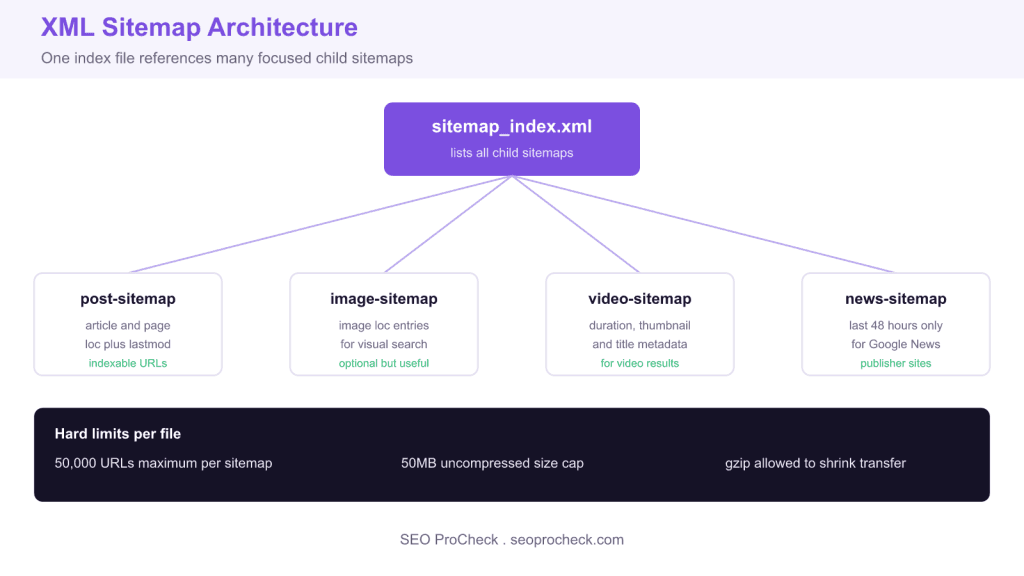
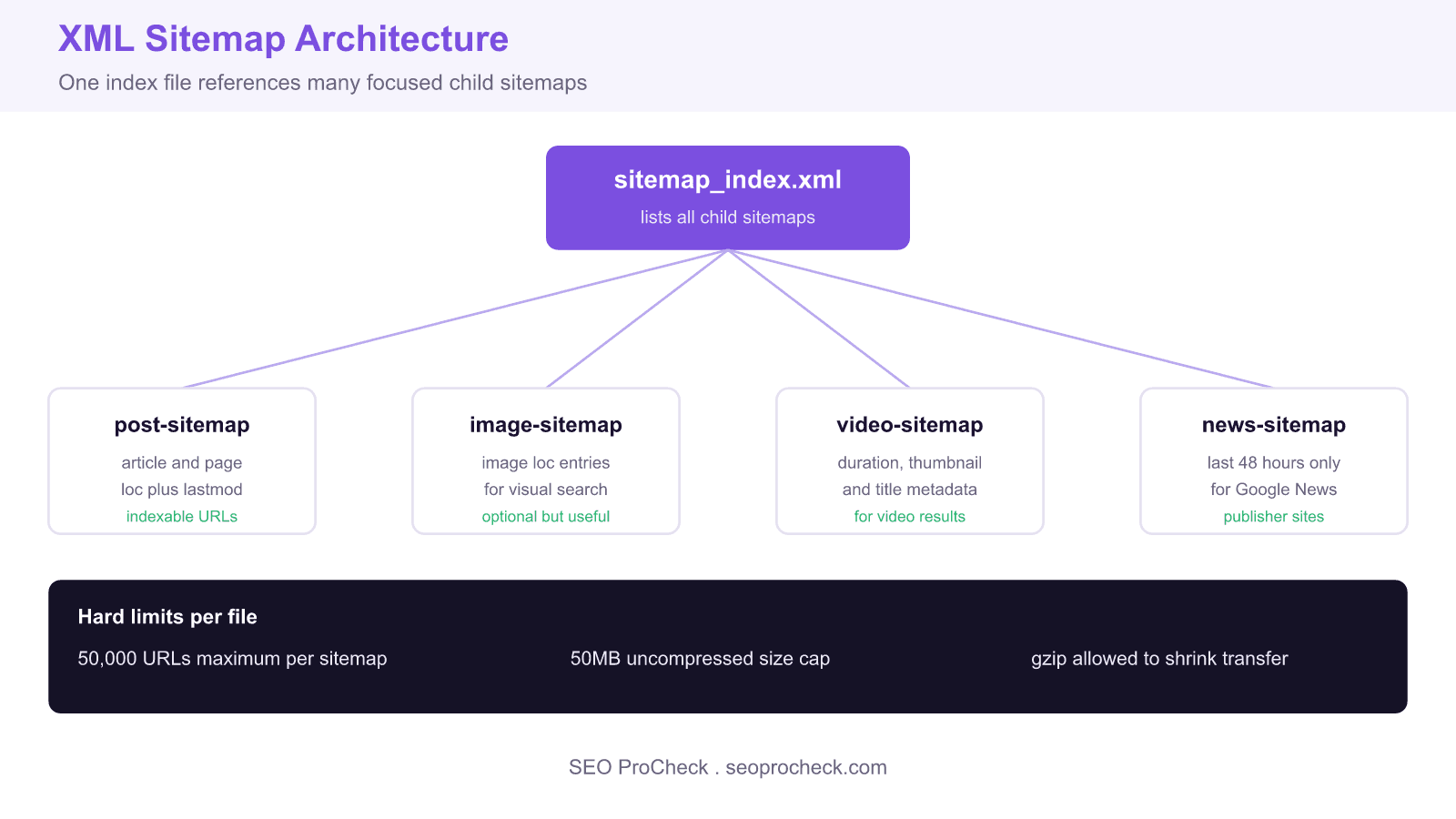
An XML sitemap is a structured file listing the URLs you want search engines to discover, organised through a sitemap index that fans out into focused child sitemaps for pages, images, video, and news. It speeds up crawling and coverage rather than boosting rankings, so the priorities are clean loc values, honest lastmod dates, and staying within the 50,000 URL and 50MB per file limits.
- A sitemap index references child sitemaps grouped by content type.
- Only loc is required per URL; lastmod is the one optional hint Google still reads.
- Image, video, and news sitemaps add specialised metadata for richer results.
- Google ignores changefreq and priority entirely.
An XML sitemap is a structured file that tells search engines which URLs on your site are available for crawling, when each was last modified, and how your content is organised. It does not force indexing and it does not boost rankings on its own, but it accelerates discovery, which is why large, deep, or newly launched sites gain the most from a well built sitemap.
How a sitemap index fans out into child sitemaps
On any site beyond a few hundred URLs you do not maintain one giant file. You maintain a sitemap index, typically at /sitemap_index.xml, that references smaller child sitemaps grouped by content type. A typical WordPress install running Yoast or Rank Math produces child files such as post-sitemap.xml, page-sitemap.xml, category-sitemap.xml, and an image or author sitemap. This structure keeps every file well under the hard limits and makes it far easier to diagnose which content group has a coverage problem.
The anatomy of a valid URL entry
Each URL in a standard sitemap is one url block. Only the loc element is required, and it must hold a single absolute URL on the same host as the property. The lastmod element is optional but valuable when it reflects a genuine content change.
<url>
  <loc>https://seoprocheck.com/articles/general/</loc>
  <lastmod>2026-07-28</lastmod>
</url>
Note what is absent. Google confirmed years ago that it ignores changefreq and priority, so including them adds bytes without benefit. Keep entries lean: an accurate loc, an honest lastmod, nothing more for standard pages.
Specialised sitemap types
Beyond the standard page sitemap, three extended formats carry extra metadata. An image sitemap adds image:image and image:loc children so Google can surface your media in image search. A video sitemap adds video:video with thumbnail, title, description, and duration so clips qualify for video rich results. A news sitemap uses the news:news namespace and, by design, only lists articles published in the last 48 hours; it is meant for approved Google News publishers, not general blogs.
International sites and hreflang in sitemaps
If you run language or country variants, you can declare hreflang inside the sitemap instead of in page markup. Each url block gains xhtml:link children with rel="alternate" and an hreflang value for every variant, including a self reference. This centralises international signals in one file, which is often cleaner than maintaining tags across hundreds of templates.
Static versus dynamic generation
A dynamic sitemap regenerates automatically whenever content changes, which is the correct default for any database driven CMS. A static file that you export once will drift out of date the moment you publish or unpublish a page, quietly listing dead URLs and omitting new ones. If you must use a static export, rebuild it on a schedule. Whichever route you choose, register the index in the robots file with a Sitemap: directive and submit it in Google Search Console under Indexing then Sitemaps.
What has changed since older sitemap guides
The core protocol at sitemaps.org has not changed, but the tooling around it has. Google removed the standalone sitemap testing tool and now validates only inside Search Console. The old ping endpoint that let you notify Google of an updated sitemap by URL was deprecated, so resubmission happens through Search Console or is discovered automatically. And the guidance on changefreq and priority hardened from lukewarm to a clear statement that both are ignored. The one hint that still counts is a truthful lastmod.
Sitemap types and when to use them
| Sitemap type | Key elements | Use when |
|---|---|---|
| Standard page | loc, lastmod | Every site, for articles and pages |
| Sitemap index | sitemap, loc | Any site above a few hundred URLs |
| Image | image:image, image:loc | Media heavy sites chasing image search |
| Video | video:video, thumbnail, duration | Sites hosting original video content |
| News | news:news, publication_date | Approved Google News publishers only |
Related reading
- How to check your XML sitemaps for errors
- Mobile first indexing and content parity
- More technical SEO articles
Frequently asked questions
Do XML sitemaps directly improve rankings?
No. A sitemap helps search engines discover and crawl URLs faster, but it is not a ranking factor by itself. Its value is coverage and crawl efficiency, which matters most on large, deep, or newly launched sites where important pages might otherwise sit undiscovered.
What is the difference between a sitemap and a sitemap index?
A sitemap lists individual page URLs, while a sitemap index lists other sitemaps. Once a site grows past a few hundred URLs, you split content into several child sitemaps and reference them all from one index file, which keeps every file within the 50,000 URL and 50MB limits.
Should I include images and videos in my sitemap?
Include them if visual or video search is a real traffic channel for you. Image and video sitemaps carry extra metadata that helps Google understand and surface that media, but for a text first blog a standard page sitemap is usually enough.
How do I handle multiple languages in a sitemap?
You can declare hreflang directly in the sitemap using xhtml:link alternate entries inside each url block, with one entry per language variant plus a self reference. This centralises international targeting in a single file instead of spreading tags across every template.
Does Google still use changefreq and priority?
No. Google has stated it ignores both changefreq and priority, so they add file size without any benefit. Keep your entries to an accurate loc and an honest lastmod, and let real update dates guide crawling.
Where should I put my sitemap so search engines find it?
Reference the sitemap index in your robots.txt with a Sitemap: line and submit it in Google Search Console under Indexing then Sitemaps. Bing Webmaster Tools accepts the same file, so submit it there too if Bing traffic matters to you.
Source: https://www.onely.com/blog/ultimate-guide-to-xml-sitemaps/
Claude Vincent is a technical SEO consultant focused on crawlability, rendering, and AI-search visibility. He writes the field guides and case studies at SEO ProCheck, with a bias toward the durable, unglamorous work that decides whether search engines and AI answer engines can actually read and cite a site.
About SEO ProCheck
Technical SEO consulting and GEO strategy with 20 years of enterprise experience. Case studies, resources, and tools for search and AI visibility.
Work With Me
Technical SEO audits, GEO strategy, site migrations, and international SEO. Hourly consulting for teams who need hands-on support, not just reports.
Subscribe to our newsletter!







Recent Posts
- Can AI Crawlers Actually Read Your Site? I Measured 400 of the Biggest September 5, 2026
- The Pre-Publish Quality Gate for AI-Assisted Content August 6, 2026
- AGENTS.md vs llms.txt vs llms-full.txt: Which Agent File Does What July 18, 2026