

5 Major SEO Mistakes You're Probably Making - PageTraffic Buzz - SEO, Search Marketing, News, Events
- February 19, 2022
- General
AI Summary
Most SEO problems trace back to a short list of avoidable mistakes: chasing keywords without matching intent, publishing thin or duplicated pages, neglecting internal links, shipping slow pages, and never measuring results. Fixing these five in order gives the fastest, most durable gains for most sites.
- Match every page to the intent behind its target query before anything else.
- Consolidate thin, near duplicate pages into fewer, deeper resources.
- Use internal links from strong pages to lift weaker ones.
- Track clicks, impressions, and position in Search Console so you can prove impact.
The article 5 Major SEO Mistakes You're Probably Making, published on PageTraffic Buzz, provides valuable insights for SEO practitioners. This resource examines approaches and considerations that can improve organic search performance.
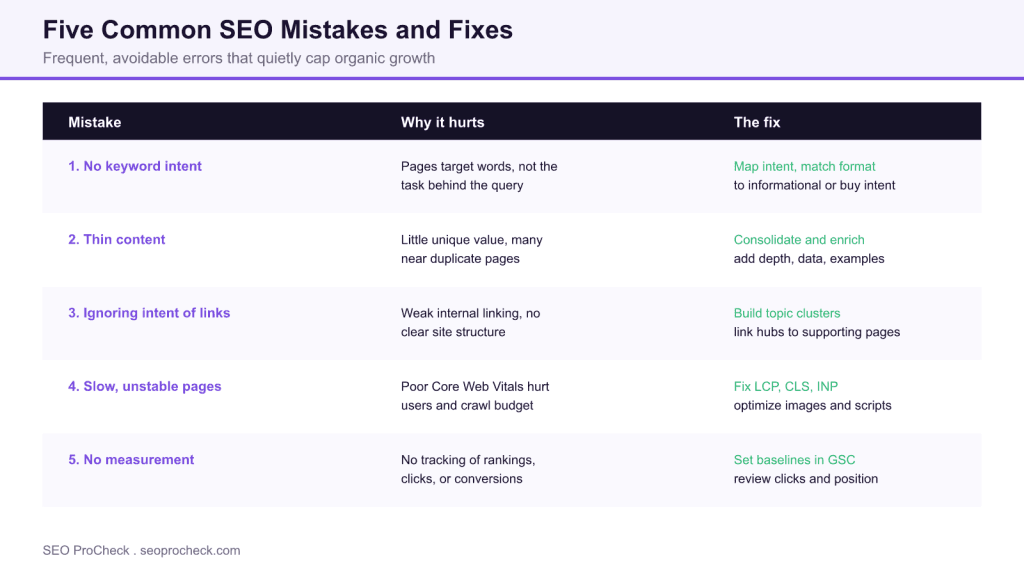
The mistakes below are not exotic. They are the ones that show up again and again in real audits, on sites of every size, and they quietly cap organic growth long before anyone notices a penalty or a crawl error. Working through them in order tends to unlock the most traffic for the least effort, because each one compounds: a page with the wrong intent cannot be saved by fast loading, and a fast page nobody links to internally will still struggle to rank.
Mistake 1: Targeting keywords without matching intent
Every query carries an implied task. Someone typing "best running shoes" wants a comparison, not a single product page, while someone typing "buy nike pegasus 40" wants a product page with a price and an add to cart button. When your page format fights the intent, Google sees a high bounce and a fast return to the results, and it demotes the page no matter how many times the keyword appears. Before writing anything, look at the top ten results for your target query and note the dominant format: list, guide, product, tool, or definition. Build that format. If the results are mixed, that is a signal the query is ambiguous and you may need more than one page. The keyword research fundamentals guide walks through classifying intent before you commit to a page type.
Mistake 2: Thin and duplicated content
Thin content adds nothing a searcher cannot already get from the pages ranking above you, and duplicated content splits your own authority across near identical URLs. Both are common on large sites that spin up a page per location, per product variant, or per tag archive. The fix is rarely deletion. It is consolidation and enrichment: merge overlapping pages into one strong resource, add original data, worked examples, and specifics that only you can provide, then redirect the retired URLs. A useful rule of thumb is that a page should answer the query more completely than anything currently ranking, or it should not exist as a separate URL.
Mistake 3: Weak internal linking
Internal links are the cheapest ranking lever you own, and most sites underuse them. Links pass authority from established pages to newer ones, they tell Google which pages you consider most important, and they define how your topics relate. The practical move is to identify your handful of highest authority pages, usually your oldest and most linked resources, and add contextual links from them to the pages you want to lift. Group related pages into topic clusters with a hub page linking out to supporting pages and each supporting page linking back to the hub. Descriptive anchor text matters here: use the phrase the target page should rank for, not "click here".
Mistake 4: Slow, unstable pages
Core Web Vitals measure loading (Largest Contentful Paint), interactivity (Interaction to Next Paint), and visual stability (Cumulative Layout Shift). They are part of Google's page experience signals, and while relevance still wins, vitals act as a tiebreaker and they influence how much of your site Google will crawl. More importantly, slow pages lose users before the content even appears. Start with the biggest offenders: oversized images, render blocking scripts, and layout shifts from ads or late loading fonts. Compress and correctly size images, defer non critical JavaScript, and reserve space for elements that load late. Related technical checks such as the viewport meta tag check keep the mobile experience usable while you tune performance.
Mistake 5: No measurement
If you cannot see what happened, you cannot tell an improvement from luck. Set a baseline in Google Search Console before you change anything, then watch clicks, impressions, average position, and click through rate per query and per page. Pair that with analytics for conversions so you optimize for revenue, not vanity rankings. When you ship a title or content change, annotate the date so you can attribute movement later. Title tests in particular reward measurement, as small wording changes can shift click through rate measurably: the case studies on whether title tags impact rankings show how much depends on testing rather than assumption.
The five mistakes at a glance
| Mistake | Why it hurts | The fix | First metric to watch |
|---|---|---|---|
| Wrong keyword intent | Format fights the searcher's task | Match page type to the query | Bounce and dwell time |
| Thin or duplicate content | Little unique value, split authority | Consolidate and enrich | Indexed pages and impressions |
| Weak internal linking | Authority never reaches key pages | Link from strong pages, build clusters | Position of target pages |
| Slow, unstable pages | Users leave, crawl budget shrinks | Fix LCP, INP, CLS | Core Web Vitals pass rate |
| No measurement | Cannot tell progress from noise | Baseline and track in GSC | Clicks and click through rate |
Key Concepts
Understanding the fundamental principles behind this topic helps inform strategic decisions. Whether optimizing for traditional search or emerging AI platforms, foundational concepts remain relevant. This resource covers the essential knowledge practitioners need.
Implementation Considerations
Moving from concept to execution requires understanding practical constraints and opportunities. Different situations call for different approaches. This resource provides guidance for applying concepts in real-world contexts.
Measuring Impact
SEO efforts require measurement to demonstrate value and guide optimization. Identifying appropriate metrics, establishing baselines, and tracking progress enables data-driven improvement. This resource addresses how to evaluate success.
What has changed since this article
The five mistakes are durable, but the stakes around two of them have risen. Core Web Vitals moved from a soft signal to a metric with a dedicated report and a shift to Interaction to Next Paint as the responsiveness measure, so interactivity now matters more than the older First Input Delay ever did. Intent has also broadened: AI overviews and answer engines increasingly summarize the best matching page, so content that precisely serves intent can earn citations that a keyword stuffed page never will. The fixes have not changed, but the reward for getting them right is larger than it was when this list was first written.
Frequently Asked Questions
What is the single most common SEO mistake?
Publishing pages that target a keyword without matching the intent behind it. If someone searches a question and lands on a product page, they leave, and Google reads that as a poor result. Confirm the intent by looking at what already ranks, then build the page format that matches it.
How do I know if my content is thin?
Thin content adds little unique value beyond what competing pages already say, or it duplicates other pages on your own site. A quick test is whether the page answers the query more completely than the results above it. If it does not, expand it with specifics, data, and examples rather than deleting it.
Do internal links really move rankings?
Yes. Internal links pass authority and help Google understand which pages are most important and how topics relate. Linking from established, high traffic pages to newer or weaker pages is one of the fastest ways to lift them, and it costs nothing but editing time.
Are Core Web Vitals a ranking factor?
Core Web Vitals are part of Google's page experience signals, and while they rarely override strong relevance, they act as a tiebreaker between similar pages and they affect how many pages Google is willing to crawl. Slow pages also lose users before the content loads, which hurts conversions.
How often should I check for these mistakes?
Run a technical and content review at least quarterly, and check Search Console every week for sudden drops in clicks or impressions. Most of these five mistakes creep back in as a site grows, so a recurring audit catches them before they compound.
Can fixing these mistakes recover lost traffic?
Often, yes. Consolidating thin pages, matching intent, and strengthening internal links can recover rankings within a few crawl cycles, usually a few weeks. Recovery is faster when the underlying content is genuinely improved rather than merely reshuffled.
This resource contributes to the knowledge base SEO practitioners need for effective optimization in an evolving search landscape.
Source: https://www.pagetrafficbuzz.com/5-major-seo-mistakes-youre-probably-making/26448/
Claude Vincent is a technical SEO consultant focused on crawlability, rendering, and AI-search visibility. He writes the field guides and case studies at SEO ProCheck, with a bias toward the durable, unglamorous work that decides whether search engines and AI answer engines can actually read and cite a site.
About SEO ProCheck
Technical SEO consulting and GEO strategy with 20 years of enterprise experience. Case studies, resources, and tools for search and AI visibility.
Work With Me
Technical SEO audits, GEO strategy, site migrations, and international SEO. Hourly consulting for teams who need hands-on support, not just reports.
Subscribe to our newsletter!







Recent Posts
- Can AI Crawlers Actually Read Your Site? I Measured 400 of the Biggest September 5, 2026
- The Pre-Publish Quality Gate for AI-Assisted Content August 6, 2026
- AGENTS.md vs llms.txt vs llms-full.txt: Which Agent File Does What July 18, 2026