Avoid These 9 Enterprise SEO Reporting Mistakes That Devalue Your Data
- February 16, 2022
- General
AI Summary
Enterprise SEO reports lose their value when they lead with vanity metrics, blend segments that should be separated, and present data without a recommendation. Fixing those habits, reporting outcomes over rankings and always closing with a decision, is what keeps leadership treating organic search as a real channel.
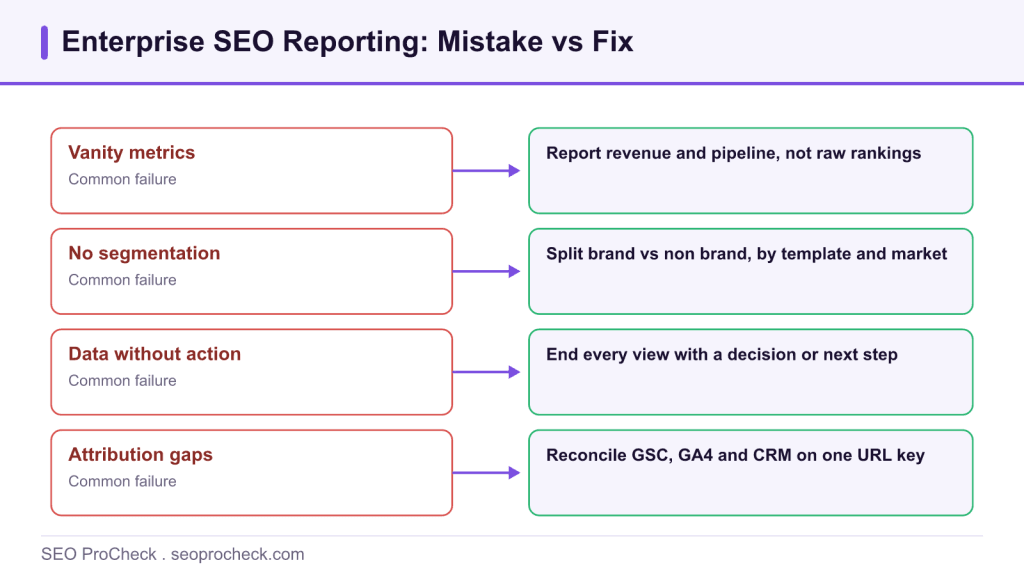
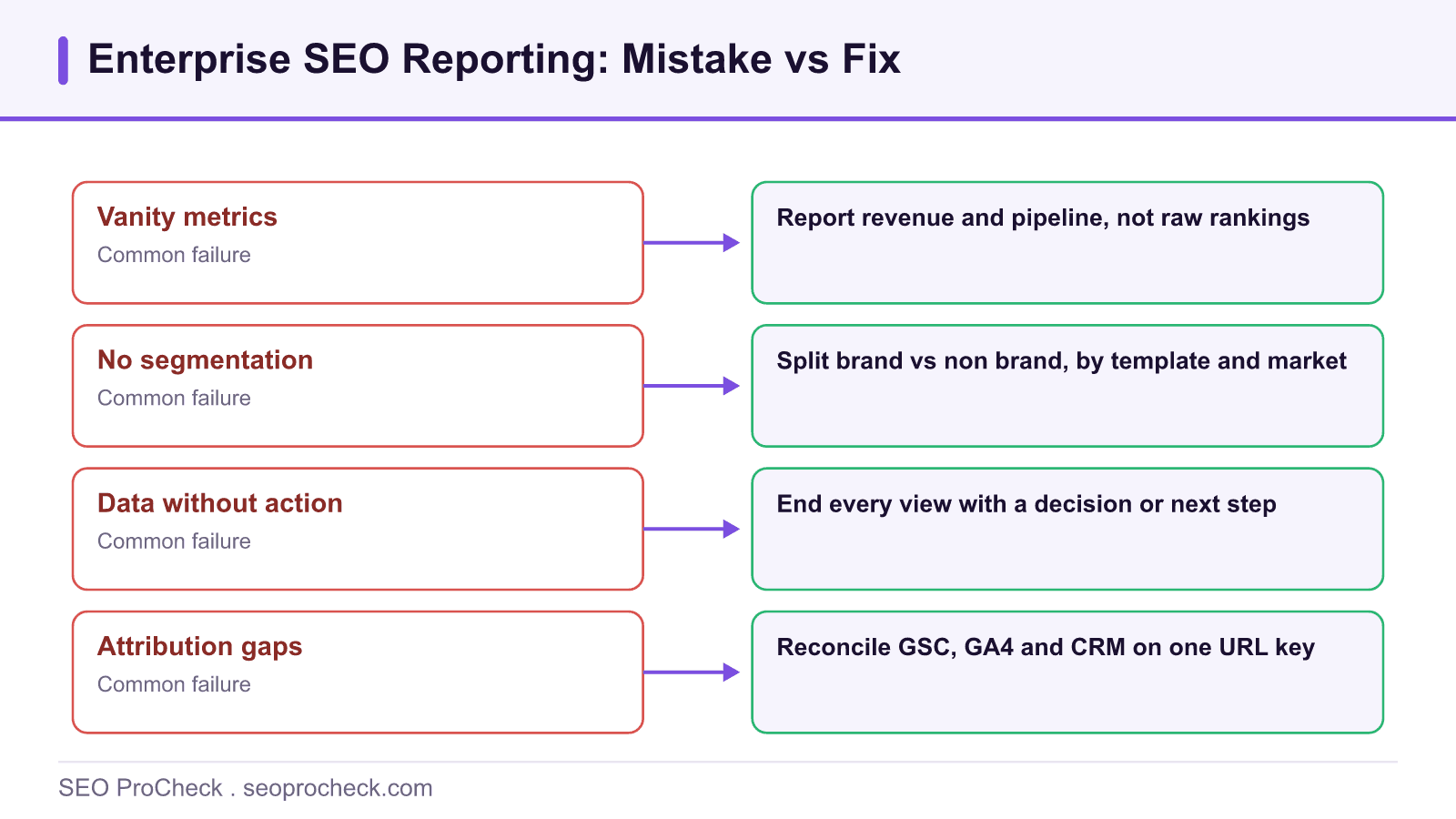
- Report revenue and pipeline first; rankings and sessions are supporting detail.
- Segment brand from non brand, and split by template and market, or trends stay hidden.
- Every view should end in a decision or next step, not a raw number.
- Reconcile Search Console, GA4 and the CRM on a single URL key so the figures agree.
Avoid These 9 Enterprise SEO Reporting Mistakes That Devalue Your Data provides valuable insights for SEO practitioners. This resource examines approaches and considerations that can improve organic search performance.
Key Concepts
At enterprise scale the audience for a report is rarely the person who did the SEO work. It is a director deciding where next quarter's budget goes. The reporting mistakes that devalue data almost all come from forgetting that. Leading with keyword rankings tells that reader nothing about the business, so the report gets skimmed and the channel gets underfunded. The fix is to open with outcomes the reader already cares about, organic revenue and pipeline against a target, and to let rankings and traffic sit underneath as the explanation for why those outcomes moved.
The second structural error is blending segments. Brand and non brand search behave differently: brand tracks demand created elsewhere, while non brand reflects the optimization work itself. Reported together, a brand spike can mask a non brand decline for months. Segmenting by brand, by page template, and by market is what turns a flat top line into a story a decision maker can act on.
Implementation Considerations
Reconciling data sources is where enterprise reports quietly break. Search Console counts clicks, GA4 counts sessions and conversions, and the CRM counts revenue, and none of them agree out of the box because they define a visit differently and sample differently. Pick the URL as your join key, decide up front which tool is authoritative for each metric, and document that choice in the report so nobody relitigates it every month. When the numbers are challenged, and at enterprise scale they will be, that documented method is what protects the report's credibility.
Then layer the output by audience. One underlying dataset can feed three views: an executive summary that is outcomes and a single narrative line, a manager view broken down by template and market, and an operational dashboard the SEO team watches for indexation, crawl errors and ranking shifts. Trying to serve all three from one sheet is how you end up serving none of them well.
Measuring Impact
You know reporting has improved when it changes decisions. A good sign is that stakeholders start quoting the outcome numbers back to you and asking about the recommended next steps rather than questioning the methodology. Track how many recommendations in each report actually get resourced, because that ratio is the real measure of whether the reporting earns the channel its budget. When you triage which issues to surface first, our SEO triage plan pairs well with this, and structuring the content behind the numbers connects to topic clusters.
| Reporting mistake | Why it devalues the data | The fix |
|---|---|---|
| Leading with vanity metrics | Rankings and sessions read as noise to executives | Open with revenue and pipeline against a goal |
| No segmentation | Brand demand hides non brand performance | Split brand vs non brand, by template and market |
| Data without a recommendation | Reader has to guess the next move | End every view with a decision or next step |
| Unreconciled sources | GSC, GA4 and CRM disagree and get challenged | Join on the URL, name the authoritative source per metric |
| One report for all audiences | Too shallow for the team, too deep for leadership | Build layered executive, manager and operational views |
What Has Changed Since This Article
Two shifts make disciplined reporting even more important now. AI Overviews and other answer features absorb clicks that never reach the site, so impressions and rankings drift further from revenue and the case for outcome led reporting gets stronger. At the same time, connected analytics and looker style dashboards make layered, reconciled views easier to build than when this list was written, so there is less excuse for a single blended sheet. The mistakes are the same; the tooling to avoid them has caught up.
Frequently Asked Questions
What makes SEO reporting devalue its own data?
Reports lose value when they show activity rather than outcomes, mix segments that should be separated, and stop at numbers without a recommendation. Leaders then read them as noise and discount the whole channel.
Which metrics belong in an executive SEO report?
Revenue, pipeline and conversions from organic, framed against a goal, plus a short read on why they moved. Rankings and traffic are supporting detail, not the headline, at the executive level.
Why segment brand and non brand traffic?
Brand demand often moves with marketing and PR rather than SEO work, so blending it hides the performance of the pages you actually optimize. Splitting them shows the true non brand trend.
How often should enterprise SEO reports go out?
Match the cadence to the decision. A monthly business review needs outcomes and narrative, while an operational dashboard can refresh daily for the team watching indexation, errors and rankings.
How do I make a report actionable?
End every view with a decision: what changed, why it matters, and the next step. A chart without a recommendation forces the reader to guess, which is where trust in the data erodes.
Should one report serve every audience?
No. An executive wants outcomes and a one line story, a product manager wants template level detail, and the SEO team wants granular diagnostics. Build layered views rather than a single sheet that satisfies nobody.
Source: https://www.searchenginejournal.com/enterprise-seo-reporting-mistakes/433176/#close
Claude Vincent is a technical SEO consultant focused on crawlability, rendering, and AI-search visibility. He writes the field guides and case studies at SEO ProCheck, with a bias toward the durable, unglamorous work that decides whether search engines and AI answer engines can actually read and cite a site.
About SEO ProCheck
Technical SEO consulting and GEO strategy with 20 years of enterprise experience. Case studies, resources, and tools for search and AI visibility.
Work With Me
Technical SEO audits, GEO strategy, site migrations, and international SEO. Hourly consulting for teams who need hands-on support, not just reports.
Subscribe to our newsletter!