

5 Technical SEO Issues On Large Ecommerce Sites & How To Solve Them
- February 16, 2022
- General
AI Summary
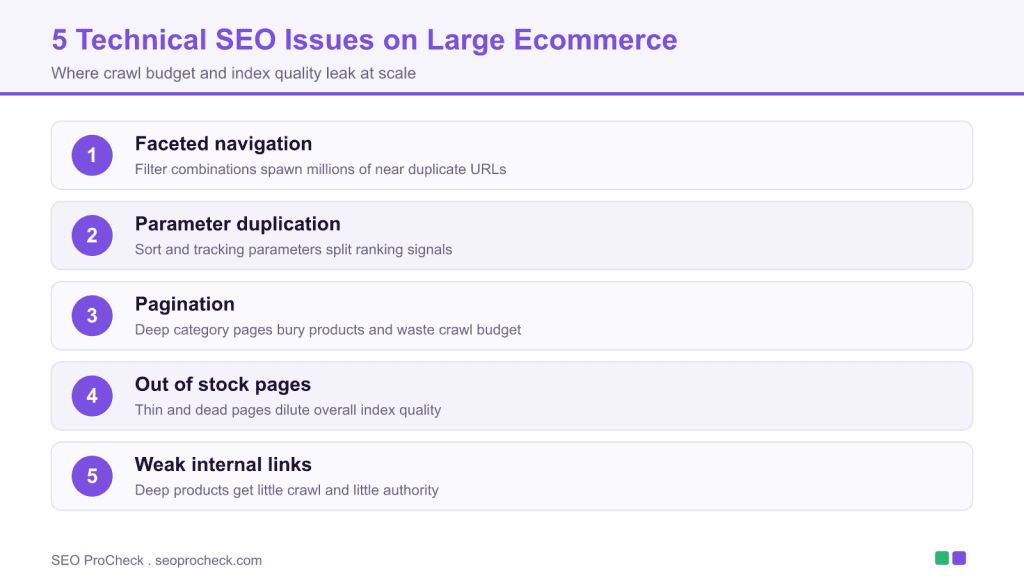
Large ecommerce sites lose organic performance less from content quality and more from scale problems: faceted navigation, URL parameters, pagination, out of stock pages and weak internal linking that together waste crawl budget and dilute index quality. Solving them means controlling which URL variations get crawled and indexed while keeping real products easy to find.
- Faceted navigation can multiply a few thousand products into millions of crawlable URLs.
- Sort and tracking parameters create duplicate URLs that split ranking signals.
- Out of stock and thin pages should be handled deliberately, not left to rot.
- Server log analysis shows where Googlebot actually spends its crawl budget.
Why scale is the enemy on large stores
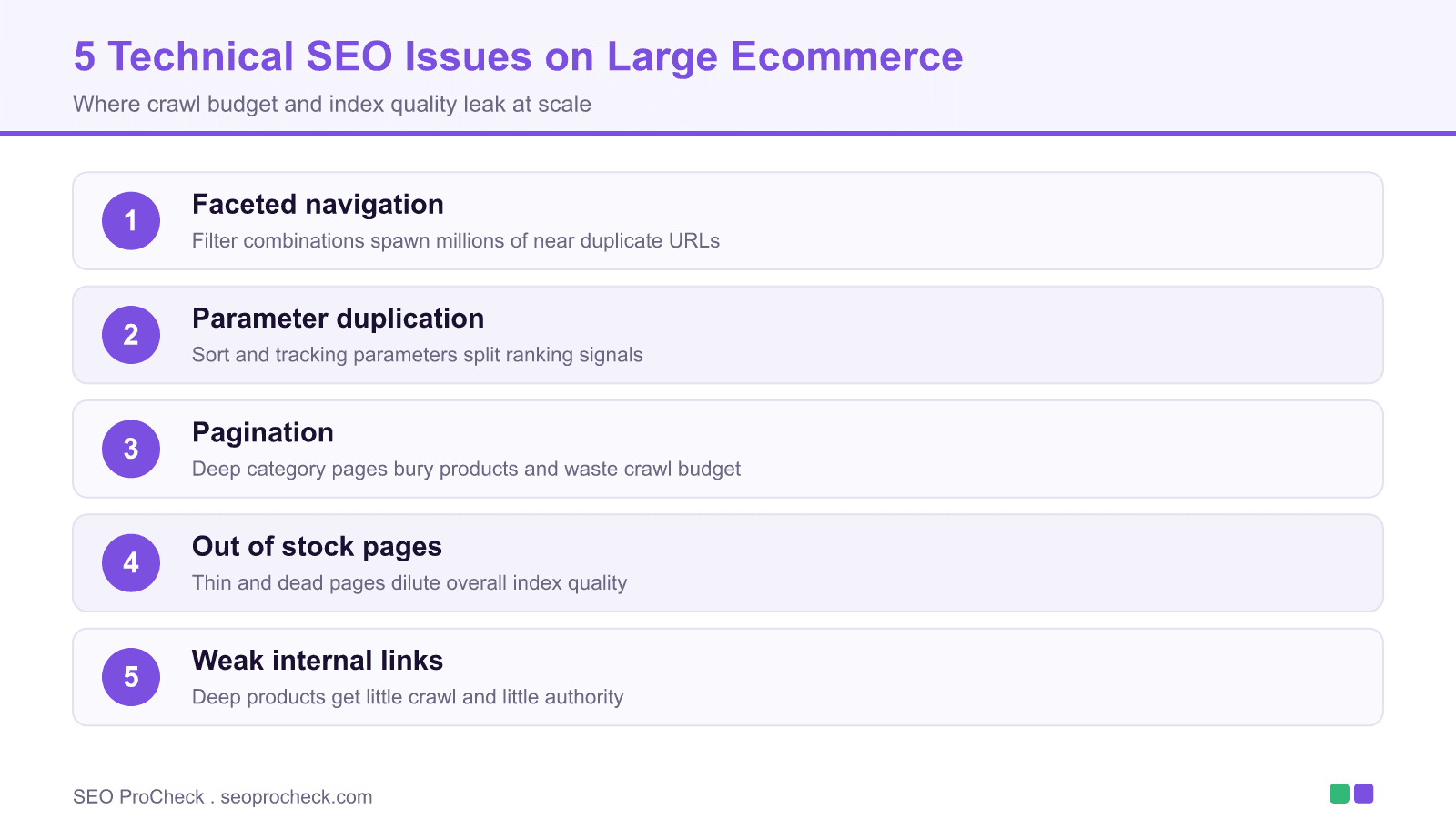
The technical problems that barely register on a small site become critical on a store with tens of thousands of products. The source article, based on JetOctopus crawl and log data, groups the damage into a handful of recurring issues. Each one is really a variation on the same theme: the site generates far more crawlable URLs than it has valuable pages, so Googlebot spends its budget in the wrong places and index quality falls.
| Issue | Symptom | Fix |
|---|---|---|
| Faceted navigation | Millions of filter combination URLs crawled | Canonical to the clean category, block filter params in robots, or noindex thin facets |
| URL parameters | Sort and tracking variants duplicate content | Self reference canonicals, consistent parameter order, avoid linking to parametered URLs |
| Pagination | Deep pages bury products and waste crawl | Self canonical each page, strong category links, consider a view all where practical |
| Out of stock pages | Thin or dead product pages linger | Keep and relist if returning, 301 if replaced, 410 if gone for good |
| Weak internal linking | Deep products rarely crawled | Add hub and related product links, flatten click depth |
Faceted navigation and parameters
Faceted navigation is the biggest offender. When colour, size, price and brand filters combine freely, a category of a few hundred products can generate millions of URLs. Decide which facets have search demand and should be indexable landing pages, and make the rest non crawlable through a mix of canonical tags, robots disallow rules on the filter parameters, and noindex on thin combinations. Keep parameter order consistent so the same selection never produces two different URLs. Google retired its URL Parameters tool in Search Console in 2022, so this control now lives entirely in your own markup and robots rules, which raises the stakes on getting it right. Our robots.txt research covers the disallow patterns in detail.
Pagination, dead pages and internal links
Deep category pagination buries products many clicks from the homepage and consumes crawl on low value list pages. Let each paginated page self canonicalise rather than pointing every page at page one, and strengthen internal links so key products are reachable without deep paging. The extreme version of this problem, where paginated URLs dominate the index, is documented in our pagination case study. Handle out of stock pages by intent: relist products that will return, redirect with a 301 when a product is replaced, and return a 410 when it is gone for good. Finally, treat internal linking as a crawl lever; flattening click depth and adding related product and hub links is often the highest value work, which you can prioritise with an ICE scoring pass. Measuring the effect of all of this comes back to crawl efficacy, covered in our crawl efficacy guide.
Background reference and source
Technical SEO provides the foundation for content visibility. Without proper technical implementation, even excellent content may fail to rank. This resource covers technical considerations that enable search engines to effectively crawl, index, and rank your content.
Crawlability Essentials
Search engines must be able to discover and access your content. This requires proper robots.txt configuration, XML sitemaps, internal linking, and server reliability. Technical barriers to crawling prevent content from entering the ranking competition regardless of quality.
Indexation Optimization
Not all crawled pages get indexed. Ensuring pages provide sufficient unique value, avoiding duplicate content issues, and using canonical tags appropriately help control what gets indexed. Monitoring indexation status through Search Console reveals issues requiring attention.
Performance and Experience
Core Web Vitals and page speed affect both user experience and rankings. Technical optimizations including caching, compression, image optimization, and code efficiency improve performance metrics. These optimizations serve users while sending positive signals to search engines.
This resource provides guidance for building and maintaining the technical foundation that enables SEO success.
Source: https://www.searchenginejournal.com/technical-seo-large-ecommerce-jetoctopus/431955/
Frequently asked questions
What is the biggest technical SEO problem on large ecommerce sites?
Faceted navigation. Freely combined filters can turn a few thousand products into millions of near duplicate URLs, which wastes crawl budget and dilutes the index. Controlling which facets are crawlable and indexable is usually the highest impact fix.
How should I handle faceted navigation URLs?
Decide which filtered views have real search demand and make those indexable landing pages. Make the rest non crawlable using canonical tags, robots disallow rules on the filter parameters and noindex on thin combinations, while keeping parameter order consistent.
What should I do with out of stock product pages?
Handle them by intent. Keep and relist products that will return, 301 redirect to a replacement or parent category when a product is permanently replaced, and return a 410 status when it is gone for good so Google can drop it.
Does Google still have a URL Parameters tool?
No. Google retired the URL Parameters tool in Search Console in 2022. Parameter handling now depends entirely on your canonical tags, robots.txt rules and internal linking, so those need to be correct.
How do I know where crawl budget is being wasted?
Analyse server logs for verified Googlebot requests. They show exactly which URLs and templates Google fetches and how often, which reveals crawl spent on parameters, filters and pagination instead of products.
How does internal linking affect ecommerce SEO?
Internal links control how easily Google reaches deep products and how authority flows through the site. Flattening click depth and adding related product and hub links improves both crawl coverage and rankings for buried pages.
Claude Vincent is a technical SEO consultant focused on crawlability, rendering, and AI-search visibility. He writes the field guides and case studies at SEO ProCheck, with a bias toward the durable, unglamorous work that decides whether search engines and AI answer engines can actually read and cite a site.
About SEO ProCheck
Technical SEO consulting and GEO strategy with 20 years of enterprise experience. Case studies, resources, and tools for search and AI visibility.
Work With Me
Technical SEO audits, GEO strategy, site migrations, and international SEO. Hourly consulting for teams who need hands-on support, not just reports.
Subscribe to our newsletter!





Recent Posts
- Can AI Crawlers Actually Read Your Site? I Measured 400 of the Biggest September 5, 2026
- The Pre-Publish Quality Gate for AI-Assisted Content August 6, 2026
- AGENTS.md vs llms.txt vs llms-full.txt: Which Agent File Does What July 18, 2026