

AI Summary
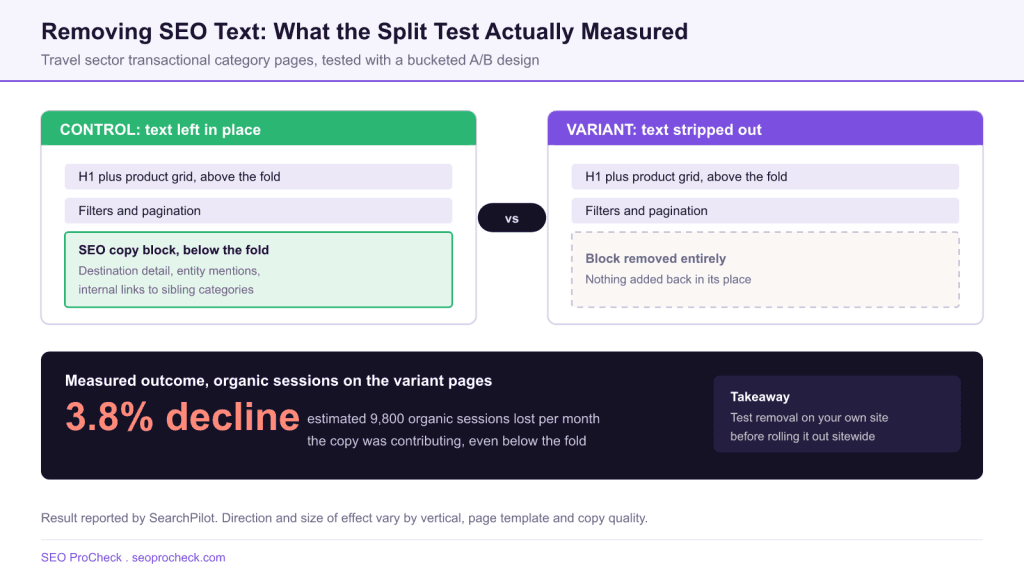
SearchPilot ran an SEO split test that removed the below the fold copy block from travel sector transactional category pages, on the hypothesis that the text was low value keyword stuffing. Organic sessions on the variant pages fell by 3.8 percent, an estimated 9,800 sessions a month, so the copy was contributing to performance despite its position on the page.
- The test removed the copy block outright, it did not replace it with better copy.
- Result: a 3.8 percent decline in organic sessions, roughly 9,800 sessions lost per month.
- SearchPilot advised against blanket removal and noted there are no hard and fast rules across verticals.
- The open question they flagged: was the informational value doing the work, or the mere presence of text?

What was actually tested
The unit of the test was a template, not a page. A group of travel sector transactional category pages was split into two buckets. The control bucket kept the page exactly as it shipped, including the block of SEO copy that sat underneath the product grid. The variant bucket served the identical page with that block deleted. Nothing was added back in its place, which matters enormously when you read the result: this measured the effect of absence, not the effect of replacing mediocre copy with good copy.
The hypothesis came from a widely quoted piece of Google guidance: John Mueller has described boilerplate keyword text pushed below the fold as keyword stuffing. Plenty of teams heard that and concluded the safe move was to delete it everywhere. This test is what happens when you check that assumption instead of acting on it. Organic sessions on the variant pages dropped 3.8 percent, an estimated 9,800 sessions a month, and SearchPilot concluded the text was contributing to search performance even though users largely were not reading it.
Why a below the fold block can still earn traffic
Three mechanisms are plausible, and the test as designed cannot separate them. That ambiguity is the most useful thing about the case study, because it tells you what to test next on your own site.
| Mechanism | What it would mean | How you would test it separately |
|---|---|---|
| Lexical coverage | The copy supplies terms and entity mentions the product grid never contains, so the page matches a wider long tail. | Variant B keeps a shortened block that retains the entities but cuts the padding. If the loss disappears, coverage was the driver. |
| Internal linking | The block carries contextual links to sibling and parent categories, so removal quietly rewires site architecture. | Variant C removes the prose but keeps the links as a styled related categories row. |
| Relevance or quality signal | The presence of substantive text marks the page as more than a bare grid. | Variant D swaps the copy for equivalent length text that is genuinely useful. If performance holds or rises, quality is what matters. |
Test designs implied by the SearchPilot result. None of these are published outcomes, they are the follow up experiments the result invites.
Read the number correctly
A 3.8 percent decline is small in relative terms and large in absolute terms. That combination is typical of template level SEO tests and it is exactly why single page before and after comparisons are useless: a 4 percent swing vanishes inside normal seasonality on any one URL. It only becomes visible when you aggregate hundreds of pages and model the expected traffic for each bucket.
It also cuts the other way. If your category copy is currently 400 words of spun keyword repetition, a 3.8 percent downside from deletion is not a reason to keep it forever. It is a reason to replace rather than remove, and to sequence the change so the replacement ships before the deletion.
A practitioner workflow for auditing category copy
Before you touch a template, get the copy out of the CMS and into a spreadsheet so you can judge it at scale. Screaming Frog custom extraction is the fastest route. Configure it under Configuration > Custom > Custom Extraction, add an XPath rule pointing at the copy container, and export.
# Screaming Frog custom extraction, XPath mode
Name:  seo_copy_text
XPath: //div[contains(@class,'category-seo-copy')]//text()

Name:  seo_copy_links
XPath: count(//div[contains(@class,'category-seo-copy')]//a)

# Export: Bulk Export > Custom > Extraction
# File:   custom_extraction_all.csv
Join that export to Search Console page level data and you can classify every category page in one pass. The columns that decide the verdict are word count, distinct entity count, number of internal links inside the block, and impressions for queries that appear only in the copy and not in the H1 or product names. That last column is the closest thing to a direct measurement of what the block is earning.
| Signal in the export | Verdict | Action |
|---|---|---|
| Fewer than 60 words, no internal links, no unique entities | Dead weight | Rewrite. Deleting it is low risk but gains nothing either. |
| 150 words plus, 2 or more internal links, unique query impressions present | Load bearing | Do not delete. Improve in place and keep the links. |
| 300 words plus, high keyword repetition, no unique query impressions | Genuine stuffing | Replace with shorter specific copy, then measure. Do not delete and leave a gap. |
| Identical text across many categories | Boilerplate duplication | Template the structure, vary the substance per category. |
Classification grid for a category copy audit. Unique query impressions means queries where the matching terms appear only inside the copy block.
If you cannot split test
Most sites cannot. The honest fallback is a staged rollout with a holdback. Pick a coherent slice of the category tree, roughly 20 to 30 percent of pages matched to the rest on traffic band and seasonality, and change only that slice. Leave the remainder untouched as your holdback. Compare the two groups over the same weeks rather than comparing the changed pages to their own past. It is weaker than a bucketed test because the groups were not randomly assigned, but it protects you from the seasonality trap that ruins naive before and after readings.
Whatever route you take, annotate the deployment date in your analytics platform. The single most common reason SEO changes get blamed or credited wrongly is that nobody recorded when they actually went live. Our guide to diagnosing a ranking drop walks through the attribution sequence when several things changed at once.
Where this sits in a wider content programme
Category copy decisions belong inside a repeatable audit rather than a one off cleanup. If you are reviewing large volumes of pages, the process in how to run a content audit that actually moves traffic gives you the scoring model, and index bloat covers the opposite failure mode, where thin category variants multiply faster than anyone can write copy for them. For the extraction and crawl mechanics, see the Screaming Frog advanced usage guide.
The broader lesson from SearchPilot is methodological rather than tactical. Guidance from search engines describes a general risk. It does not tell you the size or even the direction of the effect on your specific template. The teams that win are the ones who convert guidance into a hypothesis and then measure it.
FAQ
It can. In the SearchPilot test cited below, stripping the copy block from travel category pages produced a 3.8 percent decline in organic sessions, an estimated 9,800 sessions a month. That is one test on one template in one vertical, so treat it as evidence that the copy may be load bearing on your site too, not as proof that removal always loses.
Only if it actually is stuffed. Google has repeatedly warned about walls of keyword repetition dumped under the product grid, and that guidance is what prompted this test. Copy that answers real questions, names real entities and links to real sibling pages is not the same artifact, even though it sits in the same place on the template.
Long enough for the model to reach statistical significance, which in practice is usually two to six weeks depending on how much organic traffic the page group receives. Low traffic templates may never reach significance, which is itself a useful signal: if you cannot measure the change, you probably should not make it sitewide.
Yes, if you can serve two versions of a template to bucketed URLs and log the assignment. The hard parts are random bucketing at the URL level, keeping the buckets stable across the whole test, and modelling expected traffic per bucket so you can separate the treatment effect from seasonality. Tools exist because those parts are genuinely fiddly, not because the concept is complex.
Improve it. Replace generic keyword paragraphs with specifics a buyer actually needs: what is included, sizing or seasonality, delivery and returns detail, and links to the closest sibling categories. If layout is the real complaint, move the block or collapse it behind a details element rather than deleting the words.
Nobody knows without testing it. The published result covers travel transactional category pages. Retail listing pages differ in intent mix, competitor copy norms and how much unique product data already sits in the HTML, and any of those can flip the sign of the effect.
Not sure whether your category copy is earning its place?
An advanced audit maps which templates carry load bearing content and which carry filler, before anything gets deleted.
Source: https://www.searchpilot.com/resources/case-studies/removing-seo-text/
Claude Vincent is a technical SEO consultant focused on crawlability, rendering, and AI-search visibility. He writes the field guides and case studies at SEO ProCheck, with a bias toward the durable, unglamorous work that decides whether search engines and AI answer engines can actually read and cite a site.
About SEO ProCheck
Technical SEO consulting and GEO strategy with 20 years of enterprise experience. Case studies, resources, and tools for search and AI visibility.
Work With Me
Technical SEO audits, GEO strategy, site migrations, and international SEO. Hourly consulting for teams who need hands-on support, not just reports.
Subscribe to our newsletter!







Recent Posts
- Can AI Crawlers Actually Read Your Site? I Measured 400 of the Biggest September 5, 2026
- The Pre-Publish Quality Gate for AI-Assisted Content August 6, 2026
- AGENTS.md vs llms.txt vs llms-full.txt: Which Agent File Does What July 18, 2026