

SEO Split-Testing Lessons from SearchPilot: Increasing Internal Linking
- August 4, 2020
- Website Architecture
AI Summary
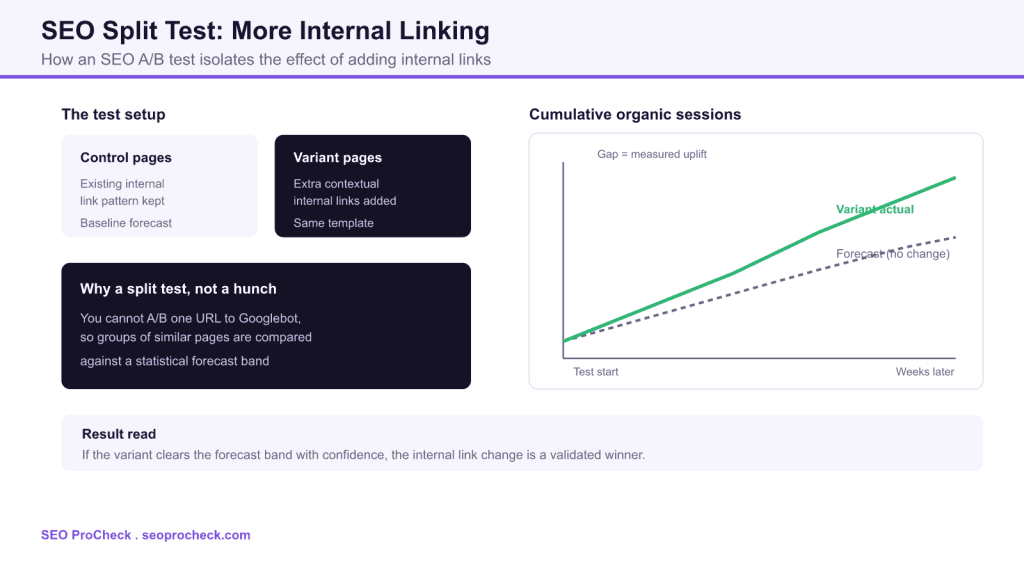
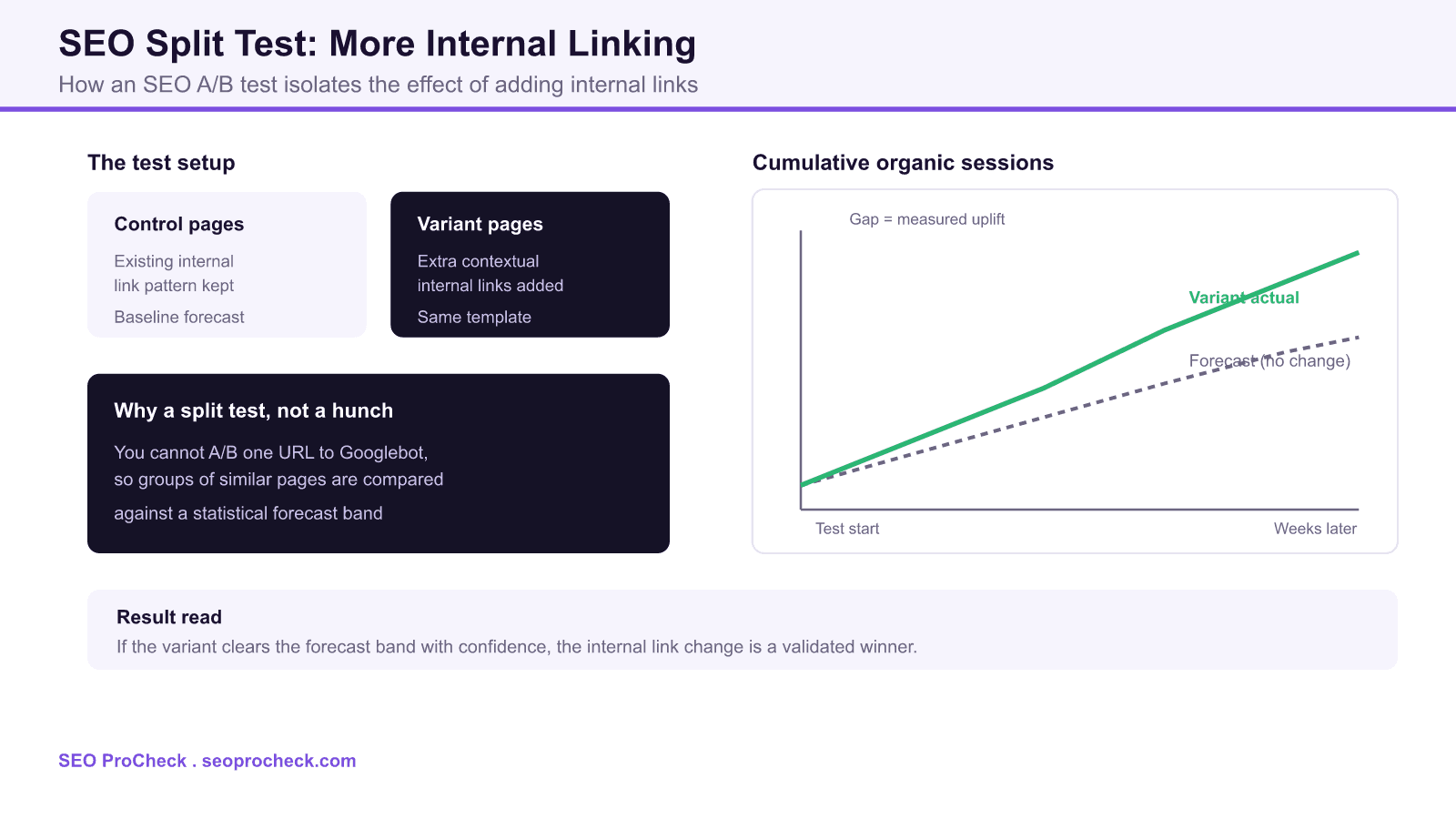
SearchPilot style SEO split tests prove or disprove internal linking changes by comparing a variant group of pages against a statistical forecast of an unchanged control group. The transferable lesson is the method: internal links can lift traffic, but the effect depends on template, link type, and position, so you should measure rather than assume.
- Split similar pages into control and variant groups and change internal links only on the variant.
- Measure the gap between the variant actual traffic and a no change forecast band.
- In-content links generally outperform footer and sidebar links.
- Treat each result as specific to that site and template, not a universal rule.
Link acquisition remains a critical ranking factor. This case study documents effective approaches to earning links that improved domain authority and supported ranking growth.
Link Building Context
Every link building initiative operates within specific constraints: industry, resources, existing authority, and competitive landscape. This case study establishes the context that shaped link building strategy and tactics.
Strategy and Tactics
Sustainable link building requires approaches that earn editorial links rather than manufacture artificial signals. This case study details the specific tactics employed: content-driven outreach, digital PR, resource creation, or relationship building.
Outreach and Execution
Link building requires efficient outreach processes and compelling value propositions. This case study documents outreach methodology, response rates, and relationship development approaches that yielded results.
Impact Assessment
Link building value manifests in domain authority growth, ranking improvements for target keywords, and referral traffic from acquired links. This case study quantifies the impact of link building efforts and their contribution to overall SEO success.
Link building case studies help practitioners understand effective approaches in an increasingly sophisticated link landscape.
What SearchPilot split testing proves about internal links
SearchPilot runs full-funnel SEO A/B tests on large websites, and their published lessons on increasing internal linking matter because they replace opinion with measured cause and effect. Most internal linking advice is asserted rather than proven: add more links, use good anchors, build topic clusters. A controlled SEO split test asks a sharper question. If we add a defined set of internal links to a group of pages and leave a comparable group unchanged, does organic traffic to the changed group actually rise beyond what it would have done anyway. That framing turns internal linking from a belief into a testable hypothesis.
The recurring lesson across these tests is that internal linking changes can move the needle, but the size and even the direction of the effect depend on the template, the type of link, and where the links sit on the page. Adding related links in a prominent, in-content position often behaves differently from adding the same links in a footer or a sidebar module. This is why practitioners should resist copying a single winning test result as if it were a universal law. The method is the transferable asset, not any one percentage.
How an SEO A/B test on internal links works
You cannot serve two versions of a single URL to Googlebot and call it an experiment, so page-level SEO A/B testing works on groups. A platform like SearchPilot takes a set of similar template pages, splits them into a control group and a variant group, and applies the internal linking change only to the variant. It then builds a statistical forecast of what the variant group would have earned in organic traffic had nothing changed, using the control group and historical patterns as the baseline. The measured uplift is the gap between that forecast band and the variant group actual performance over the following weeks. When the actual results sit clearly outside the forecast band, the change is a statistically significant winner rather than a lucky swing.
Turning the lesson into your own linking work
Even without a testing platform, you can adopt the discipline. Define the exact change before you make it: which template, which link module, how many links, and what anchor text. Apply it to one clearly bounded set of pages and hold the rest steady as an informal baseline. Record the date, then track impressions and clicks for both groups in Google Search Console over a multi-week window. If the changed group pulls ahead of the steady group by more than normal week to week variation, you have a credible signal. If it does not, you have saved yourself from rolling out a change that only felt right.
| Internal link change tested | Why it can help | Why it can fail or stay flat |
|---|---|---|
| More in-content related links | Passes equity and helps discovery of deeper pages | Links may be irrelevant or already present elsewhere |
| New footer or sidebar link module | Adds site-wide crawl paths to priority pages | Boilerplate links carry less weight than in-content links |
| Better anchor text on existing links | Clarifies topical relevance for the target page | Effect is small if anchors were already descriptive |
| Links from high-authority hub pages | Routes more PageRank into the targets | Too many links can dilute the value each one passes |
Common misreadings to avoid
The biggest mistake is treating one positive test as proof that more internal links always help. A split test result is specific to that site, template, and change. The second mistake is calling a result too early, before the forecast band has enough data to separate signal from noise. Give the test time, isolate the variable, and repeat it on a different template before you generalize. For the underlying mechanics, start with our internal linking complete guide and the field-tested checklist in 15 internal linking best practices. For related controlled experiments on this lever, compare increasing the number of related article links and adding internal links to the home page footer.
Frequently Asked Questions
What is an SEO split test for internal linking?
It is a controlled experiment that splits a set of similar pages into a control group and a variant group, applies an internal linking change only to the variant, and measures whether organic traffic to the variant rises beyond a statistical forecast. It replaces guesswork with a measured cause and effect signal.
Why can you not A/B test a single page for SEO?
Googlebot sees one version of a URL, so you cannot show it two variants at once the way you can with a conversion test on human visitors. Page-level SEO testing therefore compares groups of similar pages against a forecast rather than two versions of the same URL.
Does adding more internal links always increase traffic?
No. SearchPilot style tests show the effect depends on the template, the link type, and its position on the page. In-content links usually carry more weight than footer or sidebar links, and irrelevant or excessive links can stay flat or even reduce focus.
How long should an internal linking split test run?
Run it long enough for the forecast band to separate the real effect from normal week to week variation, which is typically several weeks. Ending a test early risks reading random noise as a win or a loss.
Can small sites benefit from this method?
Yes, in a lightweight form. Define one change, apply it to a bounded set of pages, hold the rest steady, and compare impressions and clicks in Search Console over several weeks. It is less precise than a testing platform but far better than changing everything and hoping.
What anchor text works best for internal links?
Use descriptive, topically relevant anchors that tell users and crawlers what the destination page covers. Clear anchors reinforce relevance, while generic anchors like read more give search engines little to work with.
Claude Vincent is a technical SEO consultant focused on crawlability, rendering, and AI-search visibility. He writes the field guides and case studies at SEO ProCheck, with a bias toward the durable, unglamorous work that decides whether search engines and AI answer engines can actually read and cite a site.
About SEO ProCheck
Technical SEO consulting and GEO strategy with 20 years of enterprise experience. Case studies, resources, and tools for search and AI visibility.
Work With Me
Technical SEO audits, GEO strategy, site migrations, and international SEO. Hourly consulting for teams who need hands-on support, not just reports.
Subscribe to our newsletter!







Recent Posts
- Can AI Crawlers Actually Read Your Site? I Measured 400 of the Biggest September 5, 2026
- The Pre-Publish Quality Gate for AI-Assisted Content August 6, 2026
- AGENTS.md vs llms.txt vs llms-full.txt: Which Agent File Does What July 18, 2026