

Case Study: The Impact of HrefLang Tag | Seer Interactive
- January 25, 2013
- International SEO
AI Summary
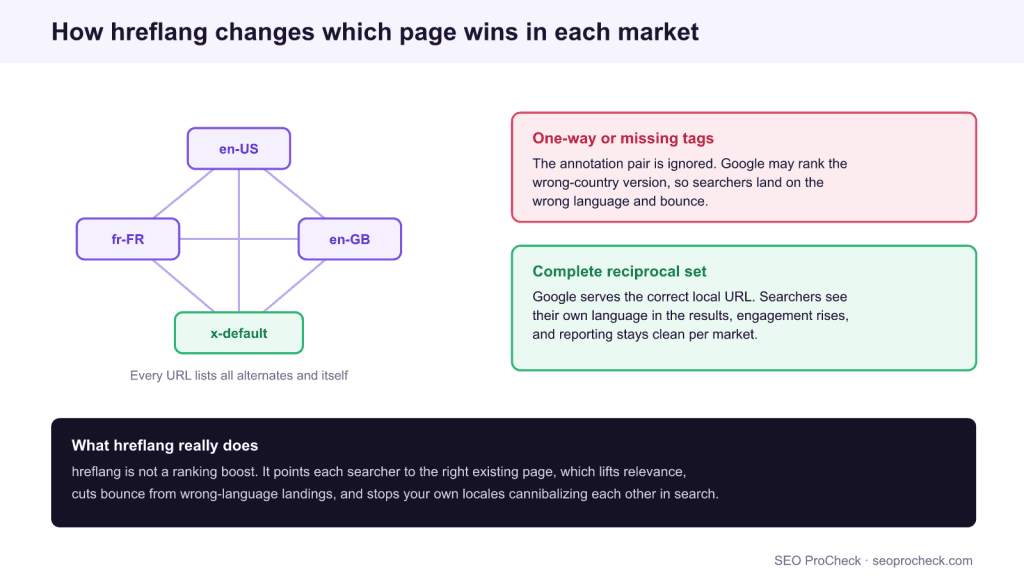
hreflang tells Google which language or region version of a page to show each searcher, so its impact is serving the right existing page rather than boosting rankings. Done as a complete reciprocal set it lifts relevance and engagement in each market and stops your own locales competing with each other; done partially it has no effect at all.
- hreflang is not a ranking factor; it is a serving and canonicalization signal between equivalent language versions.
- It only works reciprocally: if page A links B, page B must link A, or Google ignores the pair.
- Measure the impact per country in Search Console, watching the correct local URL gain clicks in its own market.
- The common impact killers are missing return tags, wrong locale codes, and targets that redirect or carry noindex.

The Seer Interactive case study this page cites tackles a question every international team eventually asks: what does correctly implemented hreflang actually change? The honest answer is subtle, and getting it right is what separates teams that see a return from those who conclude hreflang “does nothing.” hreflang does not push a page up the rankings. What it changes is which of your equivalent pages Google shows to a given searcher, and that single change ripples through relevance, engagement, and how cleanly you can even measure each market.
This guide explains what hreflang does and does not do, how to measure its impact so you can prove it, and the handful of errors that quietly erase that impact. It pairs with our full hreflang and international SEO guide and the sibling case study on JavaScript blocking Google’s view of hreflang, which covers the rendering failure that stops the tags being seen at all.
International SEO presents unique challenges for reaching users across languages and regions. This case study documents successful international expansion strategies that established search visibility in target markets.
International Context
International SEO requirements vary based on target markets, content localization needs, and technical infrastructure. This case study establishes the international scope and specific challenges addressed.
Technical Implementation
International targeting requires proper technical setup: URL structure decisions, hreflang implementation, and Search Console configuration. This case study documents the technical approach that enabled successful international targeting.
Localization Strategy
Beyond technical implementation, international success requires appropriate content localization. This case study covers translation quality, local relevance adaptation, and market-specific content development.
Market Performance
International SEO success is measured by visibility and traffic in target markets. This case study quantifies performance across markets, demonstrating the effectiveness of the international approach.
International SEO case studies help practitioners navigate the complexity of multi-market optimization.
What hreflang actually does, and does not do
hreflang is a set of reciprocal annotations that tell Google a group of URLs are the same content in different languages or regions. When a searcher’s language and location match one of the alternates, Google can swap the result to that version even though a different version earned the ranking. That is the whole mechanism, and it has two important consequences.
First, hreflang is not a ranking boost. Google has been consistent that it is a canonicalization and serving signal, not a positive ranking factor. A page will not rank higher because it has hreflang. Second, because it swaps in the locally-correct URL, its real value shows up as better outcomes on traffic you were already going to get: the French searcher lands on the French page instead of the US one, reads in their own language, and does not bounce back to the results. It also stops your own country versions competing for the same query, a form of self-cannibalization that hreflang is specifically designed to resolve.
How to measure the impact
Because the effect is a swap rather than a lift, you measure it per market, not in aggregate. These are the signals that move when hreflang starts working.
| What to look at | Where | What good looks like |
|---|---|---|
| Clicks and impressions by country | Search Console Performance, filtered by country and page | The correct local URL gains share in its own market |
| Which URL ranks for a market | Performance, compare page plus country | One canonical local URL per market, not several competing |
| Cannibalization between locales | Query and page report across country filters | Two locale URLs stop appearing for the same country and query |
| Engagement on international landings | Analytics, segment by country and landing page | Lower bounce and higher engagement on the matched-language page |
| Coverage of the annotation set | A crawl of the raw HTML for every locale | Every URL lists all alternates and itself, reciprocally |
Give it time. Google has to recrawl both sides of every annotation pair before it honors them, so on a large site the correct URLs regain their markets over weeks, with high-crawl pages correcting first.
The errors that erase the impact
Most “hreflang does not work” verdicts trace to one of these. Each one causes Google to silently ignore the annotation, so the swap never happens and there is nothing to measure.
| Error | Effect | Fix |
|---|---|---|
| Missing return tag (no reciprocity) | The pair is invalid, so Google ignores both sides | Ensure every alternate links back to every other alternate and to itself |
| Wrong language or region code | The annotation is malformed and dropped | Use ISO 639-1 language and ISO 3166-1 alpha-2 region codes, for example en-GB not en-UK |
| Target is a redirect or carries noindex | The signal points at a URL Google will not serve | Point hreflang only at canonical, indexable, 200-status URLs |
| Missing x-default | Unmatched users get an arbitrary version | Add an x-default entry, usually the global or language-selector page |
| hreflang conflicts with the canonical | Google gets contradictory signals and ignores hreflang | Keep each locale self-canonical; never canonical one language to another |
For the specific diagnostics, our checks on unsupported or misconfigured hreflang and conflicting hreflang entries walk through finding and fixing each pattern. When you are ready to implement or move the annotations, the guide on where to declare hreflang compares the HTML, HTTP header, and sitemap methods.
FAQ
No. Google treats hreflang as a canonicalization and serving signal, not a positive ranking factor. It does not raise a page’s position; it changes which equivalent version is shown to a matching searcher.
It sends each searcher to the correct language or region version of a page. That lowers bounce from wrong-language landings, improves engagement in each market, and stops your own country versions cannibalizing each other for the same queries.
Measure per country in Search Console. Filter Performance by country and page and confirm the correct local URL is gaining clicks in its own market, and that two locale URLs stop competing for the same country and query. Segment analytics by country to watch bounce fall on matched-language pages.
The usual causes are missing return tags that break reciprocity, invalid language or region codes, hreflang pointing at redirected or noindexed URLs, or a conflict with the canonical tag. Any of these makes Google drop the annotation silently.
It is strongly recommended. x-default tells Google which URL to serve users whose language or region does not match any alternate, typically a global page or a language selector. Without it, unmatched searchers get an arbitrary version.
Yes, that is one of its main jobs. For near-identical pages such as en-US and en-GB, a complete reciprocal hreflang set tells Google they are locale variants rather than duplicates, so it serves the right one per market instead of picking one and suppressing the other.
Not sure your hreflang is actually being honored?
An international SEO audit crawls every locale, checks reciprocity and codes against the raw HTML, and shows you per-country whether the right pages are winning their markets.
Source: https://www.seerinteractive.com/blog/case-study-the-impact-of-hreflang-tag/
Claude Vincent is a technical SEO consultant focused on crawlability, rendering, and AI-search visibility. He writes the field guides and case studies at SEO ProCheck, with a bias toward the durable, unglamorous work that decides whether search engines and AI answer engines can actually read and cite a site.
About SEO ProCheck
Technical SEO consulting and GEO strategy with 20 years of enterprise experience. Case studies, resources, and tools for search and AI visibility.
Work With Me
Technical SEO audits, GEO strategy, site migrations, and international SEO. Hourly consulting for teams who need hands-on support, not just reports.
Subscribe to our newsletter!





Recent Posts
- Can AI Crawlers Actually Read Your Site? I Measured 400 of the Biggest September 5, 2026
- The Pre-Publish Quality Gate for AI-Assisted Content August 6, 2026
- AGENTS.md vs llms.txt vs llms-full.txt: Which Agent File Does What July 18, 2026