

Google’s Core Algorithm Updates and The Power of User Studies: How Real Feedback From Real People Can Help Site Owners Surface Website Quality Problems (And More)
- July 2, 2019
- Uncategorized
AI Summary
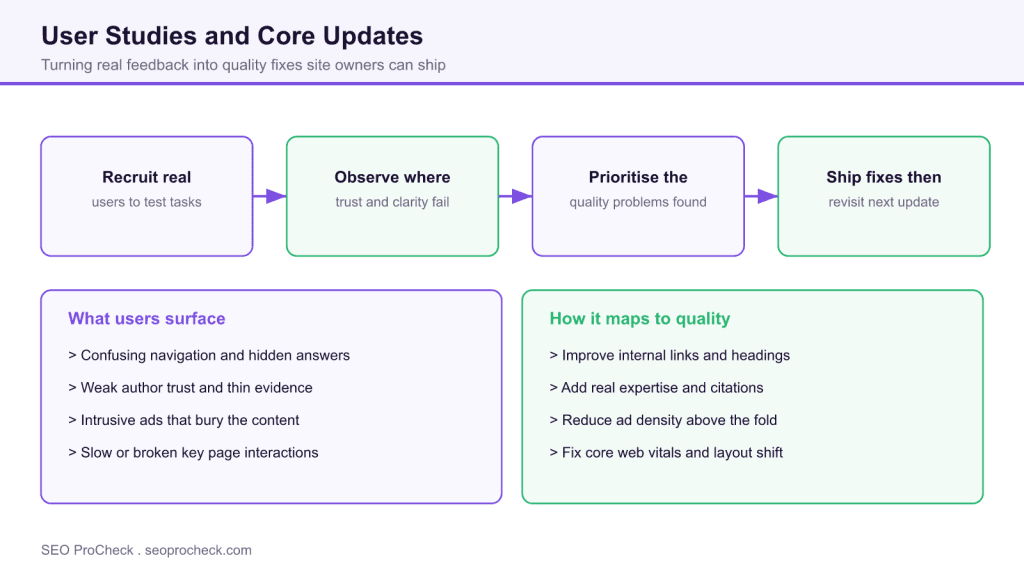
User studies put real people in front of your pages so you can watch where trust, clarity, and task success break down, which is exactly the kind of quality problem broad core updates reward you for fixing. The method turns vague advice about helpful content into a prioritised, testable list of changes.
- Real user feedback surfaces quality problems that analytics alone can hide.
- Findings map cleanly to concrete fixes: navigation, trust, ads, and speed.
- Prioritise by how often an issue blocks the core task on the page.
- Ship fixes, then measure at the next core update rather than expecting instant change.

This SEO case study documents a successful optimization initiative, providing actionable insights for practitioners. The documented approach demonstrates how strategic SEO implementation drives measurable results.
Initial Situation
Understanding the starting point is essential context for evaluating any case study. This documentation covers the initial challenges, competitive position, and business objectives that shaped the SEO strategy.
Strategy and Approach
The strategic approach combined multiple SEO disciplines to address identified opportunities. Key decisions around prioritization and resource allocation provide a template for similar initiatives.
Implementation
Moving from strategy to execution required specific technical implementations, content development, and process changes. This case study documents the practical steps that translated strategy into action.
Results and Learnings
The outcomes demonstrate effectiveness through measurable improvements in rankings, traffic, and business metrics. Analysis of successes and challenges provides learning value for practitioners.
Case studies like this contribute to the SEO knowledge base, helping practitioners learn from documented real-world experiences.
Source: https://www.gsqi.com/marketing-blog/google-core-ranking-updates-user-studies/
Why user studies belong in a core update playbook
Analytics tells you what happened, not why. A user study, even a small unmoderated one with five to ten participants, tells you why. When Google talks about helpful, reliable, people first content, it is describing signals that correlate with real satisfaction. You cannot measure satisfaction directly from a rankings tool, but you can observe it by asking real people to complete a real task on your page and narrate where they hesitate, backtrack, or give up.
The practical value is that abstract guidance becomes specific. Instead of an unactionable note that says improve quality, a study produces observations like: three of five users could not find the answer because it sat below a large ad block, or two users doubted the author because there was no byline or citation. Each of those is a fixable defect with an owner and a due date.
Turning observations into a prioritised backlog
Group what you observe into a few durable buckets, then rank by how badly each issue blocks the core task. The table below is the shape of backlog I hand to a client after a round of testing on a content page.
| Observation | Likely cause | Fix | Priority |
|---|---|---|---|
| Users cannot find the answer | Buried below ads or long intro | Move the answer up, add a summary box, trim the preamble | High |
| Users distrust the source | No author, no evidence, no dates | Add a named author, citations, and a last updated date | High |
| Users get distracted or annoyed | Heavy ad density above the fold | Reduce ad units, delay lazy loaded slots | Medium |
| Users hit friction | Slow load, layout shift, broken filters | Fix core web vitals and the interactive elements | Medium |
Keep the studies cheap and frequent. A quick round before and after a change tells you whether the fix actually helped a human, not just a metric. This is also how you avoid vanity fixes: it is easy to add a schema block or tweak a title, but if users still cannot find the answer, you have not addressed the quality problem that a core update cares about.
What is changed since this case study
Google retired the standalone helpful content system as a separate signal and folded that thinking into its core ranking systems. In practice this makes user research more important, not less, because there is no longer a single switch to blame or wait on. The question is simply whether the page satisfies the person who arrived with a specific need, and the cleanest way to answer that question is still to watch real people use the page.
Remote testing has also become far easier and cheaper, and modern session replay and heatmap tools let you spot rage clicks and dead zones at scale between formal studies. Pair a handful of moderated sessions for depth with lightweight replay data for breadth. When you combine that with the consolidation and content work covered in the copied content domino case, you cover both the technical and the human sides of quality. For the forensic side of diagnosing a sudden drop, the SEO Flatliners case is a useful companion, and the broader pattern of volatility is documented in the September 2019 core update write up.
Frequently asked questions
What is a user study in an SEO context?
It is a structured session where real people attempt a real task on your page while you observe where they hesitate, get confused, or fail. The goal is to surface quality and usability problems that plain analytics cannot explain, so you can fix the reasons a page underperforms.
How many participants do I need for useful results?
You do not need many. Five to eight participants per audience will reveal the majority of serious usability problems. Run small rounds often rather than one large study, so you can test a fix and confirm it actually helped a human.
How do user studies relate to Google core updates?
Core updates reward pages that genuinely satisfy people. User studies give you a direct read on satisfaction, so the fixes they produce, such as clearer answers, visible expertise, and lower ad density, tend to align with what core updates reward.
Can analytics replace talking to users?
No. Analytics shows what happened, such as high exits or short sessions, but not why. A user study explains the why, which is what lets you choose the right fix instead of guessing from a metric.
What fixes usually come out of a study?
The recurring themes are moving the answer higher on the page, adding author and source credibility, reducing intrusive ads, and fixing speed or layout problems. Each is concrete, assignable, and testable in a follow up round.
How soon will rankings improve after I ship fixes?
Usability improves immediately for users, but ranking effects from broad quality signals tend to appear at the next core update rather than instantly. Ship the fixes, keep measuring engagement, and expect search visibility to respond over the following update cycle.
Take this with you
The assistant links open with a question about this page already written. Nothing is sent until you press enter.
Claude Vincent is a technical SEO consultant focused on crawlability, rendering, and AI-search visibility. He writes the field guides and case studies at SEO ProCheck, with a bias toward the durable, unglamorous work that decides whether search engines and AI answer engines can actually read and cite a site.
About SEO ProCheck
Technical SEO consulting and GEO strategy with 20 years of enterprise experience. Case studies, resources, and tools for search and AI visibility.
Work With Me
Technical SEO audits, GEO strategy, site migrations, and international SEO. Hourly consulting for teams who need hands-on support, not just reports.
Subscribe to our newsletter!








Recent Posts
- Most Top Sites Never Say Who They Are in Structured Data October 14, 2026
- Homepage Titles Are Mostly Too Short, Not Too Long October 8, 2026
- Who Actually Serves an llms.txt? 184 Top Sites Measured September 29, 2026