

Google’s Core Algorithm Updates and Copied Content: The Domino Effect of Negative Impact
- September 9, 2019
- Uncategorized
AI Summary
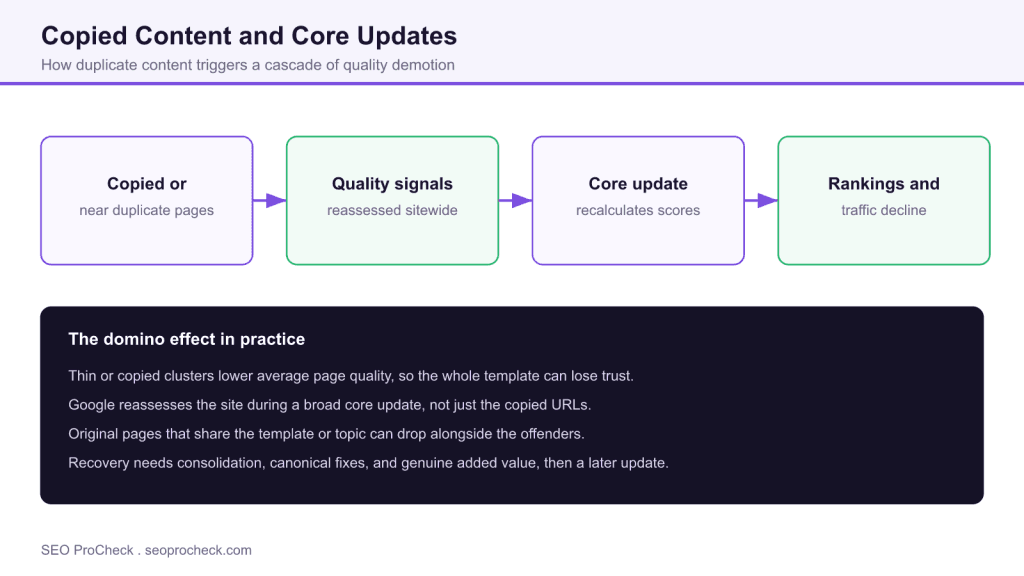
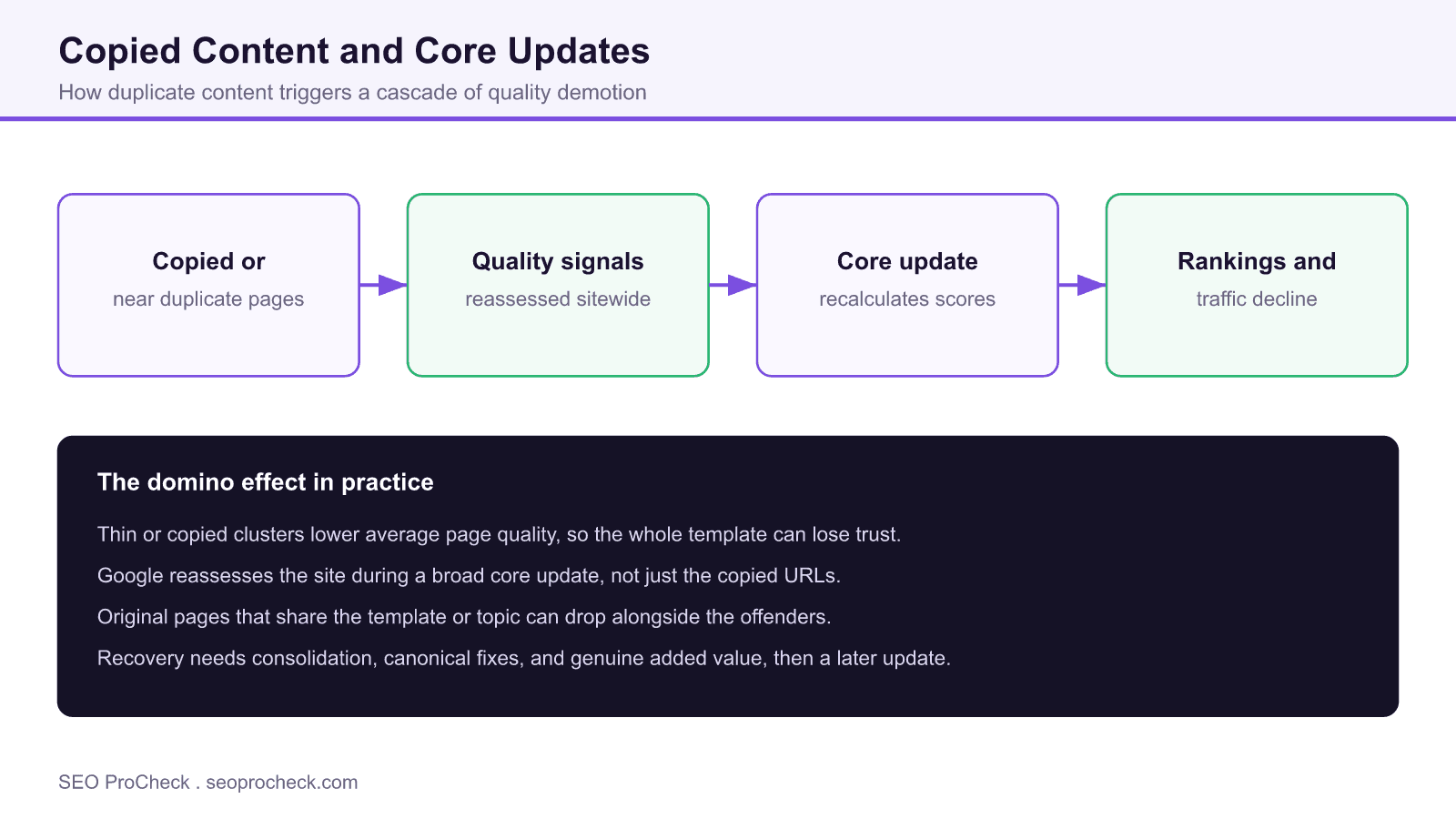
Copied and near duplicate content rarely stays a local problem: during a broad core update Google can reassess quality across a whole template or section, so original pages get pulled down with the copied ones. The fix is consolidation, honest canonicalisation, and real added value, then patience until a later update reweighs the site.
- Core updates reassess sitewide quality signals, not just the offending URLs.
- Duplicate clusters lower the average quality of a template, which is a shared signal.
- Recovery is not instant: changes take effect as core updates run, and Google says its smaller core updates can reflect them before the next major one.
- Canonical tags express a preference, they do not force Google to merge pages.
This SEO case study documents a successful optimization initiative, providing actionable insights for practitioners. The documented approach demonstrates how strategic SEO implementation drives measurable results.
Initial Situation
Understanding the starting point is essential context for evaluating any case study. This documentation covers the initial challenges, competitive position, and business objectives that shaped the SEO strategy.
Strategy and Approach
The strategic approach combined multiple SEO disciplines to address identified opportunities. Key decisions around prioritization and resource allocation provide a template for similar initiatives.
Implementation
Moving from strategy to execution required specific technical implementations, content development, and process changes. This case study documents the practical steps that translated strategy into action.
Results and Learnings
The outcomes demonstrate effectiveness through measurable improvements in rankings, traffic, and business metrics. Analysis of successes and challenges provides learning value for practitioners.
Case studies like this contribute to the SEO knowledge base, helping practitioners learn from documented real-world experiences.
Source: https://www.gsqi.com/marketing-blog/google-core-algorithm-updates-and-copied-content/
Practitioner notes on the domino effect
The pattern this case study describes is one many technical SEOs recognise. A cluster of copied, scraped, or thinly rewritten pages does not sit in isolation. Google evaluates quality at several levels: the individual URL, the template that renders it, the directory it lives in, and the site as a whole. When a broad core update runs, those aggregate signals get recalculated together. That is why a site can lose visibility on genuinely original pages at the same moment its duplicate pages fall, even though the original pages were never the problem.
In day to day auditing, the tell is correlation. Pull a Google Search Console performance export, segment by directory, and look for the date where clicks step down. If the decline lines up with a confirmed core update and spans both the weak cluster and its neighbours, you are almost certainly looking at a sitewide quality reassessment rather than a per page penalty. Manual actions show up in the Security and Manual Actions report, so if that report is empty, treat the drop as algorithmic and plan for the next update cycle.
A worked triage for a copied content problem
Start by inventorying duplication. A crawl in Screaming Frog with near duplicate detection enabled, or a Sitebulb crawl, will surface pages that share most of their body text. Cross reference with a site search and with any syndication partners who may be outranking you for your own words. Then decide, per cluster, whether to consolidate, differentiate, or remove.
| Situation | Signal | Recommended action | Expected result |
|---|---|---|---|
| Exact internal duplicates | Multiple URLs, same body | 301 redirect to one canonical URL, or noindex the extras | Consolidated equity, fewer thin pages |
| Syndicated to partners | Partner outranks you | Ask partners to noindex their copy, or at minimum link back to your original, since Google does not recommend canonical for syndication | Your version is credited as the source |
| Scraped by third parties | Copies appear elsewhere | File a removal request and strengthen your own page | Your page carries the stronger signals |
| Boilerplate heavy pages | Little unique text per URL | Add original analysis, data, and context | Higher average template quality |
A point that trips people up: a canonical tag is a hint, not a command. If your near duplicates carry conflicting signals, such as internal links, sitemap entries, and canonicals that disagree, Google may ignore the canonical you intended. Make every signal point the same way. That means one URL in the sitemap, internal links to the canonical only, and a self referencing canonical on the page you want indexed.
What is changed since this case study
Google has folded what used to be discrete quality tuning into its regular broad core updates, and it now runs several of them each year. The old distinction between a dedicated content quality update and a core update has blurred, so a copied content problem today tends to surface at the next core update rather than at a separate event. Google has also repeatedly said that scaled content produced mainly to rank, whether written by people or machines, is treated as spam under its policies, which raises the stakes for anyone padding a site with lightly rewritten pages.
The recovery timeline has not really changed. Because these signals are recomputed as core updates run, cleaning up duplication remains the realistic path, though Google says you don't necessarily have to wait for a major core update, since it also ships smaller core updates that can reflect improvements. Sites that consolidate aggressively, add genuine value, and hold their nerve tend to see the picture improve at a later update, while sites that only shuffle URLs around without adding value usually do not. For related reading on how these swings play out, see our notes on the May 2020 core update case studies and on the September 2019 core update.
Two more angles from the same body of work are worth pairing with this one: how owners can use direct feedback to find quality problems, covered in the power of user studies, and a forensic look at a sudden demotion in the SEO Flatliners case.
Frequently asked questions
Does copied content cause a Google penalty?
Not usually a manual penalty. Manual actions are rare and appear in Search Console. Far more common is an algorithmic reassessment during a broad core update, where duplicate and thin pages lower the aggregate quality signals for a template or section and rankings fall as a result.
Why did my original pages drop when only some pages were copied?
Google evaluates quality at the template, directory, and site level, not only per URL. A cluster of low value duplicate pages can pull down the average quality that Google associates with the whole area, so pages that were never duplicated can lose visibility alongside the ones that were.
Will a canonical tag fix duplicate content on its own?
A canonical tag is a strong hint, not a guarantee. It works best when every other signal agrees with it: internal links, sitemap entries, redirects, and the self referencing canonical on the preferred page. When those signals conflict, Google may pick a different canonical than you intended.
How long does recovery take after cleaning up copied content?
Recovery is tied to update cycles rather than to a fixed number of days. These quality signals are largely recomputed during core updates, and Google says you don't necessarily have to wait for a major one, because smaller core updates it ships between them can also reflect a cleanup.
Is republishing or syndicating my content risky?
Syndication is fine when it is handled cleanly. Ask partners to block indexing of their copy with noindex, or at least add a clear link back, since Google does not recommend cross domain canonicals for syndicated copies. Without that, a stronger partner site can end up being treated as the source, which weakens your own version.
Should I delete or improve thin duplicate pages?
Improve pages that can carry real unique value, and consolidate or remove ones that cannot. Redirect true duplicates to a single canonical URL, and add original analysis, data, and context to pages that deserve to stand on their own. The goal is to raise the average quality of the section, not just to cut page count.
Take this with you
The assistant links open with a question about this page already written. Nothing is sent until you press enter.
Claude Vincent is a technical SEO consultant focused on crawlability, rendering, and AI-search visibility. He writes the field guides and case studies at SEO ProCheck, with a bias toward the durable, unglamorous work that decides whether search engines and AI answer engines can actually read and cite a site.
About SEO ProCheck
Technical SEO consulting and GEO strategy with 20 years of enterprise experience. Case studies, resources, and tools for search and AI visibility.
Work With Me
Technical SEO audits, GEO strategy, site migrations, and international SEO. Hourly consulting for teams who need hands-on support, not just reports.
Subscribe to our newsletter!








Recent Posts
- Most Top Sites Never Say Who They Are in Structured Data October 14, 2026
- Homepage Titles Are Mostly Too Short, Not Too Long October 8, 2026
- Who Actually Serves an llms.txt? 184 Top Sites Measured September 29, 2026