

AI Summary
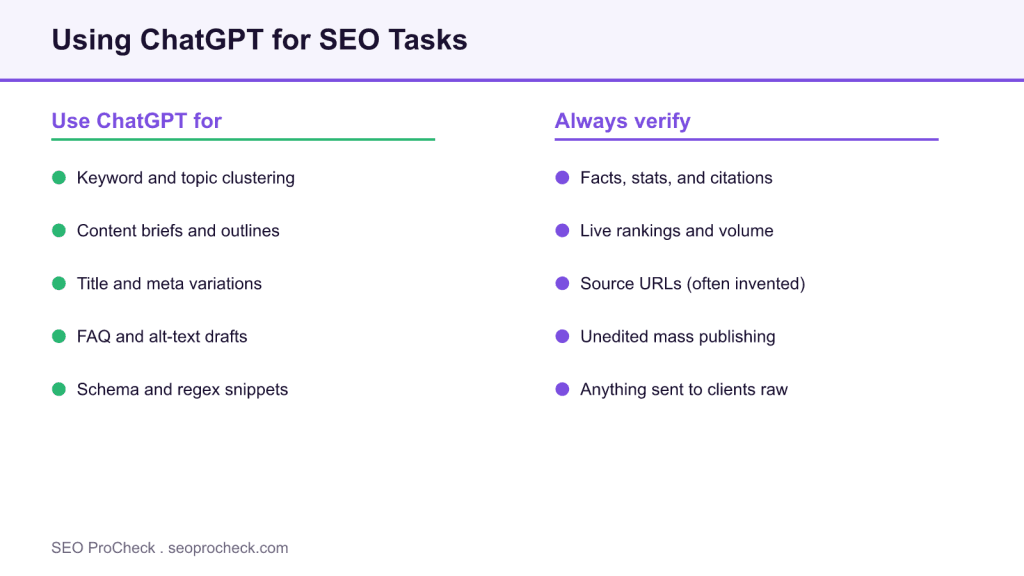
ChatGPT is a strong assistant for the language-heavy parts of SEO: clustering keywords by intent, drafting briefs and outlines, generating title and meta variations, and producing schema or regex snippets. It is unreliable for facts, statistics, live search data, and citations, so every factual claim and source it produces must be verified before you use it.
- Best fit: ideation, clustering, drafting, rewriting, and boilerplate code, where a human reviews the output.
- Never trust it for statistics, studies, quotes, or source URLs; it invents plausible-looking ones.
- Without a browsing tool it has no live ranking, volume, or SERP data; verify anything time-sensitive.
- Do not mass-publish unedited AI text; thin, templated pages invite scaled-content suppression.

ChatGPT is genuinely useful for SEO, but only for the right jobs and only with a human keeping it honest. Its strength is language at volume: turning a messy keyword export into intent-based clusters, drafting a brief, producing twenty title variations, writing valid JSON-LD from a description. Its weakness is truth. It generates fluent, confident text whether or not the underlying claim is real, so it invents statistics, studies, and source URLs that look correct and are not. Used with that distinction in mind, it saves hours. Used without it, it manufactures errors at scale.
This guide splits the work into what ChatGPT does well, what you must always verify, and how to prompt it so the output is worth keeping.
SEO tasks ChatGPT does well
These are the jobs where fluency is the point and a human reviews the result before it ships.
- Keyword and topic clustering. Paste a keyword list and ask it to group terms by search intent (informational, commercial, transactional, navigational) or by topic. It is fast at organizing what you already have, though it should not invent volumes.
- Content briefs and outlines. Give it the target query and audience and ask for an H2 and H3 structure, the questions to answer, and entities to cover. Treat the outline as a starting draft to edit, not a finished plan.
- Title and meta description variations. Ask for ten options under a character limit with the primary term near the front. Pick and refine; do not ship them unedited.
- FAQ and alt-text drafts. It is good at phrasing questions the way users search and at describing an image in a sentence. Verify each answer against reality before publishing.
- Schema, regex, and config snippets. It writes competent JSON-LD, regular expressions for filters, and robots or redirect rules. Always validate the output in the relevant tool, because a subtly wrong regex or schema is worse than none.
- Rewriting and tightening. It reliably shortens, reorganizes, or adjusts the tone of text you already wrote, where the facts are yours and it is only touching the language.
What you must always verify or avoid
The failures below are not occasional; they are how the tool works. Plan for them.
- Facts, statistics, and studies. ChatGPT will produce specific-sounding numbers and cite research that does not exist. Never publish a statistic or study reference from it without finding the primary source yourself.
- Live search data. Without an active browsing tool, the model has no current rankings, search volumes, or SERP layouts. Anything time-sensitive must come from a real data source, not the model’s memory.
- Source URLs and citations. It frequently invents plausible links that 404 or point somewhere unrelated. Check every URL it gives you before including it.
- Unedited mass publishing. Generating hundreds of thin, templated pages is the fastest way to trigger scaled-content suppression. Volume without original value is a liability, not a strategy.
- Anything client-facing sent raw. Deliverables need a human pass for accuracy, brand voice, and the judgment the model does not have.
Task-by-task reference
| Task | Good fit? | How to use it safely |
|---|---|---|
| Cluster keywords by intent | Strong | Provide the list; do not let it invent volumes |
| Draft a content brief | Strong | Edit the outline; confirm intent against the live SERP |
| Write JSON-LD schema | Good | Validate in the Rich Results Test before shipping |
| Cite statistics or studies | Poor | Find and link the primary source yourself |
| Report current rankings | Poor | Use Search Console or a rank tracker instead |
| Publish pages at scale | Avoid | Add original value and edit; never publish raw |
What has changed: browsing, tools, and citations
Two shifts matter. First, ChatGPT can now use a browsing tool to fetch live pages, which reduces but does not remove the accuracy problem: it can still misread or misattribute what it fetches, so verification remains your job. Second, large language models are becoming a discovery surface of their own. Getting your content cited inside AI answers is a discipline in itself, covered under LLM citation optimization and the broader AI and search topic. Using ChatGPT to make content and optimizing to be cited by it are related but separate goals.
Prompting for output worth keeping
Better prompts reduce, though never eliminate, the failure modes. A few habits that help: give it real inputs rather than asking it to recall facts (paste the keyword list, the draft, the data); ask it to mark anything it is unsure of instead of guessing; request structured output (a table, a list) when you will process it further; and always run its factual and code output through a real check. The workflow to trust is prompt, draft, human edit, verify, publish, with the edit and verify steps non-negotiable.
FAQ
Only after a substantive human edit for accuracy, originality, and voice. Google does not penalize AI assistance as such, but it does suppress unhelpful, mass-produced content. Raw, unedited output published at scale is exactly the pattern that gets suppressed, so the editing pass is what makes it safe.
Using it as a drafting and analysis assistant does not hurt SEO. What hurts is the output it enables when unchecked: fabricated facts, invented citations, and thin templated pages. Judgment and verification, not the tool itself, decide the outcome.
It can generate keyword ideas and cluster an existing list by intent or topic, which is useful. It cannot provide reliable search volume or difficulty, because it has no live data unless it browses. Pull the metrics from a real keyword tool and use ChatGPT to organize them.
Because it predicts plausible text rather than retrieving verified facts. A citation that looks real is statistically likely to follow a claim, so it produces one whether or not it exists. This is why every number and link it gives you needs an independent check against a primary source.
Yes, it writes competent JSON-LD for common types from a plain description, which is a real time-saver. Always validate the result in Google’s Rich Results Test and the Schema Markup Validator, because a small structural error can invalidate the whole block.
It is a reasonable starting point for generating variations, but review each one for accuracy and uniqueness before publishing. Bulk-generated descriptions tend to sound the same, so edit them so each reflects its page and reads as something a person would click.
Using AI to scale content the right way?
The line between helpful AI-assisted content and thin scaled pages is where sites get suppressed. An audit shows which side yours is on.
Take this with you
The assistant links open with a question about this page already written. Nothing is sent until you press enter.
Claude Vincent is a technical SEO consultant focused on crawlability, rendering, and AI-search visibility. He writes the field guides and case studies at SEO ProCheck, with a bias toward the durable, unglamorous work that decides whether search engines and AI answer engines can actually read and cite a site.
About SEO ProCheck
Technical SEO consulting and GEO strategy with 20 years of enterprise experience. Case studies, resources, and tools for search and AI visibility.
Work With Me
Technical SEO audits, GEO strategy, site migrations, and international SEO. Hourly consulting for teams who need hands-on support, not just reports.
Subscribe to our newsletter!






Recent Posts
- Finding a Competitor's Sitemap, and Turning It Into a Change Log September 15, 2026
- AI Crawler User Agents: The Current Names, and Which Ones Sites Actually Block September 9, 2026
- Can AI Crawlers Actually Read Your Site? I Measured 400 of the Biggest September 5, 2026