Machine Learning Rank Prediction
- January 20, 2025
- GEO (Generative Engine Optimization), AI and Search
AI Summary
Machine learning rank prediction uses a model trained on past search results to estimate where a page will rank for a query, based on features like relevance, links, and page experience. It is a useful prioritization and forecasting tool, but it models correlation in your own data, not the actual Google algorithm, so its outputs are hypotheses to test rather than guarantees.
- Models learn from features paired with observed SERP positions, then predict positions for new pages.
- Gradient boosting and learning to rank approaches are the common workhorses for this task.
- Prediction reveals which features correlate with ranking in your niche, not universal cause and effect.
- Treat every prediction as a testable hypothesis and validate it against real ranking changes.
Machine learning rank prediction is the practice of training a model to estimate where a web page will appear in search results for a given query. Instead of guessing whether a change will help, you feed a model the measurable features of pages that already rank, let it learn the patterns, and ask it to predict the position of a new or modified page. Done carefully, it turns SEO from opinion into a testable hypothesis. Done carelessly, it manufactures false confidence. This guide explains how these models are built, what they can honestly tell you, and where they mislead.
How a rank prediction model works
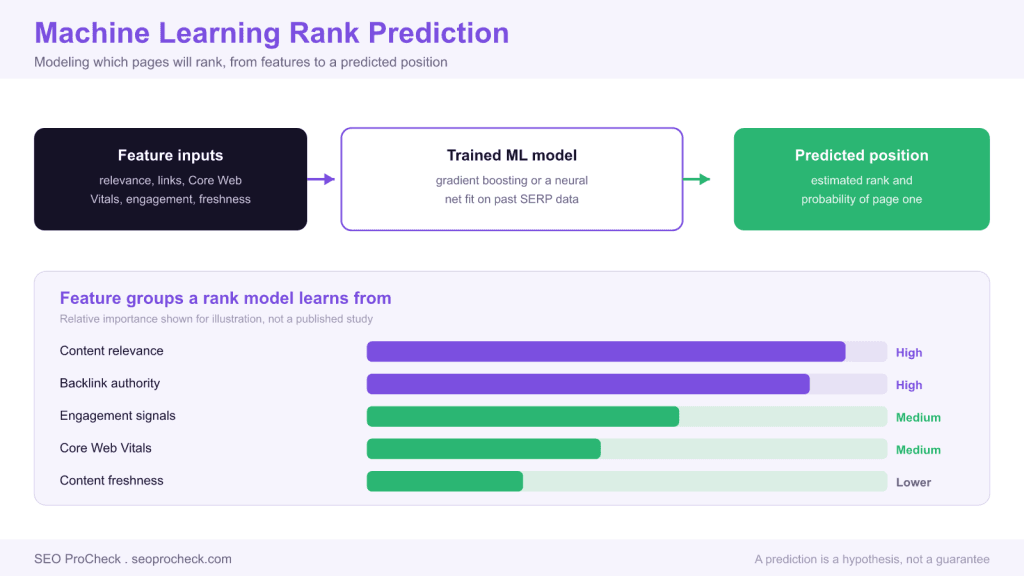
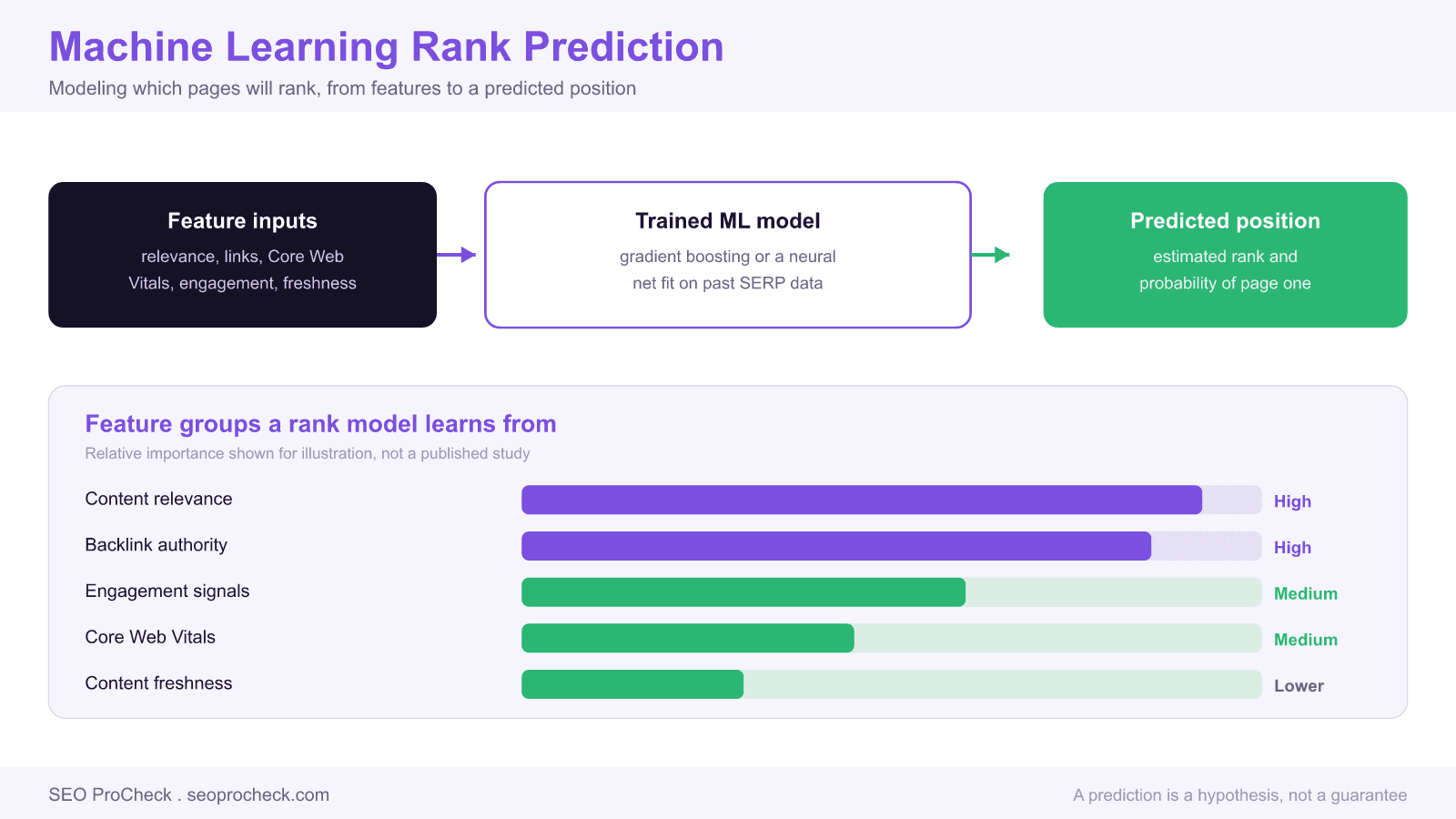
The pipeline has three stages: gather features, train on known outcomes, and predict on new inputs. The training data is a set of URLs for which you already know the ranking position, each described by a vector of features. The model learns the relationship between those features and position, then applies it to pages whose ranking you want to estimate.
The honest framing matters from the start. You are not reverse engineering Google's algorithm. You are building a statistical model of the pages that rank in your specific set of queries, at the time you collected the data. That is genuinely useful, and it is also much narrower than "predicting Google."
The features a model learns from
Features are the measurable inputs. They fall into a few groups, and the model discovers which ones correlate with ranking in your data.
| Feature group | Example signals | How you collect it |
|---|---|---|
| Relevance | Query term coverage, semantic similarity, entity match | Text embeddings, TF style scores |
| Authority | Referring domains, link quality proxies | Backlink APIs |
| Page experience | Core Web Vitals, mobile friendliness, HTTPS | CrUX, PageSpeed Insights API |
| Engagement proxies | Click through rate by position, dwell proxies | Search Console, analytics |
| Content structure | Word count, headings, schema presence | Crawler exports |
Which models are used
Two families dominate practical rank prediction.
- Gradient boosted trees (such as XGBoost or LightGBM) are the common default. They handle mixed numeric and categorical features, tolerate missing values, and expose feature importance, which is often more valuable than the prediction itself because it tells you which signals move with ranking in your niche.
- Learning to rank models are purpose built for ordering. Rather than predicting an absolute position, they learn to order a set of results correctly, which matches how search actually works. Approaches like LambdaMART optimize ranking specific metrics directly.
Simple linear regression is a reasonable starting point for understanding, but it usually underperforms because ranking relationships are non linear and full of interactions between features.
What prediction can honestly do for you
- Prioritize. When you have a hundred pages and limited time, a model that flags which pages are closest to a ranking gain, and which feature is holding each one back, focuses your effort.
- Forecast scenarios. You can estimate the directional effect of adding links or improving Core Web Vitals by changing a feature and re predicting, as long as you treat the result as a hypothesis.
- Surface feature importance. The most durable output is often the ranked list of which features correlate with position in your specific market, which guides strategy even if you never trust an individual position prediction.
The limitations you must respect
This is where most rank prediction projects go wrong. Keep these guardrails.
- Correlation is not causation. A model that finds long content correlates with ranking has not proven that adding words will help. Long content and ranking may both be caused by a third factor, such as topical depth. Never present a correlation as a lever without testing it.
- You are modeling your data, not Google. Google's systems are proprietary, change constantly, and use signals you cannot measure. Your model captures patterns in a snapshot of one niche, nothing more.
- Garbage in, garbage out. Noisy features, biased sampling, or a query set that is not representative will produce confident nonsense. Data quality decides everything.
- Rankings are personalized and volatile. Position varies by location, device, and time, so a single scraped rank is a noisy label. Aggregate before you train.
Building the feature set is itself a data engineering job. Pulling page experience and status data at scale pairs well with bulk URL testing scripts, and understanding real crawl and engagement behavior draws on Python log file parsers. Every feature you feed the model should rest on sound technical SEO measurement.
Rank prediction in the AI search era
As search shifts toward AI Overviews and generative answers, the prediction target is broadening. Practitioners now model not only classic position but the probability of being cited in an AI answer, which is the heart of generative engine optimization. The method is the same: collect features, pair them with observed outcomes, and learn the pattern, but the outcome is inclusion in a generated response rather than a blue link position. The set of crawlers and surfaces to account for keeps growing, which is tracked in the AI crawler map. The enduring discipline is the same across both worlds: a prediction is a hypothesis you validate against reality, not a verdict you act on blindly.
FAQ
It can predict rankings within your own data, not the true Google algorithm. A model learns the statistical relationship between measurable features and observed positions in a specific set of queries at a specific time. That is useful for prioritization and forecasting, but it is a model of your sample, not a copy of Google's ranking systems, which are proprietary and constantly changing.
Common feature groups are relevance signals like query coverage and semantic similarity, authority signals like referring domains, page experience metrics like Core Web Vitals, engagement proxies like click through rate, and content structure like headings and schema. The model discovers which of these correlate with ranking in your data. The exact weighting varies by niche, so importance is specific to your dataset.
Gradient boosted trees such as XGBoost or LightGBM are the usual default because they handle mixed features, tolerate missing data, and expose feature importance. Learning to rank models like LambdaMART are purpose built to order results and often fit the problem better. Linear regression is a fine baseline for intuition but usually underperforms because ranking relationships are non linear.
Not directly, and this is the biggest trap. A model shows correlation, not causation. If it finds that pages with more links rank higher, that does not prove adding links will lift a specific page, because both could stem from a third factor. Use predictions to form hypotheses, then test the change and measure the real result before trusting it.
Enough to represent your queries and reduce noise, which usually means hundreds to thousands of query and URL pairs with reliable position labels. Because a single scraped rank is noisy and personalized, aggregate positions across locations and time before training. A small, clean, representative dataset beats a large, biased one for producing trustworthy predictions.
It extends naturally. Instead of predicting a classic search position, you model the probability that a page is cited in an AI generated answer, which is the core measurement problem of generative engine optimization. The workflow is identical, collect features and pair them with observed outcomes, but the outcome becomes inclusion in an AI response rather than a ranked link.
Want signals worth modeling, not noise?
A rank model is only as good as the technical measurements feeding it. An audit makes sure your crawl, indexing, and page experience data are accurate before you build on them.
Claude Vincent is a technical SEO consultant focused on crawlability, rendering, and AI-search visibility. He writes the field guides and case studies at SEO ProCheck, with a bias toward the durable, unglamorous work that decides whether search engines and AI answer engines can actually read and cite a site.
About SEO ProCheck
Technical SEO consulting and GEO strategy with 20 years of enterprise experience. Case studies, resources, and tools for search and AI visibility.
Work With Me
Technical SEO audits, GEO strategy, site migrations, and international SEO. Hourly consulting for teams who need hands-on support, not just reports.
Subscribe to our newsletter!