

AI Summary
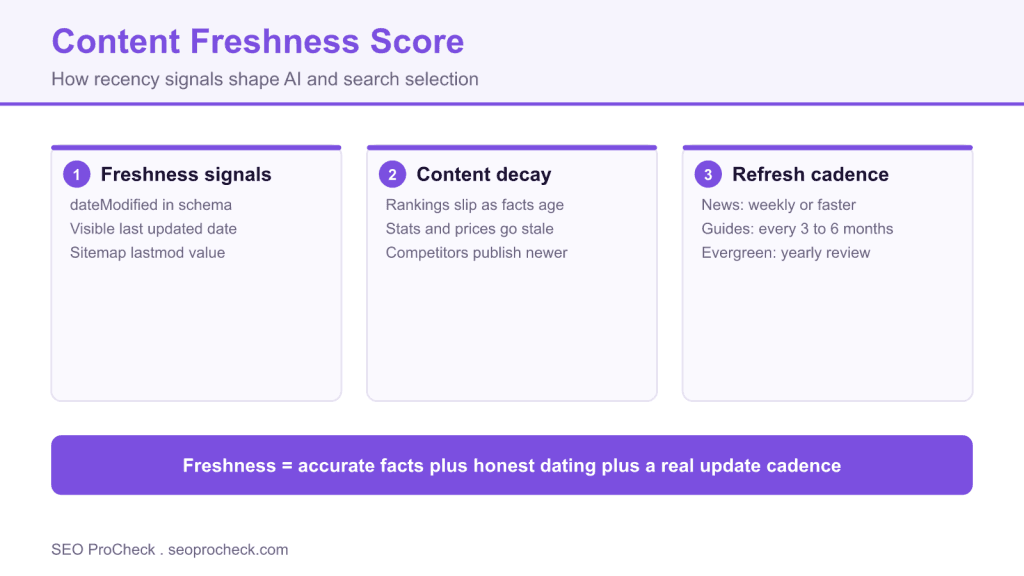
A content freshness score estimates how current a page looks to search engines and AI answer systems, based on how recently it was updated and how accurate its facts still are. You raise it by updating stale data, exposing an honest last updated date, and syncing that date to your schema and sitemap.
- Element code CO-009 in the SEO ProCheck content and GEO audit.
- Three signals feed the score: dateModified in schema, a visible updated date, and sitemap lastmod.
- Content decay is gradual: rankings and citations slip as statistics, prices, and examples age.
- Refresh cadence should match content type, from weekly for news to yearly for evergreen references.
Quick Reference
Element Code: CO-009
Issue: Content is outdated with stale information
Impact: May be passed over for fresher content
Fix: Regularly update content to maintain freshness
Detection: Content age analysis
What Is This Issue?
AI systems often prefer fresh, current content. Outdated content may be deprioritized.
Why This Matters for Your Website
Fresh content signals accuracy. Stale content may contain outdated information.
How to Fix This Issue
- Audit dates: Find stale content
- Update facts: Refresh data
- Show dates: Display update dates
Tools for Detection
- Content audit: Track freshness
AI Search and GEO Considerations
Fresh content is more likely current and accurate.
TL;DR (The Simple Version)
Keep content fresh by regularly updating statistics and facts. Display update dates.
How freshness is actually measured
Freshness is not one number a crawler reads off your page. It is inferred from several signals that should agree with each other. When they disagree, for example a schema dateModified of today but body copy that still cites last year's figures, the mismatch reads as a hollow refresh and the freshness benefit is muted.
The three signals a practitioner controls directly are:
- Structured data: the
dateModifiedanddatePublishedfields on your Article or BlogPosting JSON-LD. Confirm the value with the Rich Results Test or by viewing the renderedapplication/ld+jsonblock. - Visible dating: an on page line such as "Updated 22 July 2026" near the title. Human readers and AI extractors both use it, so it must be truthful.
- Sitemap lastmod: the
<lastmod>value in your XML sitemap. Rank Math and Yoast set this automatically when you save a real change, which is why an empty edit is worse than no edit.
Content decay, and how to spot it before rankings fall
Decay is rarely a cliff. A guide that ranked well slowly loses positions as newer pages cite fresher data and as the facts inside it drift out of date. The practical way to get ahead of it is a decay audit in Google Search Console: compare the trailing 3 months of clicks against the prior 3 months, filter to pages with the steepest percentage drop, and triage those first. Pages losing impressions as well as clicks usually need a genuine content refresh, not just a metadata bump.
A refresh workflow that holds up
The goal is a real update, not a date change. A workflow that survives scrutiny looks like this:
- Reread the page and flag every statistic, price, screenshot, tool name, and year reference that has aged.
- Replace stale facts with current, sourced values. Keep the original citation format so provenance stays intact.
- Add a short "What changed since" note when the topic is time sensitive, so readers and models see the update is substantive.
- Save the post so the CMS writes a fresh
dateModifiedand sitemaplastmod. - Request reindexing in Search Console for high value pages so the refresh is picked up quickly.
What changed since: AI answer engines now weigh recency more visibly than classic blue link search did. When a model has two comparable sources, the one with current figures and a clear recent update date is the safer citation, so freshness has shifted from a nicety to a ranking and citation input.
Reference table
| Content type | Suggested refresh cadence | Primary freshness signal to keep true |
|---|---|---|
| News and trend posts | Weekly or faster | Visible date and dateModified |
| Statistics and pricing pages | Monthly to quarterly | Sourced figures with dates |
| How to guides and tutorials | Every 3 to 6 months | Current tool names and screenshots |
| Evergreen reference and definitions | Yearly review | Accuracy over recency |
Frequently Asked Questions
How often should I update content for freshness?
Match the cadence to the content type. News needs weekly attention, statistics and pricing pages every one to three months, how to guides every three to six months, and evergreen references a yearly accuracy review. Update when facts change, not on a fixed calendar for its own sake.
Does changing the date without editing content help?
No. A date bump with no real change is a hollow refresh. Search engines and AI systems compare the claimed update date against the actual body, and a mismatch produces little or no benefit while risking trust. Always pair a new date with a genuine content change.
What is content decay?
Content decay is the gradual loss of rankings, traffic, and citations as a page ages. Facts go stale, competitors publish newer material, and search intent shifts. You spot it by comparing recent Search Console performance against an earlier period and triaging the steepest declines.
Which schema field controls freshness?
The dateModified property on Article or BlogPosting JSON-LD carries the machine readable update date. Keep it in sync with your visible on page date and your sitemap lastmod value so all three signals agree.
Do AI answer engines care about freshness?
Yes. When a model chooses between comparable sources, current figures and a recent, honest update date make a page the safer citation. Freshness has become a meaningful input for AI answer selection, not only classic search ranking.
Should the last updated date be visible to readers?
Yes. A visible updated date builds reader trust and gives AI extractors a clear recency signal. It must be truthful and reflect a real change, otherwise it undermines credibility for both humans and machines.
Related SEO ProCheck checks
- AI Citation Worthiness Score
- Human vs AI Content Balance
- Structured data checks
- All content and GEO checks
Take this with you
The assistant links open with a question about this page already written. Nothing is sent until you press enter.
Claude Vincent is a technical SEO consultant focused on crawlability, rendering, and AI-search visibility. He writes the field guides and case studies at SEO ProCheck, with a bias toward the durable, unglamorous work that decides whether search engines and AI answer engines can actually read and cite a site.
About SEO ProCheck
Technical SEO consulting and GEO strategy with 20 years of enterprise experience. Case studies, resources, and tools for search and AI visibility.
Work With Me
Technical SEO audits, GEO strategy, site migrations, and international SEO. Hourly consulting for teams who need hands-on support, not just reports.
Subscribe to our newsletter!








Recent Posts
- Most Top Sites Never Say Who They Are in Structured Data October 14, 2026
- Homepage Titles Are Mostly Too Short, Not Too Long October 8, 2026
- Who Actually Serves an llms.txt? 184 Top Sites Measured September 29, 2026