

AI Summary
The Helpful Content Update launched in August 2022 as a site wide signal that rewarded people first content and demoted pages built mainly to rank. In March 2024 it was folded into Google's core algorithm, so there is no standalone HCU anymore, but the signal now runs continuously and is reassessed during ongoing core updates.
- It is a site wide classifier, so a pile of weak pages can drag down your whole domain.
- People first content is written for a real audience with first hand experience or expertise.
- Since March 2024 recovery is gradual across core updates, not a single HCU refresh.
- Raise the floor: improve or consolidate your weakest pages instead of pruning them.

What the Helpful Content Update was, and where it lives now
The Helpful Content Update (HCU) launched in August 2022 as a site-wide signal that rewarded people-first content and demoted sites built mainly to rank rather than to help readers. In March 2024 the helpful content system was folded into Google's core ranking algorithm, so there is no more standalone HCU, but the signal it introduced never went away.
The stakes were severe. Because it was a site-wide classifier, a pile of unhelpful pages could drag down your whole domain, including pages that were genuinely good. Sites hit by the significant September 2023 update saw sweeping traffic losses that did not recover until they addressed content quality across the board.
What "helpful" and "unhelpful" actually meant
Google's framing was people-first versus search-engine-first. Helpful content is written for a real audience, draws on first-hand experience or genuine expertise, and leaves the reader satisfied. Unhelpful content is reverse-engineered from search demand: made to hit a keyword, padded to length, summarizing what others already said, and answering a question the writer never actually explored.
Real example of what it targeted: a site that noticed "best budget headphones" gets searches, then published a thin roundup assembled from other reviews without ever testing a single pair. That is the archetypal search-engine-first page the HCU was built to demote. Compare it to a page from someone who actually used the headphones for a month and tells you what broke.
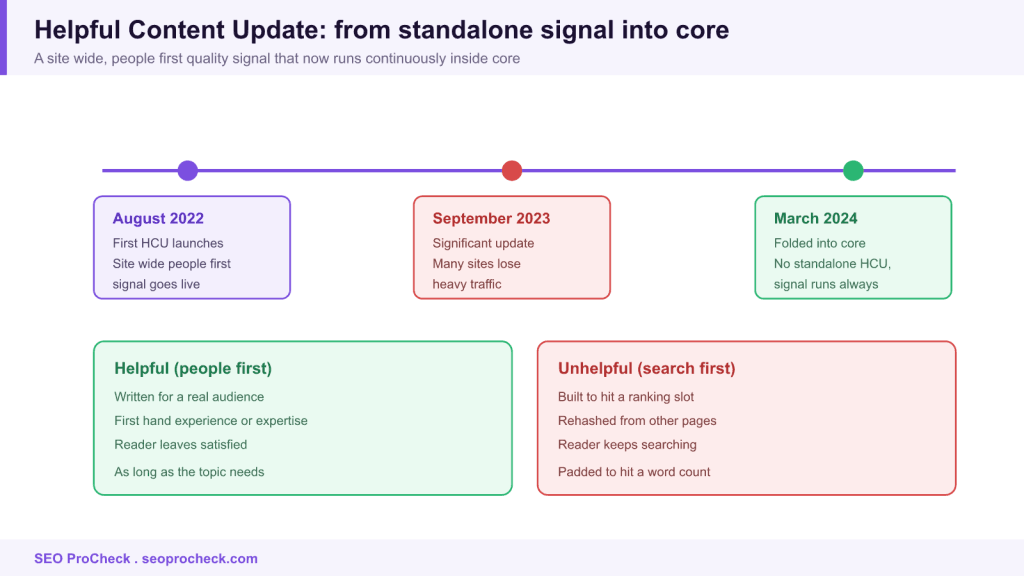
Helpful vs unhelpful signals, and the HCU-into-core timeline
| Dimension | Helpful (people-first) | Unhelpful (search-engine-first) |
|---|---|---|
| Who it is for | A real audience with a real need | A ranking slot |
| Source of the content | First-hand experience or genuine expertise | Rehashed from other pages |
| After reading | Reader feels their question was answered | Reader keeps searching |
| Length and structure | As long as the topic needs | Padded to hit a word count |
| Milestone | Date | What happened |
|---|---|---|
| First HCU | August 2022 | Site-wide people-first signal launches |
| Significant HCU | September 2023 | Large-scale impact; many sites lose heavy traffic |
| Folded into core | March 2024 | Helpful content system becomes part of the core algorithm; no more standalone HCU |
Why "into core" is the most important part
Once the helpful content system became part of the core algorithm in March 2024, quality stopped being a periodic switch and became a continuous part of how Google ranks everything. You no longer wait for an "HCU refresh" to recover. Instead, improvements get reassessed as Google re-evaluates your site during ongoing core updates. That is both good and bad: recovery is no longer gated to one rare event, but there is also no single dramatic moment where a fixed site snaps back. It is gradual.
How to tell a helpful-content problem from a core-quality problem
Since the signal now lives in core, the practical question is not "was it the HCU" but "is this a site-wide quality problem." The tell is the pattern of the drop. If specific weak sections cratered while your strongest, most experience-driven pages held, you likely have pockets of unhelpful content dragging on the domain. If the decline is broad and gradual across even good pages, the site-wide classifier is the more likely culprit, and isolated fixes will not move it.
Either way, the remedy points the same direction: raise the floor. The lowest-quality third of your site does more damage than the top third does good, because this is a site-level signal. Auditing by section, then improving or consolidating the weakest material, is almost always a better use of time than polishing pages that already work. Enrichment beats deletion here because a merged, expanded page keeps the equity that a removed page throws away.
How to respond if helpful-content signals hit you
- Confirm the timing of the drop against known updates using our algorithm update history.
- Audit content site-wide, not page by page. This is a site-level signal, so isolated fixes rarely move it.
- Find the unhelpful pages: thin, rehashed, keyword-first, or clearly written for bots. Follow our recovery steps.
- Improve or consolidate them. Add real experience, remove padding, merge overlapping thin pages.
- Strengthen E-E-A-T by making authorship, experience, and expertise visible.
- Be patient. Because it is in core now, reassessment happens over subsequent core updates, not overnight.
Common mistakes, and how to fix them
- Deleting or noindexing pages in bulk to "prune." This throws away pages that could be improved and rarely addresses the real signal. Fix: enrich weak pages with genuine value first.
- Fixing one page and expecting recovery. The signal is site-wide. Fix: raise quality across the whole site, especially your weakest sections.
- Chasing word count. Padding is a hallmark of unhelpful content. Fix: answer the question fully and stop.
- Adding an author box and calling it E-E-A-T. Signals must reflect real experience. Fix: show first-hand knowledge in the content itself, per our content quality measurement guide.
FAQ
Does the Helpful Content Update still exist?
Not as a standalone update. As of March 2024 the helpful content system is part of Google's core ranking algorithm, so its signal runs continuously rather than as a separate HCU.
Why did my whole site drop, not just some pages?
Because the helpful content signal is site-wide. A large share of unhelpful pages can weigh down the entire domain, including your good pages.
How long does recovery take now?
Since it lives in core, recovery is reassessed during ongoing core updates rather than a single HCU refresh. Expect gradual improvement after genuine, site-wide quality work.
Should I delete unhelpful pages?
Usually no. Improving, merging, or expanding weak pages preserves value that deletion destroys. Reserve removal for pages with no purpose at all.
What does people-first content actually mean?
Content written to satisfy a real reader, grounded in first-hand experience or real expertise, that leaves them feeling their question was answered. See how the helpful content system works.
Claude Vincent is a technical SEO consultant focused on crawlability, rendering, and AI-search visibility. He writes the field guides and case studies at SEO ProCheck, with a bias toward the durable, unglamorous work that decides whether search engines and AI answer engines can actually read and cite a site.
About SEO ProCheck
Technical SEO consulting and GEO strategy with 20 years of enterprise experience. Case studies, resources, and tools for search and AI visibility.
Work With Me
Technical SEO audits, GEO strategy, site migrations, and international SEO. Hourly consulting for teams who need hands-on support, not just reports.
Subscribe to our newsletter!







Recent Posts
- Can AI Crawlers Actually Read Your Site? I Measured 400 of the Biggest September 5, 2026
- The Pre-Publish Quality Gate for AI-Assisted Content August 6, 2026
- AGENTS.md vs llms.txt vs llms-full.txt: Which Agent File Does What July 18, 2026