

JavaScript and AI Search: Why Server-Side Rendering Matters for GEO
- January 5, 2026
- AI Search
AI Summary
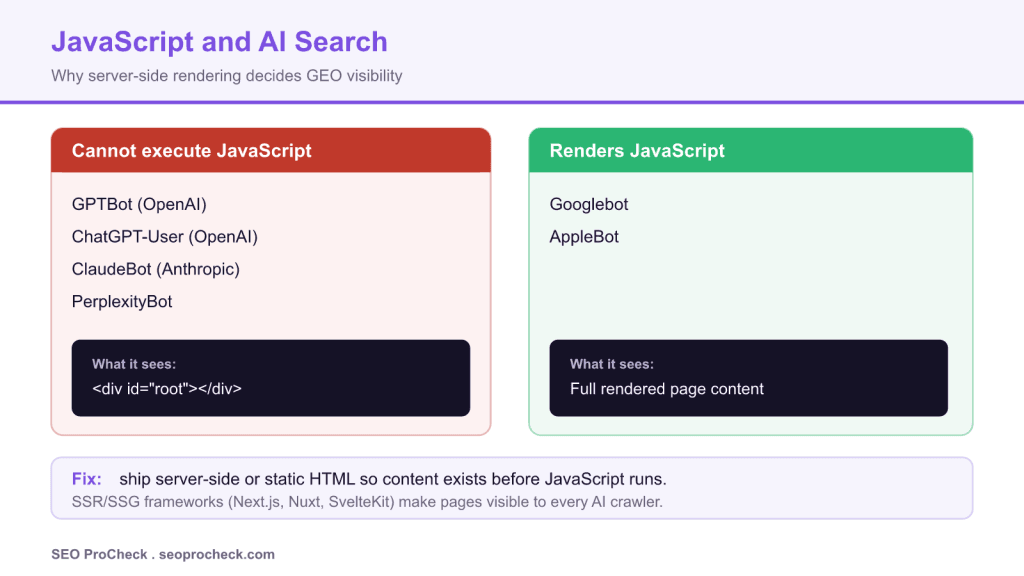
Most AI crawlers, including GPTBot, ClaudeBot and PerplexityBot, cannot execute JavaScript, so any content rendered client-side is invisible to them. Server-side rendering (SSR) or static generation puts your text in the initial HTML, which is what GEO visibility depends on.
- Only Googlebot and AppleBot render JavaScript among major crawlers; the rest read raw HTML.
- Client-side React, Vue or Angular pages can return an empty shell to AI crawlers.
- Fix with SSR (Next.js, Nuxt, SvelteKit), static generation, or a prerender service.
- Embed JSON-LD schema in the server HTML, never inject it with JavaScript.
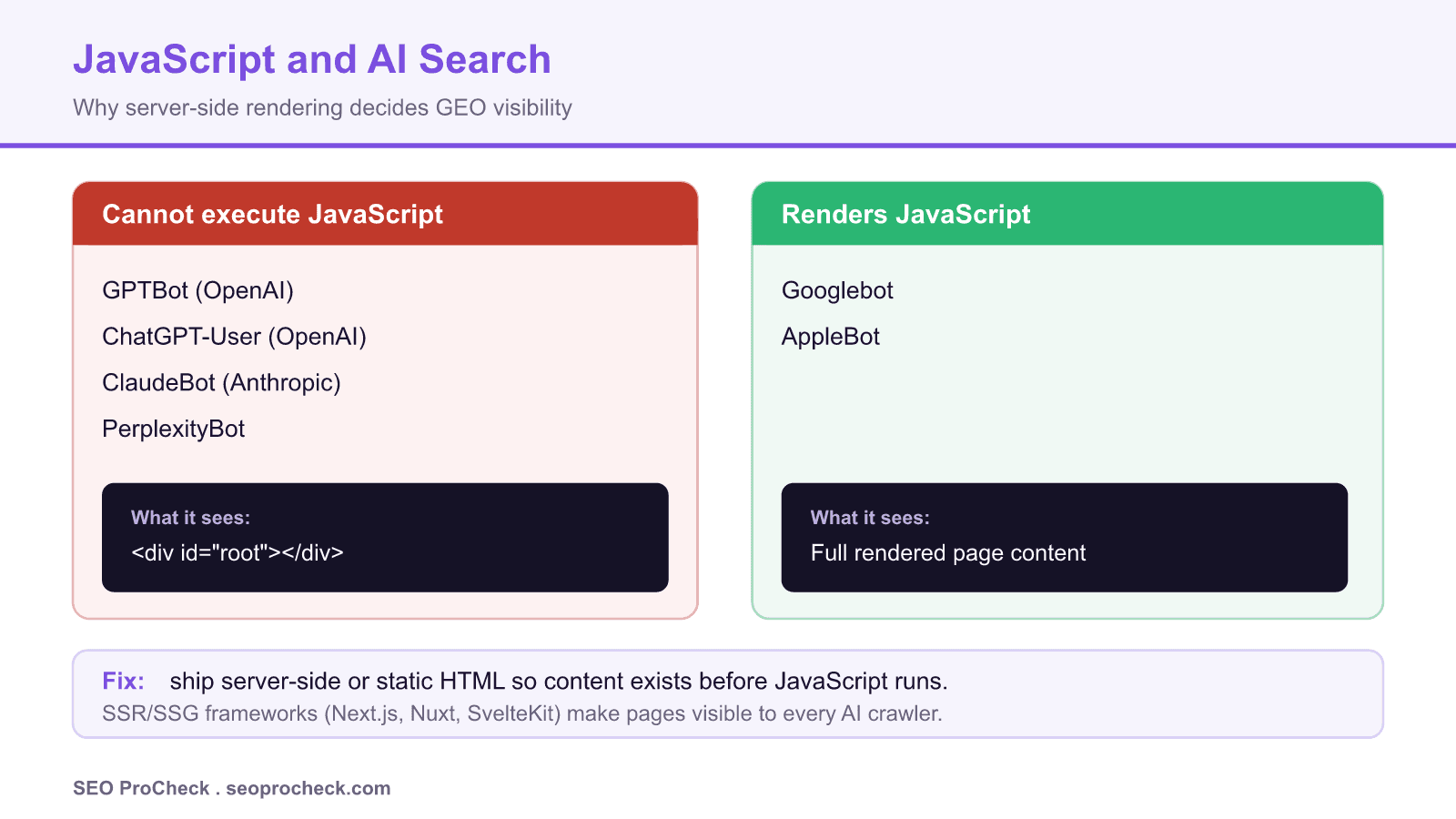
Most AI crawlers cannot execute JavaScript. According to Vercel's December 2024 research, this is the single most important technical factor for AI visibility. Sites using client-side rendering frameworks (React, Vue, Angular) without server-side rendering may be completely invisible to AI search tools.
Why this is the highest leverage GEO decision
Generative engine optimization has a blunt gatekeeper: if the crawler cannot see your words, nothing else you do matters. Keyword targeting, internal linking, and schema all sit downstream of one question, does the content exist in the HTML the crawler receives. For pages built on a client-side framework that answer is often no, and the page contributes nothing to how AI tools source information even when it ranks well in Google.
The practical tell is a mismatch: strong Google rankings (Googlebot renders JavaScript) paired with zero citations in ChatGPT or Perplexity. When you see that pattern, rendering is the first thing to check, before you touch content or authority signals.
AI Crawler JavaScript Rendering Support
| Crawler | JavaScript Rendering | Impact |
|---|---|---|
| GPTBot (OpenAI) | No | Client-side content invisible |
| ChatGPT-User (OpenAI) | No | Client-side content invisible |
| ClaudeBot (Anthropic) | No | Client-side content invisible |
| PerplexityBot | No | Client-side content invisible |
| Googlebot | Yes | Full content access |
| AppleBot | Yes | Full content access |
Source: Vercel: The Rise of the AI Crawler
Key finding: Only Googlebot and AppleBot among AI-related crawlers can render JavaScript. All others see only the initial HTML.
What AI Crawlers Actually See
Vercel's research confirmed that while ChatGPT and Claude crawlers do fetch JavaScript files (11.50% and 23.84% of requests respectively), they don't execute them.
ChatGPT explicitly returns this message for JavaScript-dependent pages: "I cannot read the content of the page because it relies on JavaScript-based rendering."
Example: Client-Side Rendered Page
What users see:
Welcome to Our Restaurant
Menu | Reservations | Private Events
Our award-winning steakhouse has been serving Chicago since 1995...
What GPTBot sees:
The AI crawler sees an empty page because the content is rendered client-side.
The Business Impact
Sites with server-side rendering have significantly higher AI citation rates compared to client-side only sites which show near-zero AI visibility regardless of Google rankings. This affects ChatGPT, Claude, Perplexity, and all AI tools except Google AI Overviews.
What has changed since Vercel published this
Vercel ran its measurements in late 2024. The headline finding has proven durable: through 2025 the major AI crawlers still fetch JavaScript assets without executing them, so client-side content stays hidden. Treat rendering support as a moving target rather than a fixed fact, because vendors update crawler behavior quietly and without announcements.
The safe operating assumption has not changed: build so that content is present in the server response, then verify per crawler with the tests below rather than trusting any published table indefinitely. If a crawler starts rendering JavaScript later, a server-rendered page still works; the reverse is not true.
Solutions for JavaScript Frameworks
1. Server-Side Rendering (SSR)
Render pages on the server before sending to the client. The HTML contains all content.
| Framework | SSR Solution |
|---|---|
| React | Next.js, Remix, Gatsby (hybrid) |
| Vue | Nuxt.js |
| Angular | Angular Universal |
| Svelte | SvelteKit |
2. Static Site Generation (SSG)
Pre-render pages at build time. Best for content that doesn't change frequently:
- Content pages (blog posts, documentation)
- Marketing pages
- Product pages with infrequent updates
3. Hybrid Rendering
Use SSR or SSG for crawlable pages, client-side for interactive features:
- SSG for content pages (AI crawlers can access)
- Client-side for user dashboards, forms, interactive tools
- ISR (Incremental Static Regeneration) for frequently updated content
4. Pre-rendering Services
Services like Prerender.io or Rendertron can serve pre-rendered HTML to crawlers while users get the SPA experience.
How to Test What Crawlers See
Method 1: Disable JavaScript in Browser
- Open Chrome DevTools (F12)
- Press Ctrl+Shift+P (Command+Shift+P on Mac)
- Type "Disable JavaScript" and select it
- Refresh the page
- What you see is what AI crawlers see
Method 2: Use Curl
curl -A "GPTBot" https://yoursite.com/page
This shows the raw HTML without JavaScript execution.
Method 3: View Page Source
Right-click, then View Page Source shows the initial HTML. If your content isn't there, crawlers can't see it.
Schema Markup and JavaScript
Schema markup (JSON-LD) is typically embedded in HTML and doesn't require JavaScript execution. However, if your schema is generated client-side, AI crawlers won't see it.
Recommendation: Always embed schema markup in the initial HTML response, not generated via JavaScript.
Impact on Different Content Types
| Content Type | SSR Priority | Reason |
|---|---|---|
| Blog posts / Articles | Critical | Primary content for AI citation |
| Product pages | Critical | E-commerce visibility |
| Location pages | Critical | Local search + AI visibility |
| FAQ pages | Critical | High AI citation potential |
| User dashboards | Low | Not crawlable content |
| Checkout flows | Low | Not crawlable content |
Frequently asked questions
Does Google AI Overviews require SSR?
No. Googlebot can render JavaScript, so Google AI Overviews can access client-side rendered content. However, ChatGPT, Claude, and Perplexity cannot, so SSR still matters for overall AI visibility.
Is pre-rendering the same as SSR?
Pre-rendering generates static HTML at build time or on demand. SSR generates HTML on each request. Both work for AI crawlers; choose based on how often the content changes.
Will AI crawlers eventually support JavaScript?
Possibly, but JavaScript rendering is resource intensive. For now, assume AI crawlers cannot render JavaScript and plan accordingly.
What about single-page applications (SPAs)?
Pure SPAs without SSR are largely invisible to AI crawlers. Consider migrating to a framework that supports SSR or adding a pre-rendering solution.
How do I test what GPTBot sees without special tools?
Request the page with the crawler user agent, for example curl -A "GPTBot" https://yoursite.com/page, then read the raw HTML it returns. If your main content is missing from that response, the crawler cannot see it either.
Will client-side JSON-LD schema be read by AI crawlers?
No. Schema injected by JavaScript is invisible to crawlers that do not execute scripts. Put your JSON-LD in the initial server HTML so both search engines and AI crawlers can parse it.
Sources
Related Research
- How AI Search Tools Source Information from Organic Search Results
- AI Crawler Comparison: GPTBot, ClaudeBot, PerplexityBot Guide
- Schema Markup for AI Search: FAQPage and Structured Data
Take this with you
The assistant links open with a question about this page already written. Nothing is sent until you press enter.
Claude Vincent is a technical SEO consultant focused on crawlability, rendering, and AI-search visibility. He writes the field guides and case studies at SEO ProCheck, with a bias toward the durable, unglamorous work that decides whether search engines and AI answer engines can actually read and cite a site.
About SEO ProCheck
Technical SEO consulting and GEO strategy with 20 years of enterprise experience. Case studies, resources, and tools for search and AI visibility.
Work With Me
Technical SEO audits, GEO strategy, site migrations, and international SEO. Hourly consulting for teams who need hands-on support, not just reports.
Subscribe to our newsletter!








Recent Posts
- Most Top Sites Never Say Who They Are in Structured Data October 14, 2026
- Homepage Titles Are Mostly Too Short, Not Too Long October 8, 2026
- Who Actually Serves an llms.txt? 184 Top Sites Measured September 29, 2026