

AI Summary
An SEO content calendar is a single source of truth that maps each planned piece to one target query, its intent, a cluster, an owner, a due date, and a status through the pipeline. Building one means gathering topics from keyword and gap research, grouping them into clusters, assigning one primary query per piece to avoid cannibalization, and scheduling both new content and refreshes at a cadence you can sustain.
- Give every row one primary target query so two pieces never compete for the same result.
- Track intent, cluster, format, owner, due week, status, and a refresh date in each entry.
- Balance the calendar across clusters and funnel stages rather than clustering all effort in one place.
- Schedule content refreshes as first class items, not an afterthought, to protect existing rankings.
What a content calendar is for
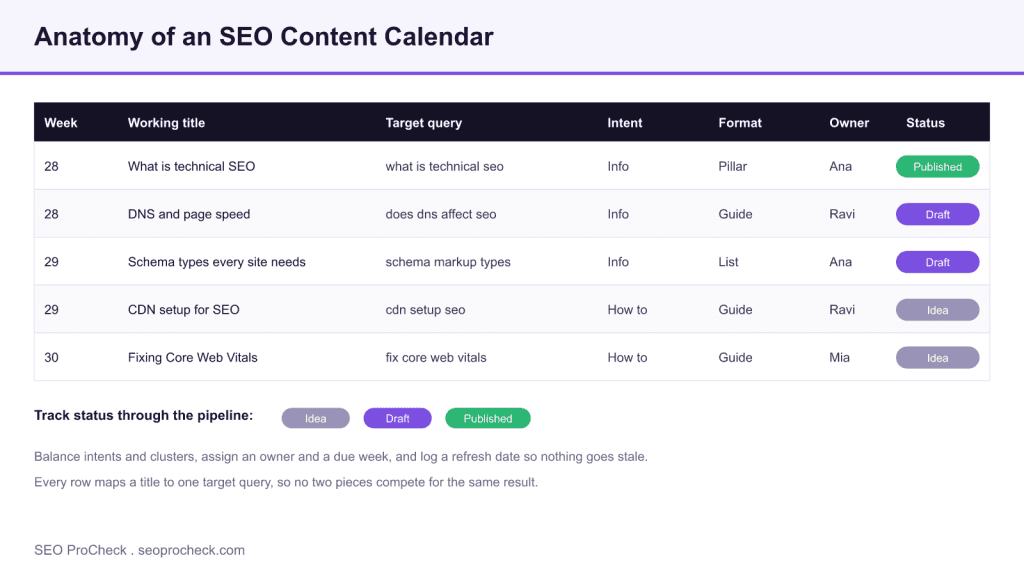
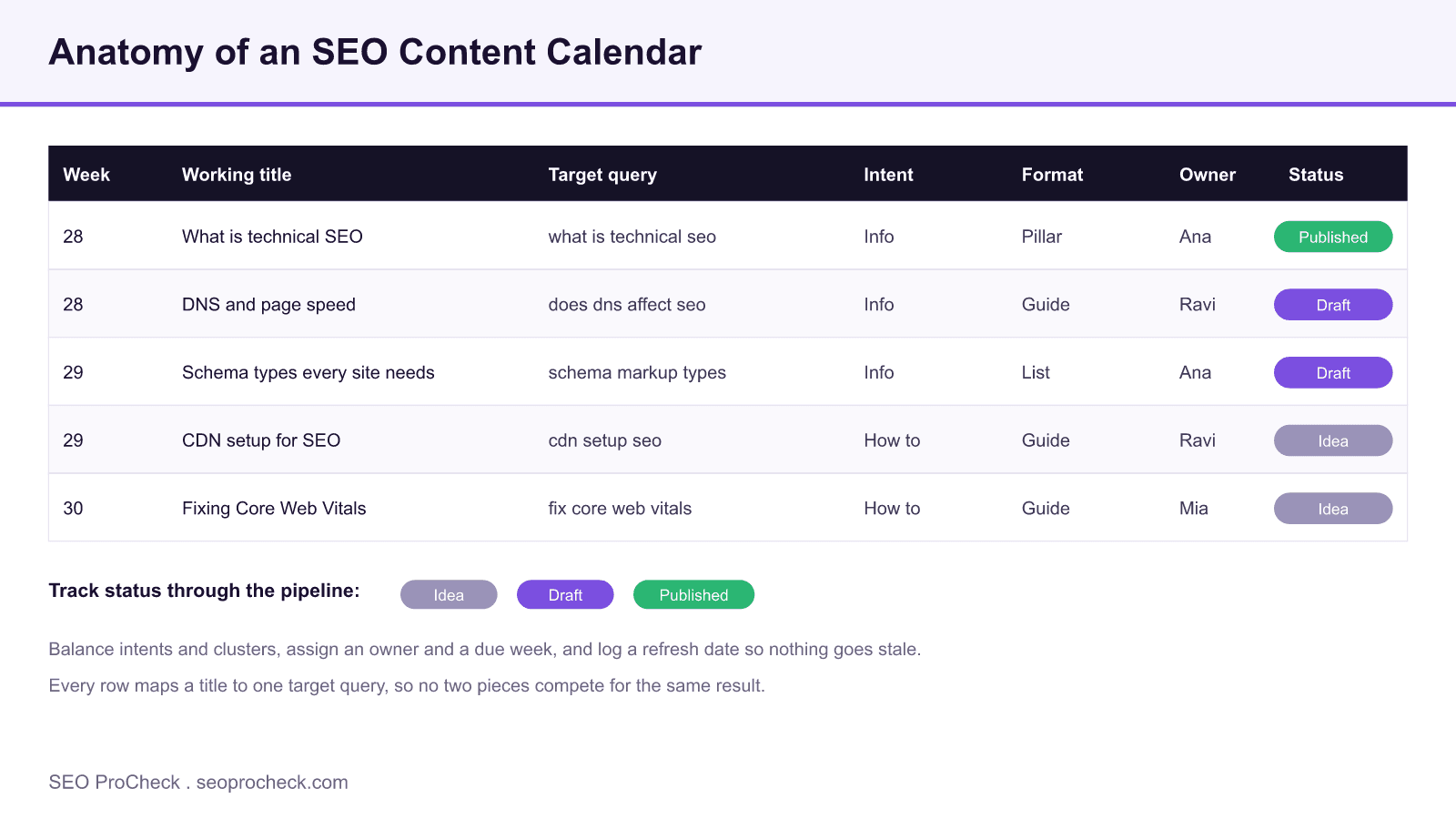
A content calendar is the operating system for an SEO content program. Without one, publishing becomes reactive: someone has an idea, a page ships, and nobody can see whether it fits the strategy, competes with an existing page, or ever gets updated. A good calendar turns that chaos into a plan you can see at a glance. It answers four questions for every piece: what query it targets, why it exists, who owns it, and when it is due. The mock calendar above shows the shape; the value is in the columns, so this guide walks through each one and how to fill it.
The columns that make a calendar useful
A calendar with only a title and a date is a to do list, not an SEO plan. The columns that make it strategic are the ones that tie each piece to search demand and to your production process. At minimum, track the following fields per entry.
| Field | What it captures | Why it matters |
|---|---|---|
| Target query | One primary query per piece | Prevents two pages competing for the same result |
| Intent | Informational, commercial, transactional | Shapes format and internal linking |
| Cluster | Which topic hub the piece supports | Keeps coverage balanced across topics |
| Format | Pillar, guide, list, comparison, tool | Sets scope and production effort |
| Owner | The person accountable | Nothing ships without a named owner |
| Due week | Target publish week | Enforces a sustainable cadence |
| Status | Idea, draft, published | Shows pipeline health at a glance |
| Refresh date | Next scheduled update | Stops winning pages going stale |
The single most important discipline is one primary query per row. When two pieces chase the same query, they split signals and can cannibalize each other, and Google may pick the weaker one to rank. Assigning a unique primary query forces you to decide, before writing, whether a new idea deserves its own page or belongs as a section of an existing one.
How to build it from research to schedule
Start with a topic inventory, not a blank calendar. Pull candidate topics from keyword research, from a content gap analysis against competitors, from your Search Console queries where you rank on page two, and from the questions your sales and support teams hear. Dump everything into one list first; prune second.
Next, group the topics into clusters around pillar pages so the calendar builds topical depth rather than scattered posts. Within each cluster, assign the primary query and the intent, then choose a format that matches: an informational query wants a guide or a definition, a commercial query wants a comparison, and a broad head term wants a pillar. Only after that mapping do you place items into weeks. Sequencing matters: publish the pillar or the foundational pieces first so supporting pages have something to link up to.
Set a cadence you can actually hold. Two well researched pieces a week that ship on time beat five planned pieces that slip, because consistency compounds and a stalled calendar erodes trust in the plan. Leave slack for reactive content and for the refreshes described below.
Balance, and do not forget refreshes
Two failure modes show up in real calendars. The first is imbalance: all effort pours into one cluster or one funnel stage while others starve. Review the calendar each month and check that new pieces are spread across your clusters and across informational, commercial, and transactional intent in the mix your business needs. The second failure mode is treating updates as an afterthought. Existing pages decay as facts change and competitors improve, so schedule refreshes as first class calendar items with their own owner and due week. A refresh that reclaims a slipping top ten ranking is often a better return than a brand new page, so give updates a permanent place in the plan rather than squeezing them in when time allows.
Pick a tool that your team will actually keep updated. A shared spreadsheet works for small teams; a database view in a project tool works better once several people collaborate, because it lets you filter by owner, status, or cluster. The tool matters less than the habit of updating it, so choose the lowest friction option your team will maintain.
A worked example of one planning cycle
Concretely, here is how a monthly cycle runs. In the first week you review performance: pull the queries where you sit in positions five through fifteen, note pages whose rankings or traffic have slipped, and skim the gap analysis for topics competitors cover that you do not. That review produces two lists, new opportunities and refresh candidates. In the second week you turn those lists into calendar rows, assigning each a primary query, an intent, a cluster, a format, and an owner, and slotting them into the next four due weeks with the pillar or foundational pieces first. Weeks three and four are execution: owners draft, editors review, pieces publish, and you move each row from idea to draft to published so the pipeline stays visible.
The cycle repeats, and the calendar becomes a record as well as a plan. Over a quarter you can look back and see how coverage grew across clusters, which owners are overloaded, and whether refreshes are keeping pace with new content. That feedback is what lets you tune the cadence and the balance instead of guessing, and it is the reason a living calendar beats a one off content brief every time.
Connect the calendar to the rest of your strategy
A calendar is only as good as the research and structure behind it. Feed it from a content gap analysis so you plan against real opportunities, and build the clusters it schedules using our evergreen content development framework. As the program grows, the operational side is covered in how to scale SEO operations, and the metrics that tell you whether the calendar is working are laid out in our guide to SEO KPI selection and tracking. Together these turn a list of dates into a system that builds authority on purpose.
Frequently asked questions
How far ahead should an SEO content calendar plan?
A rolling quarter is a practical horizon: detailed for the next four to six weeks and looser beyond that. Planning too far in rigid detail wastes effort because priorities and search demand shift, while planning nothing ahead leaves you reacting. Keep the near term firm and the far term flexible.
How do I avoid keyword cannibalization in my calendar?
Assign one primary target query to each entry and check new ideas against the existing list before adding them. If a new topic overlaps an existing primary query, make it a section of that page rather than a competing page. This single rule prevents most cannibalization at the planning stage.
What should I include in each calendar entry?
At minimum: the target query, the intent, the cluster it supports, the format, an owner, a due week, a status, and a refresh date. Those fields tie each piece to search demand and to your production process, which is what separates a strategic calendar from a simple publishing schedule.
How often should I publish for SEO?
Choose a cadence you can sustain rather than a fixed number. Two well researched pieces a week that ship on time outperform an ambitious schedule that slips, because consistency compounds and a stalled calendar undermines the whole plan. Match the pace to your real capacity.
Should content refreshes go on the calendar?
Yes, as first class items with their own owner and due week. Existing pages decay as facts change and competitors improve, and updating a page that is slipping in the top ten often returns more than a brand new page. Scheduling refreshes protects the rankings you already have.
What tool is best for an SEO content calendar?
The best tool is the one your team will keep updated. A shared spreadsheet is fine for a small team, while a database view in a project tool scales better once several people collaborate because you can filter by owner, status, or cluster. Prioritize low friction over features.
Take this with you
The assistant links open with a question about this page already written. Nothing is sent until you press enter.
Claude Vincent is a technical SEO consultant focused on crawlability, rendering, and AI-search visibility. He writes the field guides and case studies at SEO ProCheck, with a bias toward the durable, unglamorous work that decides whether search engines and AI answer engines can actually read and cite a site.
About SEO ProCheck
Technical SEO consulting and GEO strategy with 20 years of enterprise experience. Case studies, resources, and tools for search and AI visibility.
Work With Me
Technical SEO audits, GEO strategy, site migrations, and international SEO. Hourly consulting for teams who need hands-on support, not just reports.
Subscribe to our newsletter!








Recent Posts
- Most Top Sites Never Say Who They Are in Structured Data October 14, 2026
- Homepage Titles Are Mostly Too Short, Not Too Long October 8, 2026
- Who Actually Serves an llms.txt? 184 Top Sites Measured September 29, 2026