

AI Summary
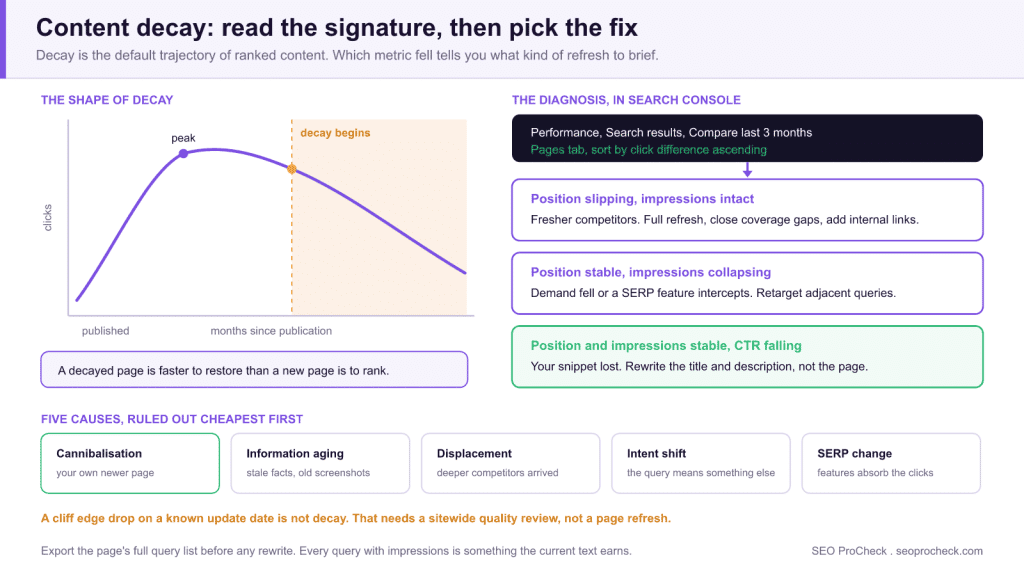
Content decay is the gradual loss of rankings, impressions and clicks on a page that once performed, driven by aging information, fresher competitors, shifting intent or a changed SERP rather than by any penalty. You find it by comparing clicks per URL period over period in Search Console, and you reverse it with a refresh scoped to whichever metric actually fell.
- Three signatures, three different fixes: position loss means competitors, impression loss means demand or a SERP feature, CTR loss means your snippet.
- Rule out self cannibalisation first. It is the cheapest cause to fix and the easiest to miss.
- A decayed page with history, indexed age and backlinks is faster to restore than a new page is to rank.
- Export the page's full query list before any rewrite. Every query with impressions is something the current text already earns.
Quick answer: Content decay is the gradual loss of rankings, impressions, and clicks on a page that once performed: driven by aging information, fresher competitors, shifting search intent, or eroding internal relevance rather than any penalty. You identify it by comparing period-over-period clicks per URL in Google Search Console, and you reverse it with targeted refreshes; a decayed page that once ranked is almost always faster to restore than a new page is to rank.
Understanding Content Decay and Content Updates
Content Updates represents a critical component of modern SEO strategy. As search engines continue to evolve and user expectations shift, understanding the nuances of content updates becomes essential for maintaining and improving organic visibility. This guide covers the key concepts, implementation approaches, and strategic considerations that SEO practitioners need to master.
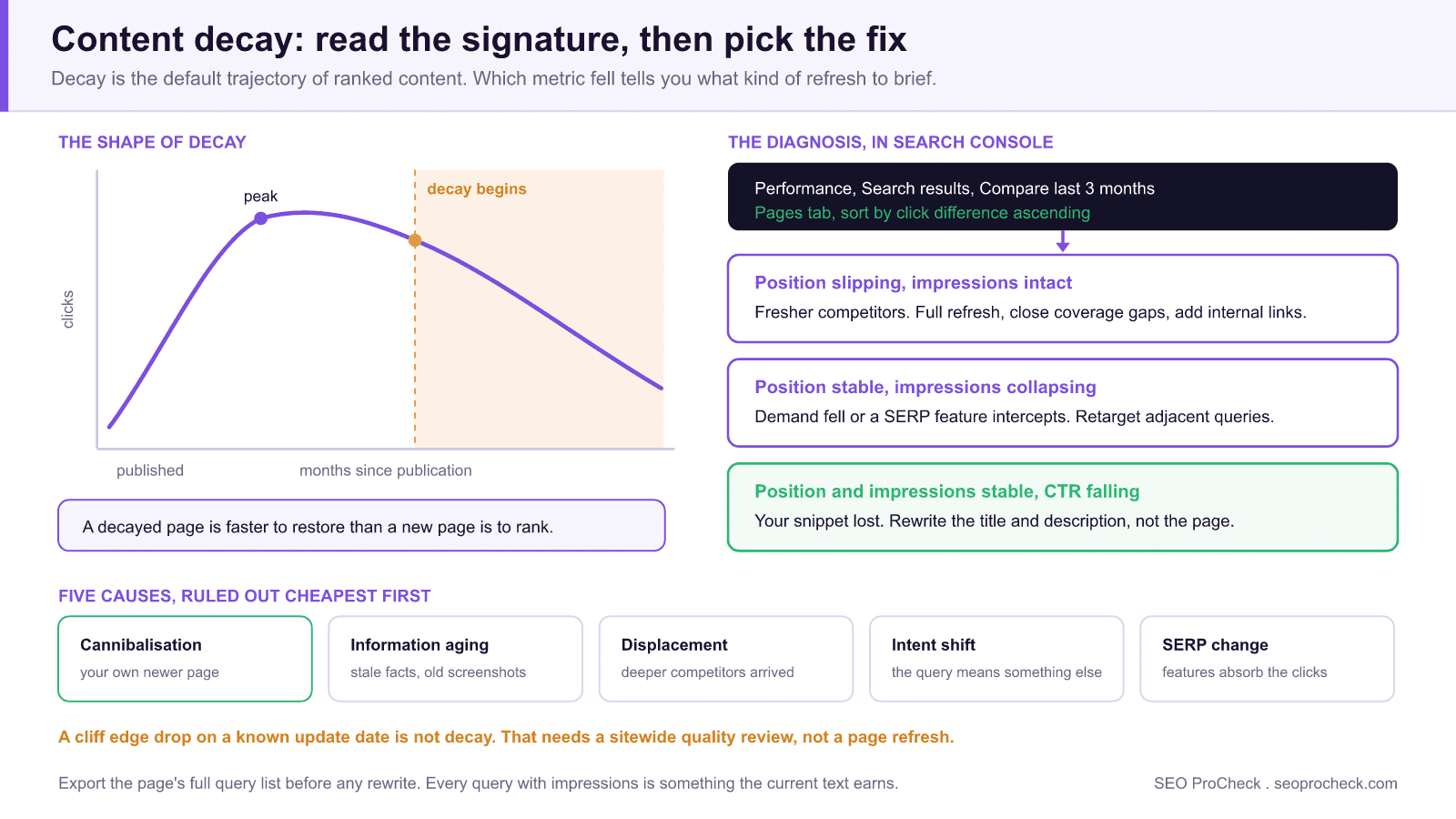
Decay is the default trajectory of ranked content, not an anomaly. A page peaks some months after publication, holds while its information stays current and its SERP stays stable, then bleeds position as any of four forces act on it: the facts age out (screenshots of old UIs, superseded prices, "best tools" lists missing the current leaders), competitors publish fresher and deeper coverage, the query's intent shifts (a term that meant "definition" starts meaning "comparison"), or the SERP itself changes shape: AI Overviews, featured snippets, or video carousels absorbing clicks the page used to get. Diagnosing which force is at work matters, because the fix is different for each. The glossary entry on content decay covers the short definition, and the refresh signals breakdown goes deeper on reading each pattern.
Key Considerations for Content Decay
When approaching content updates, several factors require careful attention. Technical implementation must align with broader SEO objectives while maintaining site performance and user experience. The balance between optimization and over-optimization requires ongoing monitoring and adjustment based on performance data and algorithm changes. Industry benchmarks and competitor analysis provide context for evaluating your own implementation.
The detection workflow lives in Google Search Console. Open Performance > Search results, set the date filter to Compare > Last 3 months vs. previous period (and separately vs. same period last year, to cancel seasonality), switch to the Pages tab, and sort by click difference ascending. The top of that list is your decay queue. On a large site, narrow it first with a regex page filter so you are only reviewing the section you actually own. Then, for each declining URL, click into it and open the Queries tab with the same comparison: falling clicks with stable position but falling impressions means demand or SERP-feature change; falling position across queries means competitive or freshness loss; stable impressions with falling CTR at the same position means your snippet lost against a changed SERP. That one distinction (position loss vs. impression loss vs. CTR loss) tells you what kind of fix to brief.
| GSC signature (period-over-period) | Likely cause | Fix |
|---|---|---|
| Position slipping across many queries, impressions intact | Fresher/deeper competitors outranking you | Full refresh: update facts and examples, close coverage gaps vs. the current top 5, strengthen internal links to the page |
| Position stable, impressions collapsing | Query demand fell or a SERP feature (AI Overview, snippet) intercepts it | Check the live SERP; retarget the page toward adjacent queries that still deliver clicks, or accept the structural loss |
| Position and impressions stable, CTR falling | Your title/snippet lost against a changed SERP | Rewrite title and meta description against what now surrounds you; add dates or specifics that earn the click |
| Cliff-edge drop on a known Google update date | Algorithmic reassessment, not gradual decay | Sitewide quality review, not a single-page refresh; compare hit vs. spared pages for patterns |
| Slow bleed on queries where a newer page of yours also ranks | Self-cannibalization | Consolidate or differentiate the two pages; fix internal anchors pointing at the wrong one |
Implementation Best Practices
Successful implementation begins with thorough auditing of current state and clear goal definition. Document baseline metrics before making changes to enable accurate impact measurement. Prioritize changes based on potential impact and implementation effort, focusing on high-impact items first. Test changes in staging environments when possible, and monitor closely after deployment to production. Maintain documentation of changes for future reference and troubleshooting.
For refresh work specifically, scope the intervention to the diagnosis. A light refresh (2 to 3 hours) updates facts, dates, examples, and the title, and suits pages that slipped a few positions. A structural refresh (a day or more) rebuilds the outline against current SERP intent, adds missing subtopics pulled from the page's own GSC query report, and re-briefs internal links: this is for pages that fell off page one or whose query meaning shifted. In both cases: keep the URL, update dateModified honestly (change the visible date only when changes are substantial), request recrawl via URL Inspection, and log the change date. Changing dates without changing substance is a pattern Google explicitly discounts.
A worked example: a "how to set up GA4" tutorial published in 2023 drops from position 3 to 11 over six months. The Queries tab shows position loss across all query variants: competitive/freshness decay. The refresh: re-shoot the walkthrough against the current GA4 UI, replace deprecated steps, add the three setup questions now appearing in People Also Ask, update the title year, and add links from the site's two newer analytics articles. Recovery to former range within 3 to 6 weeks of recrawl is the typical outcome when the diagnosis was right; no movement in 8 weeks means the diagnosis was wrong: usually intent shift, not freshness.
Scoping the refresh to the diagnosis
The two intervention sizes are not interchangeable, and picking the wrong one is why refresh programmes stall. Match the effort to what the data actually says:
| Light refresh | Structural refresh | |
|---|---|---|
| Effort | 2 to 3 hours | A day or more |
| Trigger | Slipped a few positions, still on page one | Fell off page one, or the query meaning shifted |
| What you change | Facts, dates, examples, title and description | The outline itself, rebuilt against current SERP intent |
| Research needed | A look at the live SERP and the page's query list | Full gap analysis against the current top five, plus the page's own GSC queries |
| Internal links | Leave as they are | Re-brief them: new sections need new entry points |
| Typical recovery | 3 to 6 weeks after recrawl | 6 to 10 weeks, and it is normal to see a dip first |
| If nothing moves in 8 weeks | Escalate to a structural refresh | The diagnosis was wrong. Usually intent shift, not freshness |
Common Mistakes to Avoid
Several patterns consistently cause problems in content updates implementations. Rushing implementation without proper planning leads to errors that can be costly to fix. Ignoring the interplay between different SEO factors creates conflicts that undermine results. Failing to monitor and iterate based on performance data means missing optimization opportunities. Over-optimization signals can trigger algorithmic penalties that take months to recover from.
Decay-specific traps: treating every traffic drop as decay when it's actually seasonality (always compare year-over-year before acting); "refreshing" by swapping the publish date and a paragraph, which does nothing durable; refreshing pages whose queries died: no refresh resurrects search demand for a product nobody searches anymore; deleting decayed pages that still hold backlinks and long-tail rankings instead of rebuilding them; and rewriting a page so aggressively that it loses the exact sections that were still earning long-tail clicks. Before any major rewrite, export the page's full query list from GSC: every query with impressions is something the current text earns, and the new version must keep covering it.
Measuring Success
Effective measurement requires defining appropriate KPIs aligned with business objectives. Track both leading indicators (rankings, impressions, technical metrics) and lagging indicators (traffic, conversions, revenue) to build a complete picture. Establish reasonable timeframes for evaluation, as SEO changes often take weeks or months to fully manifest in results. Compare performance against historical baselines and competitor benchmarks to contextualize results.
For refreshes, measure per URL against its own history: clicks and average position for the 8 weeks after recrawl vs. the 8 weeks before the refresh, on the same query set. Roll it up quarterly as a simple program metric (share of refreshed pages that recovered 80%+ of peak clicks), and use that recovery rate to tune how you diagnose. Teams typically find refresh work outperforms new content on effort-per-click by a wide margin, which is the argument for giving decay work a standing slot in the content calendar rather than treating it as cleanup.
Where refreshes sit alongside merges and removals, and how to budget capacity across all three, is set out in the refresh, prune and merge system. The content refresh entry covers the terminology if you are briefing this to someone new.
Strategic Recommendations
Approach content updates as an ongoing program rather than a one-time project. Build processes for regular auditing, monitoring, and optimization. Stay current with industry developments and algorithm changes that may affect your strategy. Invest in education for team members to build internal capabilities. Consider how content updates fits within your broader digital marketing and business strategy for maximum impact.
A sustainable cadence for most sites: the monthly GSC decliner review (30 minutes, comparison view, Pages tab), a standing rule that some fixed share of content capacity (a common split is roughly one refresh for every two or three new pieces) goes to decay work, and a per-page freshness expectation set by topic volatility: tool tutorials and "best X" lists decay in months, evergreen concept pages in years. Prevention is cheaper than cure: pages built around durable structures with clearly dated, easily-swappable specifics decay slower and refresh faster.
Frequently Asked Questions
What causes content decay?
Four causes cover nearly every case: information aging (facts, screenshots, prices go stale), competitive displacement (fresher or deeper pages outrank you), intent shift (the query starts meaning something else), and SERP-structure change (AI Overviews, snippets, or video absorbing clicks). A fifth, self-inflicted cause (cannibalization by your own newer content) is worth ruling out first because it's the cheapest to fix.
How do I find decaying content in Google Search Console?
Performance > Search results, set Compare to last 3 months vs. previous period, Pages tab, sort by click difference ascending. Cross-check the worst decliners against the same period last year to eliminate seasonality, then open each URL's Queries tab to see whether you lost position, impressions, or CTR: each points to a different fix.
How is content decay different from an algorithm-update hit?
Shape and scope. Decay is a gradual, single-page slide over months; an update hit is a step-change across many pages within days of a confirmed rollout. Check the drop date against Google's update timeline before diagnosing. The remedies differ too: decay wants page-level refreshes, update hits want a sitewide quality assessment: refreshing one page won't move a sitewide reassessment.
Should I update the publish date when I refresh content?
Update the visible date only when the changes are substantial enough that a returning reader would notice: new sections, corrected facts, current examples. Always update dateModified in your Article schema to match reality. Date-bumping unchanged content is a known manipulation pattern; Google cross-checks dates against actual content change and simply stops trusting your dates.
How often should content be refreshed?
By volatility, not calendar. Version-dependent tutorials and "best tools" lists: review every 3 to 6 months. Stats-heavy and trend pages: every 6 to 12 months. Evergreen conceptual pages: check during the annual audit and otherwise leave them alone. The monthly GSC decliner review overrides all of these: refresh when the data says decay started, not when a schedule says it's due.
Can refreshing content recover lost rankings?
Frequently, yes: a page with ranking history, indexed age, and backlinks is starting from a far better position than a new URL. When the refresh matches the actual decay cause, recovery within 3 to 6 weeks of recrawl is common. When nothing moves after 8 weeks, revisit the diagnosis: the usual culprits are intent shift or a SERP-feature change, which no amount of freshness fixes.
Take this with you
The assistant links open with a question about this page already written. Nothing is sent until you press enter.
Claude Vincent is a technical SEO consultant focused on crawlability, rendering, and AI-search visibility. He writes the field guides and case studies at SEO ProCheck, with a bias toward the durable, unglamorous work that decides whether search engines and AI answer engines can actually read and cite a site.
About SEO ProCheck
Technical SEO consulting and GEO strategy with 20 years of enterprise experience. Case studies, resources, and tools for search and AI visibility.
Work With Me
Technical SEO audits, GEO strategy, site migrations, and international SEO. Hourly consulting for teams who need hands-on support, not just reports.
Subscribe to our newsletter!








Recent Posts
- Most Top Sites Never Say Who They Are in Structured Data October 14, 2026
- Homepage Titles Are Mostly Too Short, Not Too Long October 8, 2026
- Who Actually Serves an llms.txt? 184 Top Sites Measured September 29, 2026