

AI Summary
The Google API documentation that surfaced in 2024 gave the SEO community a rare look at feature names inside Google systems, but a documented feature is a hypothesis, not a confirmed ranking weight. This guide keeps the original Moz Whiteboard Friday reference and adds a disciplined testing loop for turning leak signals into evidence instead of speculation.
- Treat leaked feature names as hypotheses to test, never as confirmed ranking factors.
- State a clear, measurable prediction before you change anything.
- Isolate one variable and compare against a matched control so results are attributable.
- Keep what moves your metrics and discard what does not, regardless of the hype.

Testing Ideas From the Google API Leaks: Whiteboard Friday provides valuable insights for SEO practitioners. This resource examines approaches and considerations that can improve organic search performance.
Why a leak is a starting point, not an answer
When internal documentation becomes public, it is tempting to read a feature name and assume it is a lever you can pull. That is a mistake. Documentation shows that a system stores a value, not how much that value counts, when it applies, or whether it even affects ranking. The professional response is to convert interesting names into testable hypotheses, which is exactly the mindset the referenced Whiteboard Friday encourages.
A disciplined testing loop
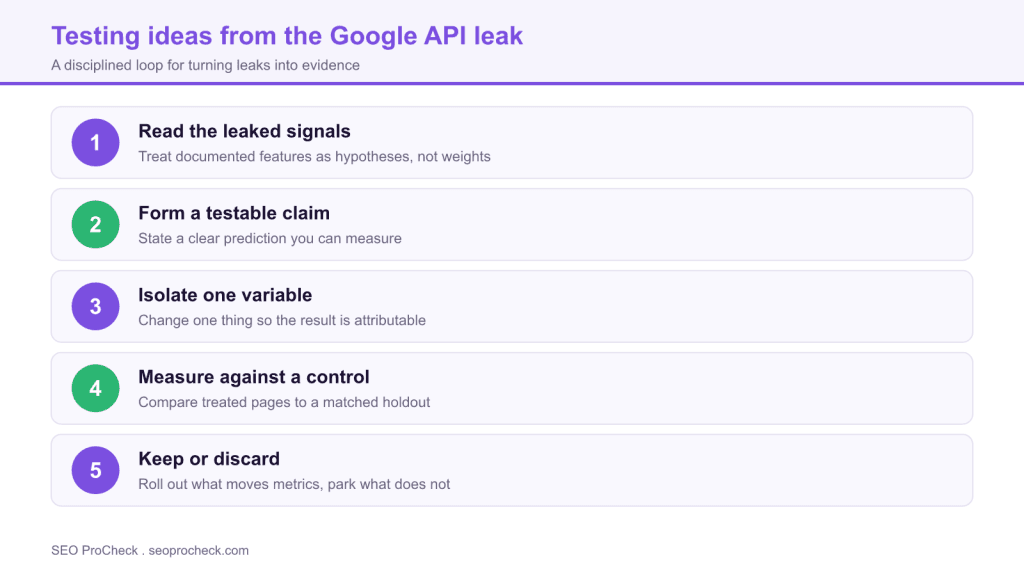
1. Read the leaked signals carefully
Note the themes that keep appearing in coverage, for example click and engagement signals, site level authority, content freshness and link related features. Treat each as a question, not a fact.
2. Form a testable claim
Turn a theme into a prediction you can measure. For example, if freshness is stored, updating and genuinely improving a set of stale pages should improve their impressions relative to comparable pages you leave alone.
3. Isolate one variable
Change one thing at a time. If you rewrite titles, add internal links and refresh content all at once, you will not know which move mattered. This is the same discipline that separates real SEO from the myths marketers believe.
4. Measure against a control
Compare your treated pages to a matched holdout group you did not touch. Without a control you cannot tell your change from a seasonal swing or an algorithm update, which is why controls matter as much here as when you diagnose a ranking drop.
5. Keep or discard
Roll out what reliably moves your metrics and park what does not. One clean win beats a dozen untested theories repeated across the industry.
Common testing mistakes to avoid
Even careful teams undermine their own tests. The first mistake is too small a sample: a handful of pages will not produce a signal you can trust, so test across a group large enough to average out noise. The second is running a test during a volatile period, such as a known algorithm update or a seasonal spike, which contaminates the result. The third is stopping too early, before search engines have recrawled and reassessed the changed pages. The fourth is changing the control group by accident, for example by publishing a site wide template tweak that touches every page. Guard against these by writing the hypothesis, the sample, the metric and the end date before you start, then leaving the test alone until it finishes. Discipline in setup is what makes the conclusion worth anything.
From leak theme to test
| Leak theme discussed in coverage | Testable hypothesis | How to measure |
|---|---|---|
| Click and engagement signals | Better titles that lift click rate help visibility | Compare click rate and position for treated pages |
| Site level authority | Stronger topic depth lifts related pages | Track a cluster before and after against a control |
| Content freshness | Genuine updates help stale pages | Compare refreshed pages to untouched peers |
| Link related features | Relevant internal links help target pages | Add links to one group, hold back a matched group |
| Host and subdomain signals | Structure changes affect a section | Measure the section against the rest of the site |
What has changed since the leak surfaced
The documentation became public in 2024 and set off months of analysis. Since then the useful lesson has settled: the leak did not hand anyone a cheat code, it validated a mindset of testing rather than guessing. The safest takeaways line up with long standing advice, namely satisfy intent, earn engagement honestly and build genuine authority. Anyone selling a guaranteed tactic pulled straight from a field name is overreaching, because a stored feature is still just a hypothesis until your own controlled test confirms it.
Key Concepts
Understanding the fundamental principles behind this topic helps inform strategic decisions. Whether optimizing for traditional search or emerging AI platforms, foundational concepts remain relevant. This resource covers the essential knowledge practitioners need.
Implementation Considerations
Moving from concept to execution requires understanding practical constraints and opportunities. Different situations call for different approaches. This resource provides guidance for applying concepts in real-world contexts.
Measuring Impact
SEO efforts require measurement to demonstrate value and guide optimization. Identifying appropriate metrics, establishing baselines, and tracking progress enables data-driven improvement. This resource addresses how to evaluate success.
This resource contributes to the knowledge base SEO practitioners need for effective optimization in an evolving search landscape.
Frequently asked questions
What was the Google API leak?
In 2024 a large set of internal Google API documentation became public, exposing many feature names inside Google systems. It offered rare visibility, but it did not reveal how those features are weighted.
Do the leaked features confirm ranking factors?
No. A documented feature shows that a value is stored, not how much it counts or whether it affects ranking at all. Each name is best treated as a hypothesis to test.
How should SEOs use the leak?
Turn interesting themes into measurable predictions, test one variable at a time against a control group, and keep only the changes that reliably move your own metrics.
Why do I need a control group?
Because without a matched group of untouched pages you cannot separate your change from seasonality or an algorithm update, so any result is unreliable.
Did the leak change SEO best practice?
Not fundamentally. It reinforced familiar advice: satisfy search intent, earn engagement honestly and build genuine authority, rather than chasing a single leaked signal.
Is it safe to act on a single leaked signal?
No. Acting on an untested field name is speculation. Run a controlled test first, because the same signal can behave differently across sites and query types.
Source: https://moz.com/blog/google-leak-test-ideas-whiteboard-friday
Claude Vincent is a technical SEO consultant focused on crawlability, rendering, and AI-search visibility. He writes the field guides and case studies at SEO ProCheck, with a bias toward the durable, unglamorous work that decides whether search engines and AI answer engines can actually read and cite a site.
About SEO ProCheck
Technical SEO consulting and GEO strategy with 20 years of enterprise experience. Case studies, resources, and tools for search and AI visibility.
Work With Me
Technical SEO audits, GEO strategy, site migrations, and international SEO. Hourly consulting for teams who need hands-on support, not just reports.
Subscribe to our newsletter!







Recent Posts
- Can AI Crawlers Actually Read Your Site? I Measured 400 of the Biggest September 5, 2026
- The Pre-Publish Quality Gate for AI-Assisted Content August 6, 2026
- AGENTS.md vs llms.txt vs llms-full.txt: Which Agent File Does What July 18, 2026