


AI Summary
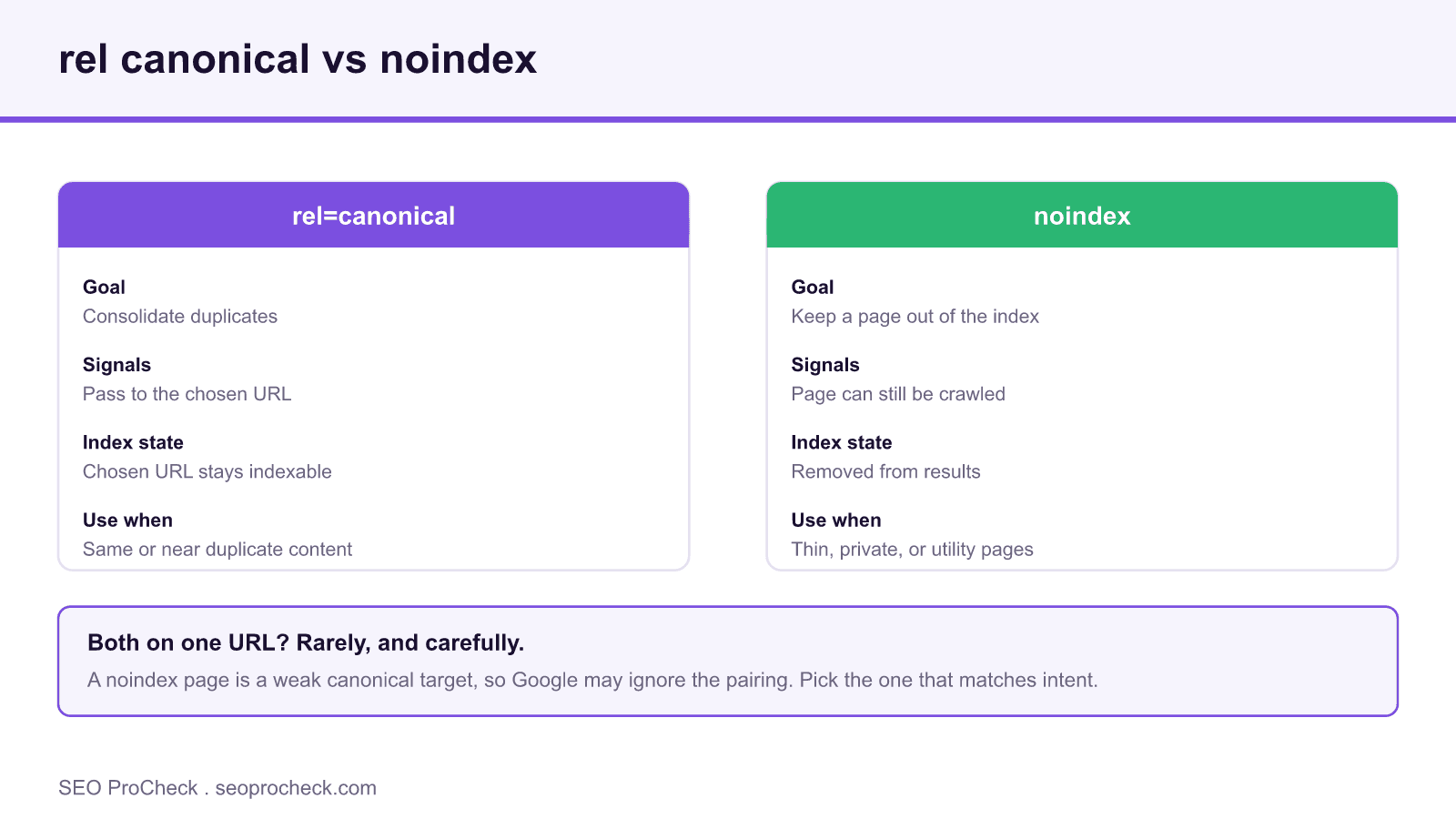
Use rel=canonical when you have duplicate or very similar pages and want to consolidate their ranking signals onto one preferred URL that stays indexable. Use noindex when you want to keep a page out of search results entirely, and avoid putting both on the same URL, because a noindexed page makes a poor canonical target.
- Canonical consolidates duplicates and passes signals to the chosen URL.
- Noindex removes a page from the index while leaving it crawlable.
- Combining both on one URL sends conflicting signals and is rarely correct.
- They solve different problems: deduplication versus suppression.
When To Use Rel Canonical Or Noindex ...Or Both provides valuable insights for SEO practitioners. This resource examines approaches and considerations that can improve organic search performance.
What each tag does
A rel=canonical tag names the preferred version among duplicate or near duplicate pages. It tells Google to consolidate signals onto the chosen URL and to index that one, while the duplicates step aside. Importantly, canonical is a hint, not a strict command, so Google can pick a different canonical if the signals disagree.
A noindex directive, set via a meta robots tag or the X-Robots-Tag HTTP header, tells Google to keep a page out of the index entirely. The page can still be crawled and can still pass links, but it will not appear in search results. Our meta robots and X-Robots-Tag reference covers the exact syntax.
When to use rel=canonical
Reach for canonical when the same or very similar content exists at multiple URLs and you want them to compete as one. Classic cases include tracking parameters, printer friendly versions, and product pages reachable through several category paths; for syndicated copies, Google now recommends that partners noindex their copy instead.
The goal is consolidation, not suppression. You still want the canonical URL indexed and ranking, you are just telling Google which one to keep. Point weaker duplicates at the strong version, never the other way around, or you can bury the page you actually want to rank. A missing canonical tag on a duplicated template is a common cause of split signals.
When to use noindex
Reach for noindex when a page should exist for users but never show up in search. Think thank you pages, internal search results, thin tag archives, staging content, and account or utility pages. These add no value in the index and can even cause index bloat that wastes crawl budget.
Noindex is about keeping a page out of results, not about choosing between duplicates. If two pages are duplicates and you want the good one to rank, that is a canonical job, not a noindex job.
The both trap and worked examples
Putting canonical and noindex on the same URL sends a mixed message: canonical says treat this as the same as another page, while noindex says drop this page from the index. Because a noindexed page is a weak canonical target, Google may ignore the canonical, and the outcome becomes unpredictable. As a rule, pick one.
Worked examples make the choice clearer. Faceted navigation that creates near duplicate filtered URLs usually wants canonical to the main category. A printer friendly copy wants canonical to the standard page. An internal search results page wants noindex. A thank you page wants noindex. See the table for a quick decision guide.
| Scenario | Canonical | Noindex | Both |
|---|---|---|---|
| Duplicate product URLs | Yes, to the main URL | No | No |
| Printer friendly page | Yes, to the standard page | No | No |
| Internal search results | No | Yes | No |
| Thank you or confirmation page | No | Yes | No |
| Thin tag or filter archive | Sometimes, if near duplicate | Often, if low value | No |
What has changed since
- Google treats rel=canonical as a hint rather than a directive, so conflicting signals can lead it to choose a different canonical than you intended.
- Since 2019 Google no longer supports noindex in robots.txt, so use a meta robots tag or the X-Robots-Tag header instead. See the meta robots reference.
- With crawl efficiency under more scrutiny, teams increasingly noindex low value utility pages to control index bloat rather than leaving them to accumulate.
Key Concepts
Understanding the fundamental principles behind this topic helps inform strategic decisions. Whether optimizing for traditional search or emerging AI platforms, foundational concepts remain relevant. This resource covers the essential knowledge practitioners need.
Implementation Considerations
Moving from concept to execution requires understanding practical constraints and opportunities. Different situations call for different approaches. This resource provides guidance for applying concepts in real-world contexts.
Measuring Impact
SEO efforts require measurement to demonstrate value and guide optimization. Identifying appropriate metrics, establishing baselines, and tracking progress enables data-driven improvement. This resource addresses how to evaluate success.
This resource contributes to the knowledge base SEO practitioners need for effective optimization in an evolving search landscape.
Source: https://www.searchenginejournal.com/when-to-use-rel-canonical-or-noindex-or-both/427522/#close
Frequently asked questions
What is the difference between canonical and noindex?
Canonical consolidates duplicate or similar pages onto one preferred URL that stays indexable. Noindex keeps a page out of the search index entirely. One chooses a winner among duplicates, the other suppresses a page, so they solve different problems.
Can I use canonical and noindex together?
It is not recommended. The two send conflicting signals, and because a noindexed page is a weak canonical target, Google may ignore the canonical. Decide whether you want to consolidate duplicates or suppress the page, then use the matching tag alone.
When should I use rel=canonical?
Use it when the same or very similar content lives at multiple URLs and you want them to rank as one. Point the weaker duplicates at the strongest version so Google consolidates signals onto the page you want indexed.
When should I use noindex?
Use noindex for pages that should exist for users but never appear in search, such as thank you pages, internal search results, staging content, and thin utility archives. It keeps them crawlable while removing them from results.
Does noindex still work in robots.txt?
No. Google stopped supporting the noindex directive in robots.txt in 2019. Apply noindex with a meta robots tag in the page head or with the X-Robots-Tag HTTP header instead.
Is rel=canonical a directive or a hint?
It is a hint. Google usually respects a clear canonical, but if other signals such as internal links, sitemaps, or content disagree, it may select a different canonical. Keep your signals consistent so Google follows your choice.
Take this with you
The assistant links open with a question about this page already written. Nothing is sent until you press enter.
Claude Vincent is a technical SEO consultant focused on crawlability, rendering, and AI-search visibility. He writes the field guides and case studies at SEO ProCheck, with a bias toward the durable, unglamorous work that decides whether search engines and AI answer engines can actually read and cite a site.
About SEO ProCheck
Technical SEO consulting and GEO strategy with 20 years of enterprise experience. Case studies, resources, and tools for search and AI visibility.
Work With Me
Technical SEO audits, GEO strategy, site migrations, and international SEO. Hourly consulting for teams who need hands-on support, not just reports.
Subscribe to our newsletter!








Recent Posts
- Most Top Sites Never Say Who They Are in Structured Data October 14, 2026
- Homepage Titles Are Mostly Too Short, Not Too Long October 8, 2026
- Who Actually Serves an llms.txt? 184 Top Sites Measured September 29, 2026