

Barry Adams on AI-powered search and lllms new considerations for content optimization
- January 7, 2025
- General
AI Summary
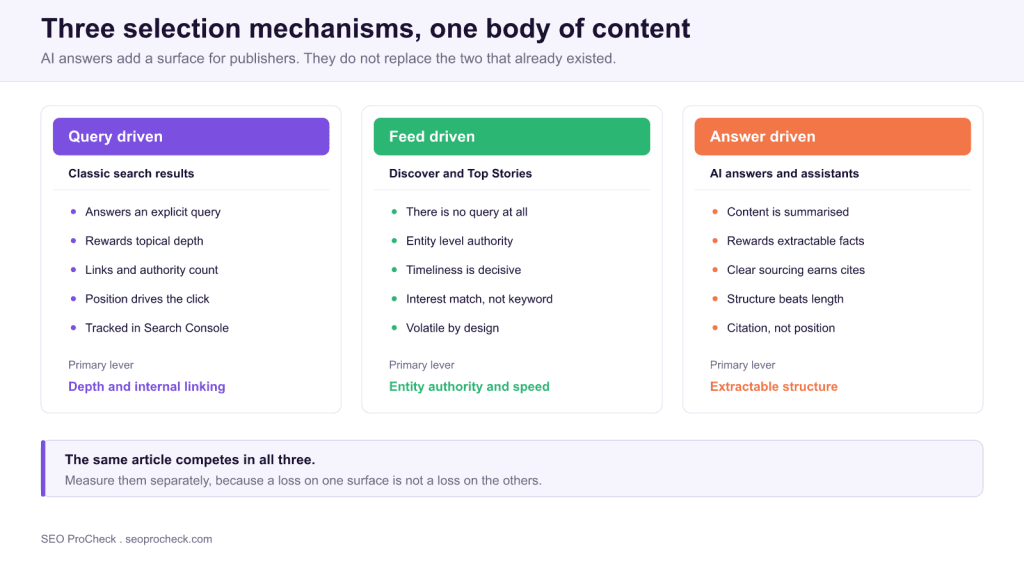
AI answers change how some search results are presented, but they do not collapse publisher discovery into a single channel. Publishers still earn attention through three distinct mechanisms, query driven search results, feed driven Discover and Top Stories, and answer driven AI surfaces, and each one selects content on different signals.
- Aggregate traffic numbers hide the story: measure each surface separately.
- Commodity coverage is the most substitutable content; original reporting is the least.
- AI extraction rewards unambiguous facts, dates and attribution, not longer prose.
- Blocking AI crawlers is a real strategic choice with costs on both sides, not a default.
Every few years the media industry decides that search is over. The arrival of AI Overviews and conversational answer engines produced the most recent round of that argument, and the LinkedIn post cited at the end of this page pushes back on it directly, arguing that the doom framing gets ahead of what the evidence actually supports. Barry Adams works specifically on news publisher SEO, which makes the pushback worth engaging with rather than dismissing as contrarianism.
The useful version of this debate is not "is search dying" but "which parts of publisher traffic are actually exposed, and to what." Those are answerable questions, and the answers point at different work than panic does. What follows is the practitioner view: what genuinely changes, what does not, and what to do about it.
The three mechanisms, and why they move independently
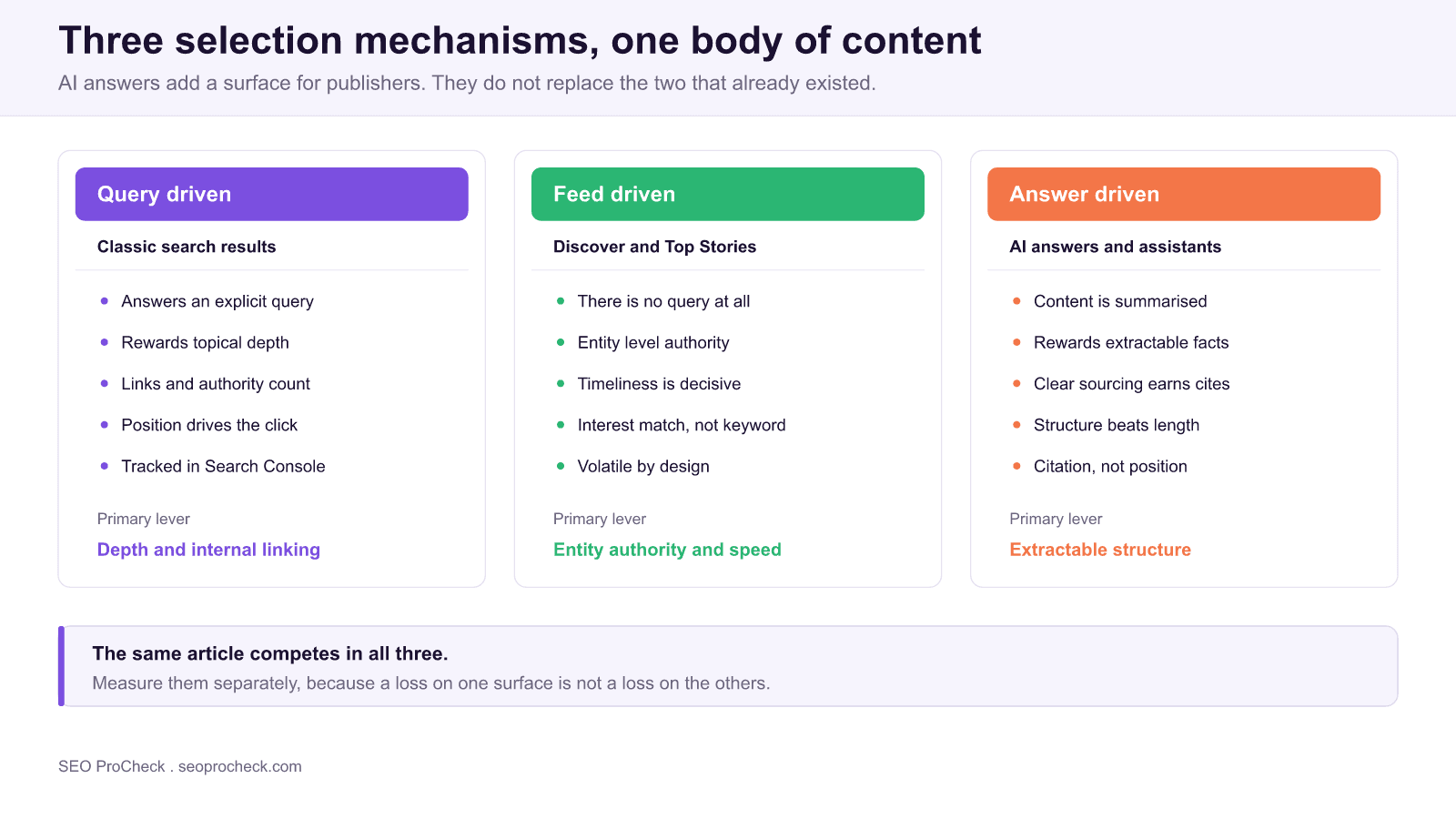
A publisher does not have one audience pipeline. It has at least three, and they are selected by different systems with different inputs. Conflating them is what produces both the panic and the complacency.
Query driven results are the classic ten blue links. A user expresses an intent, and ranking decides who gets the click. This is the surface where AI Overviews genuinely intercept demand, because a summary can satisfy an informational query outright.
Feed driven surfaces, chiefly Google Discover and to a lesser extent Top Stories, have no query at all. Discover predicts interest from a user profile and surfaces content it expects them to engage with. Nothing about an AI answer to somebody else's question affects whether your article gets fed to a person who never searched.
Answer driven surfaces are the new entrant: AI Overviews, AI Mode, and assistants such as ChatGPT, Claude, Perplexity and Gemini. Here your content is not listed, it is read, compressed and attributed. Visibility means being cited inside somebody else's answer.
Which content is actually exposed
Substitutability is the variable that matters. An AI answer is a summary, and a summary needs something to summarise. The more your article is a restatement of publicly available facts, the more completely a summary replaces it.
| Content type | Exposure to AI summarisation | Why | Where the value moves |
|---|---|---|---|
| Commodity news rewrites | Very high | The facts exist in many places already | To whoever reported it first |
| Explainers and definitions | High | A short summary fully answers the intent | To the answer itself |
| Original reporting and scoops | Low | You are the source being cited | Stays with the originator |
| Analysis, opinion and voice | Low | A summary of an argument is not the argument | Stays with the author |
| Live and developing coverage | Low to moderate | Freshness outpaces the index behind the answer | Stays with the publisher |
| Reviews with first hand testing | Moderate | Verdicts summarise, but methodology does not | Depends on demonstrable testing |
The pattern is consistent: what gets absorbed is what was already replaceable. That is uncomfortable for publishing models built on volume, and largely irrelevant to models built on access, expertise or reporting.
Understanding AI Content Consumption
An answer engine reads a page very differently from a ranking system. Ranking evaluates a document as a whole and orders it against competitors. Extraction pulls discrete claims out of a document and needs to be confident enough about each one to repeat it with your name attached.
That confidence requirement drives what actually helps. Claims stated plainly in a single sentence extract cleanly, whereas an assertion spread across three paragraphs of build up does not. Explicit dates matter disproportionately, because a system deciding whether a fact is current needs a date it can trust rather than a vague reference to "last year". Attribution inside your own copy, naming who said a thing and where, gives an engine the provenance chain it needs. Tables and clear headings do real work here, since they map claim to value without inference.
Publisher specific markup carries weight for the same reason. Accurate NewsArticle structured data with genuine datePublished and dateModified values, a real named author, and a resolvable publisher entity removes ambiguity about who is making the claim. None of this forces a citation, but ambiguous pages are the easiest ones to skip. The mechanics are covered in schema markup for AI search, and the citation selection question in how to optimise for AI Overview citations.
Optimization Approaches
The practical response splits into things that were always good practice and things that are genuinely new.
- Separate your reporting by surface. In Search Console, break performance out by search appearance so Discover, News and web results never sit inside one averaged line. A Discover collapse and an AI Overview interception look identical in a sessions chart and require opposite responses.
- State facts in extractable form. Lead sections with the answer, put concrete values in tables, and give every time sensitive claim an explicit date. This costs nothing and helps human skimmers as much as machines.
- Make authorship real and verifiable. Named authors with genuine credentials, bylines that resolve to populated author pages, and clear editorial policies. This is standard trust work that answer engines lean on heavily.
- Invest where substitution is weakest. Reporting, access, data you gathered, testing you performed. The table above is effectively a commissioning brief.
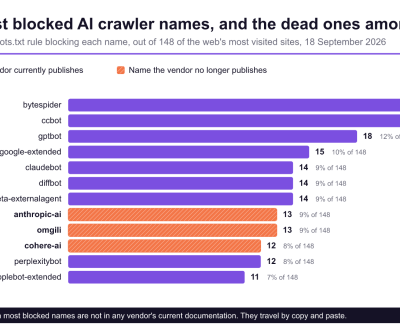
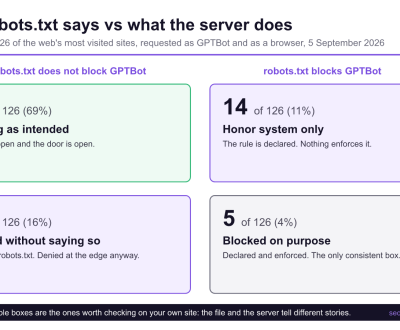
- Decide the crawler question deliberately. Whether to allow GPTBot, ClaudeBot, PerplexityBot and Google-Extended is a strategic call, and it is made per origin. Remember that a rule on your main hostname does nothing for a subdomain, as covered in the complete robots.txt reference.
- Protect the channels nobody can disintermediate. Newsletters, apps and direct brand demand are the parts of the audience that no ranking or answer system sits in front of.
Strategic Implications
The doom framing and the nothing has changed framing are both wrong in the same way: they treat a portfolio of channels as one number. What is actually happening is a redistribution. Attention is moving away from content whose only merit was being indexed and towards content that is either the origin of a fact or the reason somebody trusts an interpretation of it.
For strategy, that argues against publishing volume as a growth lever and in favour of a smaller body of work with defensible provenance. It argues for treating Discover as a distinct discipline with its own inputs rather than a bonus on top of SEO, since it is feed driven and unaffected by query interception. And it argues for measurement discipline, because the single most common error right now is attributing a Discover volatility event to AI Overviews and rebuilding a content strategy on that misreading.
None of this is an argument for complacency. Query driven traffic to explainer content is genuinely under pressure and that pressure will continue. It is an argument for accuracy about which part of the business is exposed, so the response is proportionate. For the full framing of optimising toward generative surfaces, see the generative engine optimization FAQ, and for qualifying in the news specific surfaces, Google News and Top Stories.
Frequently asked questions
The honest answer is that it varies enormously by surface and by content type. Reference style queries that a summary can fully satisfy lose clicks, while ongoing news, original reporting and opinion still send people to the source. Treating one aggregate traffic number as the verdict hides the fact that Search, Discover and Top Stories move independently.
It is a real choice with a real cost on both sides, and it should be made deliberately rather than by default. Blocking protects content from being ingested but also removes you from the answers where competitors will still appear. Many publishers split the decision, allowing crawlers that drive cited referral traffic and blocking those that only harvest training data.
Discover is a personalised feed with no query behind it, surfacing content it predicts an individual will find interesting. Top Stories is a news module inside a search results page, triggered by a query on a newsworthy topic. Discover rewards sustained entity authority and compelling presentation, Top Stories rewards speed and topical relevance to the query.
It helps by making the facts on your page unambiguous, which is what extraction depends on. NewsArticle markup with an accurate datePublished, dateModified, author and publisher removes guesswork about who said what and when. It is not a switch that forces a citation, but ambiguous pages are much easier to skip.
Split reporting by search appearance so Discover, News and web results are never averaged together, and track brand queries as a proxy for the demand that survives disintermediation. Add citation presence in AI answers for the topics you cover. A single sessions line cannot tell you which mechanism changed.
It is the strongest one available, because a summary of a fact still needs a source for that fact and originating it makes you that source. Commodity coverage that restates what is already published is the most substitutable content there is. This is a reason to invest in reporting, access and expertise rather than in publishing volume.
Source: https://www.linkedin.com/posts/barryadams_ai-aioverviews-google-activity-7197175885530103808-Lu7y
Take this with you
The assistant links open with a question about this page already written. Nothing is sent until you press enter.
Claude Vincent is a technical SEO consultant focused on crawlability, rendering, and AI-search visibility. He writes the field guides and case studies at SEO ProCheck, with a bias toward the durable, unglamorous work that decides whether search engines and AI answer engines can actually read and cite a site.
About SEO ProCheck
Technical SEO consulting and GEO strategy with 20 years of enterprise experience. Case studies, resources, and tools for search and AI visibility.
Work With Me
Technical SEO audits, GEO strategy, site migrations, and international SEO. Hourly consulting for teams who need hands-on support, not just reports.
Subscribe to our newsletter!
Recent Posts
- Most Top Sites Never Say Who They Are in Structured Data October 14, 2026
- Homepage Titles Are Mostly Too Short, Not Too Long October 8, 2026
- Who Actually Serves an llms.txt? 184 Top Sites Measured September 29, 2026