

Breaking Down the Google SEO Exploit: A Look Inside Google's Algorithm
- January 10, 2025
- General
AI Summary
There is no single "Google SEO exploit" because ranking is produced by many systems working in sequence, not one lever. Understanding the pipeline, from crawl and index to core ranking and the re-ranking systems that follow, explains why updates move traffic and why durable gains come from user value rather than tricks.
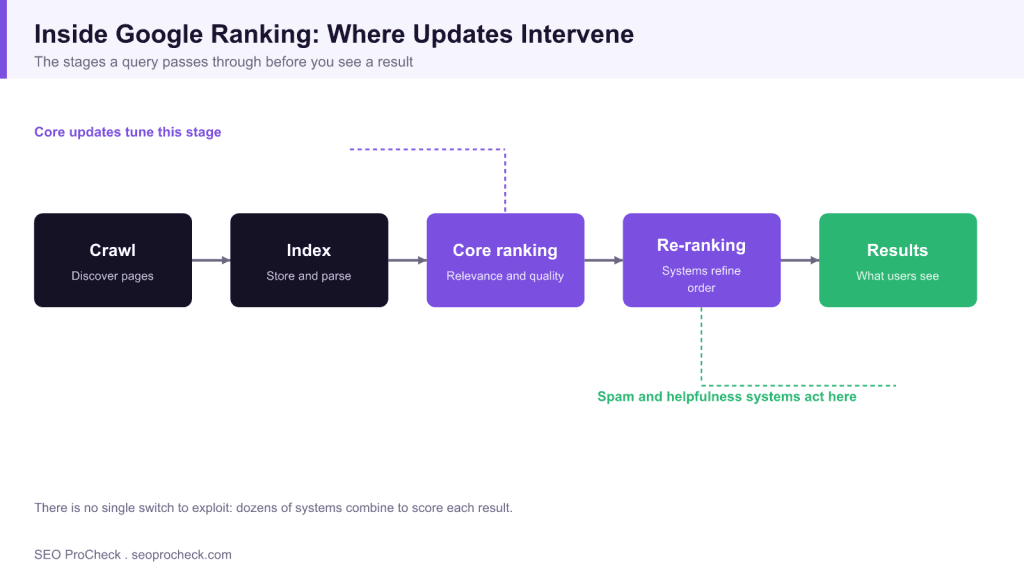
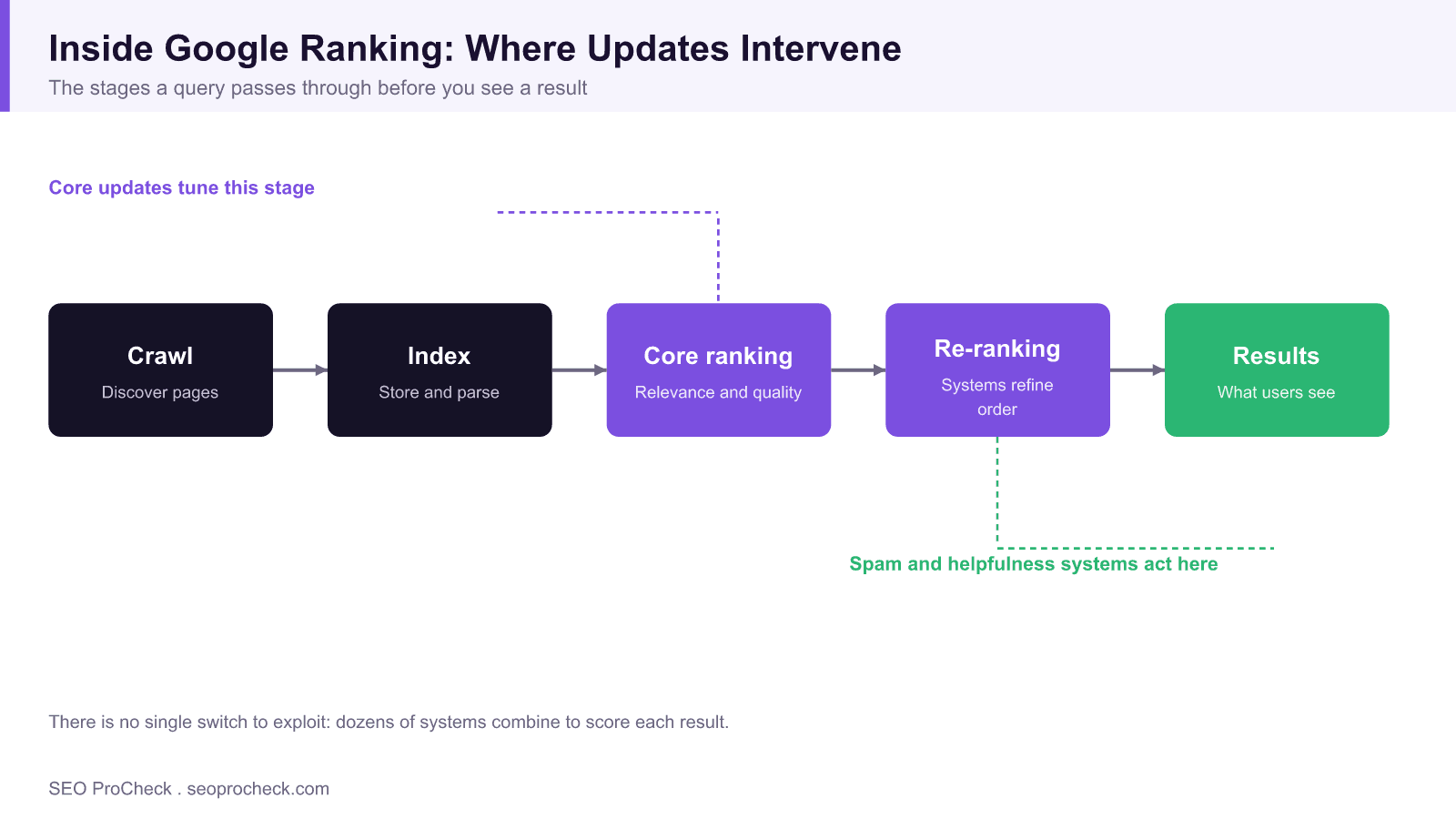
- A result passes through crawl, index, core ranking, and re-ranking systems before it reaches the page.
- Core updates retune how quality and relevance are weighed across the whole index, so they can move sites that changed nothing.
- Spam and helpfulness systems act as filters and demotions layered on top of core ranking.
- Loopholes that ignore user value tend to be short lived, since each update closes them.
The "exploit" framing, and why it misleads
Content that promises a look inside an SEO exploit usually implies there is one hidden switch you can flip for rankings. The reality visible in how Google describes its own systems is less dramatic and more useful: a query is answered by a chain of processes, and no single one of them decides your position. When you understand that chain, the mysterious volatility around updates becomes readable, and you can tell the difference between a tactic that borrows time and a change that compounds.
Google publicly documents that ranking depends on many systems including its core ranking systems, helpful content signals folded into core ranking, spam detection such as SpamBrain, and language understanding systems like BERT. None of these is a password. Each is a scorer, and your page is evaluated against all of them at once.
The pipeline a query travels
Break the journey into stages so you know which lever a given tactic actually touches:
- Crawl: Googlebot discovers and fetches URLs. If a page is blocked in robots.txt, orphaned, or buried behind crawl waste, nothing downstream matters. This is where log analysis and internal linking earn their keep.
- Index: the fetched page is rendered, parsed, and stored. Canonicalization happens here, duplicates are consolidated, and thin or blocked pages may be dropped. A page that is crawled but not indexed cannot rank at all.
- Core ranking: for a given query the index is scored for relevance and quality. This is the stage core updates retune, which is why a site can lose visibility after a core update without changing a line of code.
- Re-ranking systems: additional systems refine the initial order, applying freshness, spam demotions, and helpfulness signals. A page can pass core ranking and still be filtered here.
- Results: the final list, often blended with features like AI overviews, images, and video, is assembled and shown.
Most so called exploits act on one narrow stage, for example manipulating anchor text to influence relevance, and ignore the systems designed to catch exactly that pattern at the next stage.
Update types and the right response
| Update type | What it targets | Practitioner response |
|---|---|---|
| Broad core update | Overall relevance and quality weighting across the index | Improve genuine helpfulness and E-E-A-T, expect recovery over weeks not hours |
| Spam update | Manipulative links, cloaking, scaled content abuse | Remove or disavow manipulative patterns, stop the tactic that triggered it |
| Helpful content signals | Content made for search engines rather than people | Consolidate thin pages, add first hand experience, cut filler |
| Product or reviews systems | Low value review and product content | Add hands on evidence, comparisons, and original media |
| Continuous changes | Thousands of small ranking tweaks per year | Do not react to daily noise, watch trends and confirmed rollouts |
Diagnosing a drop without guessing
When traffic falls around a known update, work the pipeline backwards before assuming an algorithmic penalty. Confirm the affected URLs are still indexed in Search Console, since a drop caused by accidental noindex or a canonical conflict is a technical fix, not an algorithm story. Segment the loss by query and page to see whether an entire template lost ground or only a handful of pages. Compare against the confirmed rollout window: correlation with a dated update supports an algorithmic cause, but you still need to identify what the winners now do better. Export rankings before and after so you have a baseline to measure recovery against, and resist shipping ten changes at once, which makes cause and effect impossible to read.
The original resource
Google algorithm updates regularly reshape the SEO landscape. Understanding update patterns, impacts, and appropriate responses helps maintain visibility through algorithmic changes. This resource examines update dynamics and strategic responses.
Update Types and Impacts
Google releases different update types: core updates affecting overall ranking systems, specific updates targeting issues like spam or helpful content, and incremental improvements happening continuously. Understanding which type affects your site informs response strategy.
Analyzing Update Impact
When traffic changes coincide with updates, analysis should identify what changed: which pages, which queries, which competitors gained. Correlation with update timing suggests algorithmic cause, but confirmation requires examining what changed in the ranking landscape.
Strategic Response
Response depends on update type and impact diagnosis. Core updates often reward sustained quality improvements over quick fixes. Specific updates may require addressing identified issues. In all cases, focusing on user value and content quality remains the sustainable approach.
This resource provides guidance for understanding and responding to Google's evolving algorithm landscape.
Source: https://www.linkedin.com/pulse/breaking-down-google-seo-exploit-look-inside-googles-algorithm-2fczc
Frequently asked questions
Is there really a Google algorithm exploit that boosts rankings?
No durable one. Ranking is decided by many systems in sequence, and tactics that exploit a single signal are typically neutralized by the spam and quality systems that follow. Anything framed as a permanent loophole tends to stop working at the next update.
Why did my rankings drop when I changed nothing?
Core updates retune how quality and relevance are scored across the entire index, so your relative position can fall even with no on page change. It usually means competitors are now judged more helpful for those queries, which points to content and authority work rather than a quick fix.
How is a core update different from a spam update?
A core update reweighs overall quality and relevance broadly, while a spam update targets specific manipulative behavior such as link schemes or scaled content abuse. Recovery from a core update comes from sustained quality improvement, whereas a spam hit requires removing the offending tactic.
How long does recovery from a core update take?
Often weeks, and sometimes not until the next core update, because Google reassesses quality signals over time rather than instantly. Make genuine improvements and keep publishing rather than expecting an overnight rebound.
Should I react to daily ranking fluctuations?
Rarely. Google makes thousands of changes a year and daily movement is mostly noise. Track trends and act on confirmed, dated rollouts rather than on single day swings.
What is the safest long term strategy against algorithm risk?
Build content and technical foundations that serve users regardless of the current weighting: clear intent coverage, demonstrated experience, sound site architecture, and honest signals. This reduces exposure to any single update because you are not relying on a loophole.
Related reading on seoprocheck.com
Claude Vincent is a technical SEO consultant focused on crawlability, rendering, and AI-search visibility. He writes the field guides and case studies at SEO ProCheck, with a bias toward the durable, unglamorous work that decides whether search engines and AI answer engines can actually read and cite a site.
About SEO ProCheck
Technical SEO consulting and GEO strategy with 20 years of enterprise experience. Case studies, resources, and tools for search and AI visibility.
Work With Me
Technical SEO audits, GEO strategy, site migrations, and international SEO. Hourly consulting for teams who need hands-on support, not just reports.
Subscribe to our newsletter!




Recent Posts
- Can AI Crawlers Actually Read Your Site? I Measured 400 of the Biggest September 5, 2026
- The Pre-Publish Quality Gate for AI-Assisted Content August 6, 2026
- AGENTS.md vs llms.txt vs llms-full.txt: Which Agent File Does What July 18, 2026