

BruceClay - Search Engine Optimization SEO Training, SEO Services, Search Engine Ranking, and Placem
- March 28, 2020
- General
AI Summary
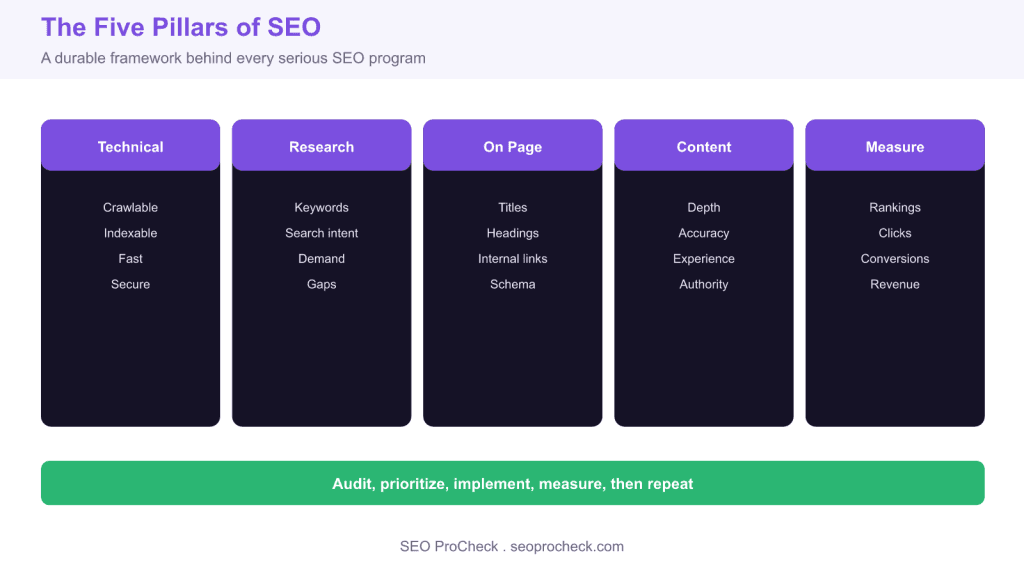
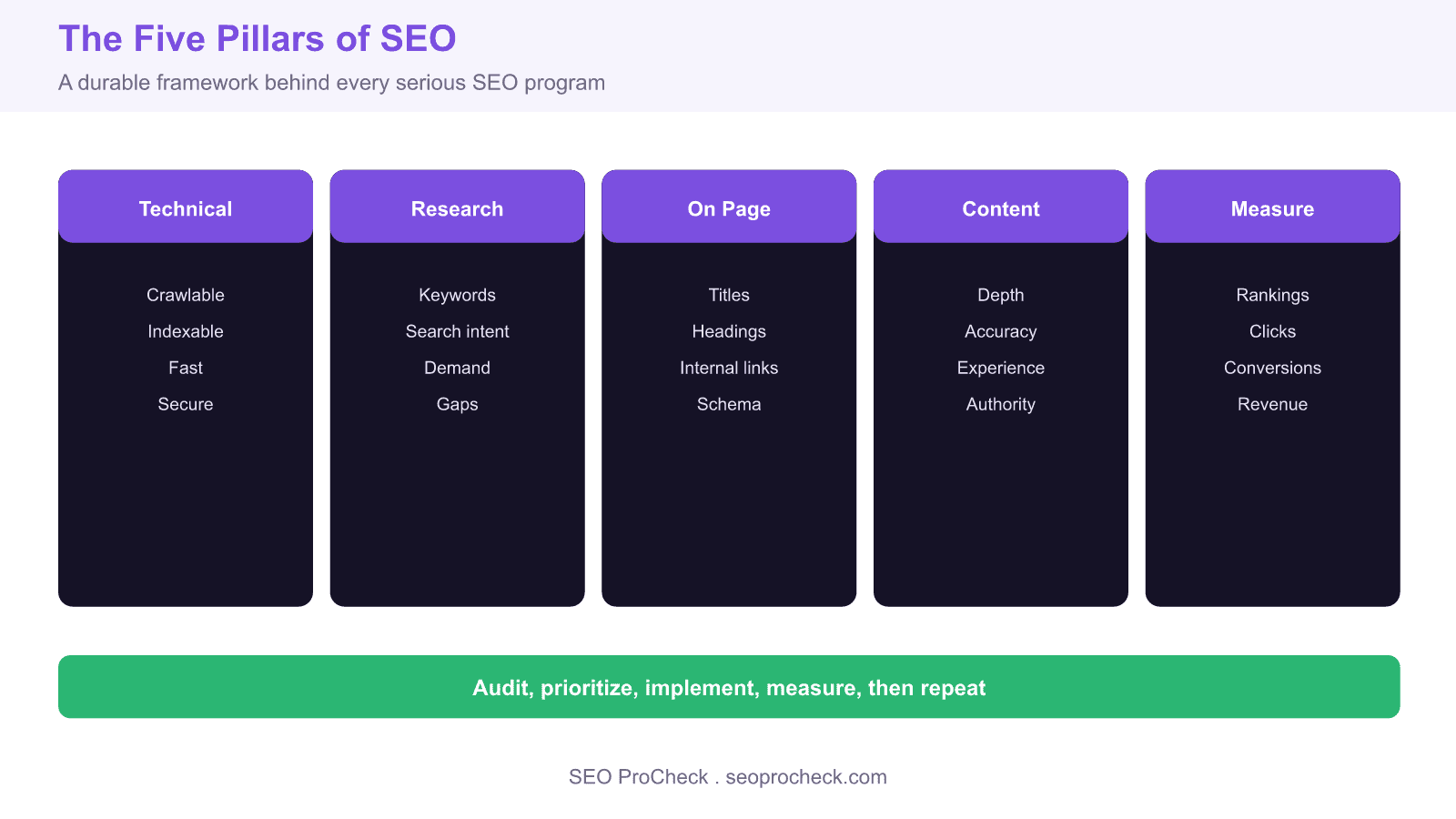
The SEO discipline rests on five durable pillars: a sound technical foundation, keyword and intent research, on page optimization, content depth with earned authority, and measurement. There is no secret trick, consistent execution of these fundamentals is what produces and sustains rankings.
- A crawlable, fast, secure site is the foundation every other pillar stands on.
- Keyword research is really intent research, mapping queries to page types.
- Content depth plus E-E-A-T and earned links drive lasting authority.
- AI Overviews reward the same fundamentals, so the discipline did not change.
Bruce Clay is one of the longest running names in search engine optimization, and the linked resource is a broad overview of SEO training, services, and the methodology the firm has taught for years. Rather than restate the sales page, this article distils the durable discipline underneath it: the five pillars every serious SEO program rests on, and the repeatable process that connects them. None of this is secret, and that is precisely the point, because SEO rewards consistent execution of fundamentals far more than any single trick.
Pillar one, a sound technical foundation
If search engines cannot crawl, render, and index a page, nothing else matters. The technical pillar covers crawlability, a clean robots.txt, XML sitemaps that list only canonical indexable URLs, a logical site architecture, HTTPS, and Core Web Vitals. Practitioners verify this with Search Console coverage reports and a crawler such as Screaming Frog or Sitebulb, then fix blockers before investing in content. A fast, secure, crawlable site is the ground the other four pillars stand on.
Pillar two, keyword and intent research
Research is where you decide what to compete for. Modern keyword research is really intent research: you group queries by the job the searcher is trying to do, informational, commercial, transactional, or navigational, and map each cluster to the right page type. Tools such as Semrush, Ahrefs, and Search Console query data reveal demand, difficulty, and the gaps where you can realistically win. The output is a prioritized topic map, not a spreadsheet of disconnected phrases.
Pillar three, on page optimization
On page work aligns a specific page with a specific intent. That means a descriptive title tag, a single clear H1, a logical heading structure, keyword informed but naturally written copy, descriptive internal links, image alt text, and structured data where it earns a rich result. The classic Bruce Clay SEO checklist emphasises putting the primary term in the title, the first paragraph, and at least one heading, without stuffing. Done well, on page optimization tells both users and search engines exactly what a page is about.
Pillar four, content depth and authority
Content and off page authority are two halves of the same trust question. On the content side, Google rewards pages that satisfy the query fully and demonstrate first hand experience, expertise, authoritativeness, and trust, the framework known as E-E-A-T. On the authority side, links and brand mentions from credible sources remain a strong signal, earned through genuinely useful assets rather than bought at scale. The pages that win combine real depth with an authoritative source reputation.
Pillar five, measurement and iteration
Measurement turns SEO from guesswork into a loop. You track rankings, impressions, and clicks in Search Console, behaviour and conversions in GA4, and technical health in your crawler. The practitioner loop is simple to state and hard to sustain: audit the current state, prioritize the highest impact fixes, implement them, measure the result, then repeat. Programs that skip the measurement step keep repeating work that never moved a metric.
What has changed since this overview
The pillars are stable, but the surface area has expanded. Google added a second E to E-A-T for experience, launched the helpful content system to reward people first content, and rolled out AI Overviews that summarise answers directly in the results. A new layer, often called generative engine optimization or answer engine optimization, focuses on being cited by AI assistants. The good news for practitioners is that the same fundamentals, crawlable pages, matched intent, real depth, and earned authority, are what get content surfaced in AI answers too. The channels multiplied, the discipline did not.
The five pillars at a glance
| Pillar | Core tasks | Typical tools | Primary KPI |
|---|---|---|---|
| Technical | Crawl, index, speed, HTTPS | Search Console, Screaming Frog, Sitebulb | Valid indexed pages |
| Research | Keyword and intent mapping | Semrush, Ahrefs, Search Console | Coverage of target topics |
| On page | Titles, headings, links, schema | Rank Math, Rich Results Test | Average position |
| Content and authority | Depth, E-E-A-T, earned links | Content briefs, digital PR | Referring domains |
| Measurement | Track, analyse, iterate | GA4, Search Console, Looker Studio | Organic conversions |
Related reading
- The complete guide to internal linking
- How SEO, AEO, and GEO fit together
- Avoiding multiple title tags on a page
Frequently asked questions
What are the main pillars of SEO?
Most practitioners group SEO into a technical foundation, keyword and intent research, on page optimization, content depth and off page authority, and measurement. Each pillar depends on the others, so a strong site invests across all five rather than chasing a single tactic.
Is there a secret to ranking on Google?
No. Durable rankings come from consistent execution of fundamentals: a crawlable, fast site, content that matches search intent, clear on page signals, and earned authority. Tactics that promise shortcuts tend to be neutralised or penalised by the next algorithm update.
What is E-E-A-T and does it matter?
E-E-A-T stands for experience, expertise, authoritativeness, and trust. It is part of how Google's quality raters assess content and it shapes the systems that reward helpful pages. Demonstrating first hand experience and clear expertise helps content earn and keep rankings, especially in sensitive topics.
How long does SEO take to work?
It varies with competition, site authority, and how much needs fixing, but meaningful movement usually takes a few months rather than weeks. Technical fixes can show up quickly, while content and authority gains compound over a longer horizon. Consistent measurement keeps the effort honest.
Do I still need on page SEO in the age of AI search?
Yes, arguably more than ever. AI Overviews and assistants pull from pages they can crawl, parse, and trust, so clear titles, structured headings, schema, and factual depth all help your content get cited. The same on page signals that win classic rankings also feed AI answers.
What tools do I need to start doing SEO?
A crawler such as Screaming Frog or Sitebulb, Google Search Console, GA4, and a keyword tool such as Semrush or Ahrefs cover the essentials. That stack lets you audit technical health, research demand, optimise pages, and measure the results without expensive overhead.
Source: https://www.bruceclay.com/seo/search-engine-optimization#seoksp
Claude Vincent is a technical SEO consultant focused on crawlability, rendering, and AI-search visibility. He writes the field guides and case studies at SEO ProCheck, with a bias toward the durable, unglamorous work that decides whether search engines and AI answer engines can actually read and cite a site.
About SEO ProCheck
Technical SEO consulting and GEO strategy with 20 years of enterprise experience. Case studies, resources, and tools for search and AI visibility.
Work With Me
Technical SEO audits, GEO strategy, site migrations, and international SEO. Hourly consulting for teams who need hands-on support, not just reports.
Subscribe to our newsletter!







Recent Posts
- Can AI Crawlers Actually Read Your Site? I Measured 400 of the Biggest September 5, 2026
- The Pre-Publish Quality Gate for AI-Assisted Content August 6, 2026
- AGENTS.md vs llms.txt vs llms-full.txt: Which Agent File Does What July 18, 2026