

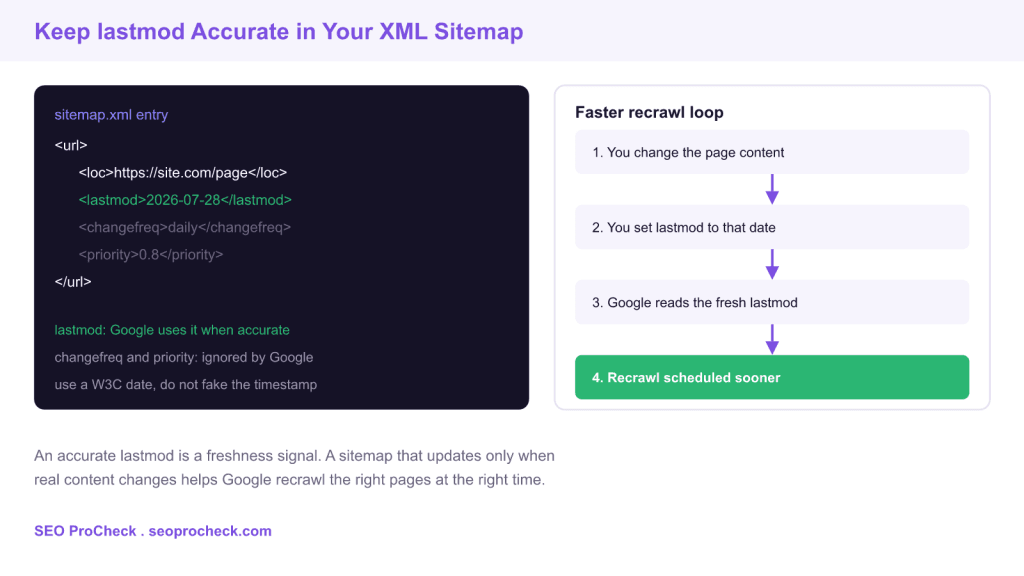
AI Summary
Google has said that keeping your XML sitemap updated often can be a good idea, because an accurate lastmod date helps Google understand when a page really changed and schedule a recrawl. The key is honesty: bump lastmod when content genuinely changes, not on every page every day, because a sitemap full of fake fresh dates teaches Google to ignore the signal.
- Google reads the lastmod value when it is trustworthy and uses it to prioritize recrawling.
- Google ignores the changefreq and priority tags, so do not rely on them.
- Set lastmod to the date of the last significant content change, in W3C date format.
- The old sitemap ping endpoint is deprecated, so submit through Search Console and reference the sitemap in robots.txt.
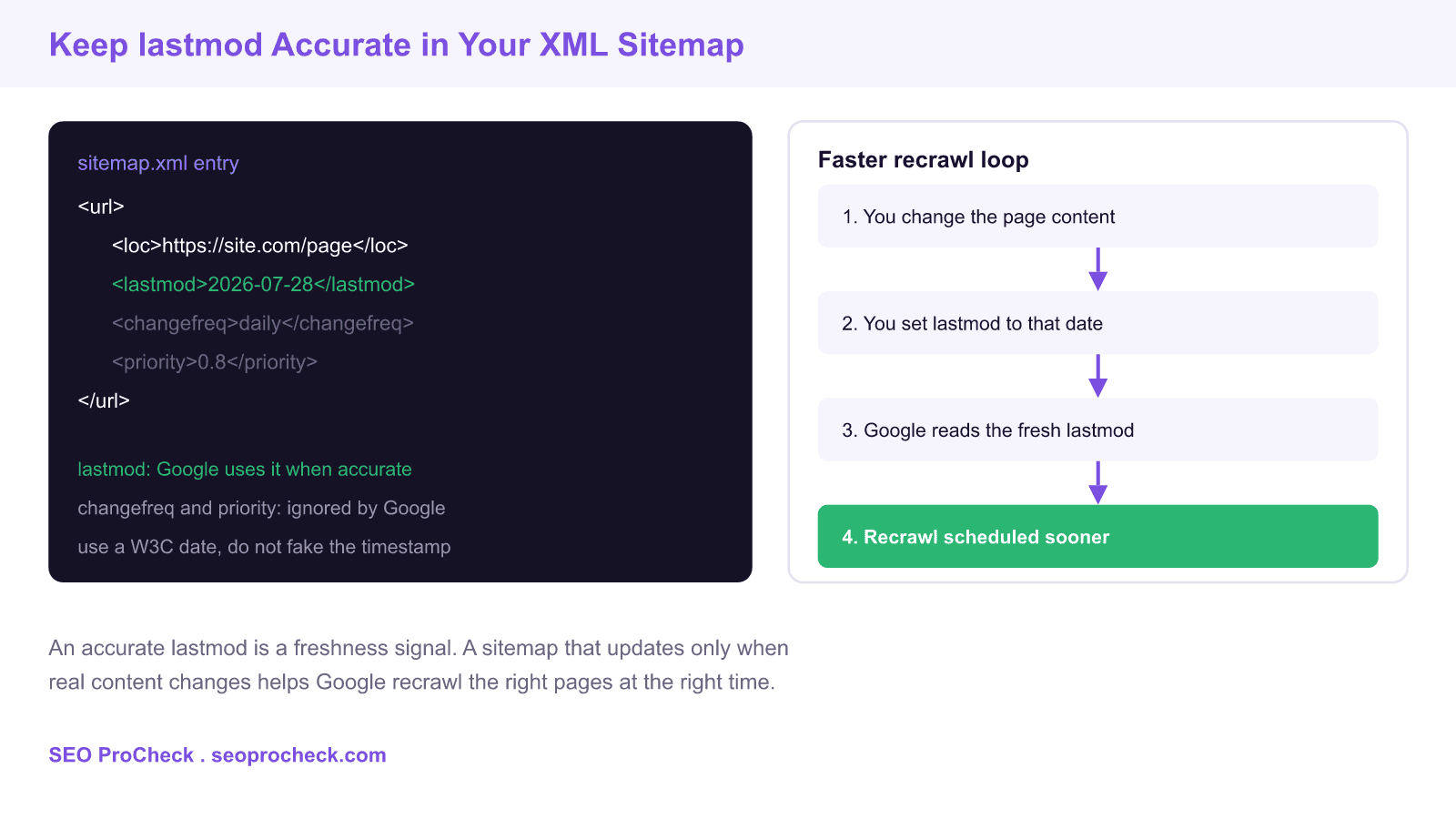
The source behind this page reports Google guidance that an often updated XML sitemap can be a good idea. That advice is easy to misread as update everything constantly. What Google actually means is narrower and more useful: keep your sitemap current so the lastmod dates reflect reality, and Google can use those dates to recrawl changed pages sooner. This page keeps the source and adds practitioner detail on how to make the sitemap a signal Google trusts rather than one it learns to ignore.
Why an updated sitemap helps
Google does not recrawl every URL on every visit. It budgets crawling, and it leans on signals to decide what to fetch again and when. The lastmod element inside each sitemap entry is one of those signals. When lastmod accurately marks the last meaningful change to a page, Google can use it to move a changed page up the recrawl queue and skip pages that have not changed. A sitemap that quietly updates whenever real content changes is therefore a way to nudge faster indexing of your edits.
The catch is trust. Google only leans on lastmod when it looks reliable. If every URL in your sitemap shows today as the last modified date on every crawl, the signal is worthless and Google discounts it. The goal is an honest sitemap, not a constantly churning one.
What each sitemap tag does, and what Google ignores
The sitemap protocol defines several tags, but Google does not treat them equally. The table below shows how Google actually handles each one.
| Tag | Purpose | Does Google use it |
|---|---|---|
loc | The canonical URL of the page | Yes, this is the core of the entry |
lastmod | Date of the last significant change | Yes, when it is accurate and consistent |
changefreq | Hint about how often a page changes | No, Google ignores it |
priority | Relative importance of the URL | No, Google ignores it |
How to set lastmod correctly
Use the W3C datetime format. A date such as 2026-07-28 is valid, and a full timestamp such as 2026-07-28T09:30:00+00:00 is also fine. A single sitemap file holds up to 50,000 URLs or 50MB uncompressed, whichever comes first, so large sites split into multiple sitemaps referenced by a sitemap index. A minimal entry looks like this:
<url>
  <loc>https://example.com/guides/router-setup</loc>
  <lastmod>2026-07-28</lastmod>
</url>
Three rules keep the signal clean. Only change lastmod when the page content actually changes in a way that matters, not when a sidebar widget or a footer date updates site wide. Keep the value consistent with what a crawler sees on the page, because an obviously wrong date undermines trust. And do not set every URL to the current date as a batch, since that is the fastest way to get lastmod discounted.
How to tell Google about the sitemap
Reference the sitemap in your robots.txt file so any crawler can discover it, and submit it in Google Search Console for reporting and status. A robots.txt line looks like this:
Sitemap: https://example.com/sitemap_index.xmlNote that the old sitemap ping endpoint, the request you could send to notify search engines that a sitemap changed, has been deprecated. Google announced it was retiring that unauthenticated ping, so you should no longer depend on it. Instead, keep robots.txt pointing at the sitemap and rely on Search Console for submission and monitoring. Under Sitemaps in Search Console you can confirm the last read date and the count of discovered URLs, which tells you whether Google is picking up your updates.
What has changed since this guidance
The core advice still holds: an accurate, current sitemap helps Google find and recrawl your changes. What has shifted around it is the tooling. The sitemap ping endpoint is gone, so submission now runs through robots.txt discovery and Search Console. Google has also repeatedly confirmed that changefreq and priority carry no weight, so time spent tuning them is wasted. Focus that effort on a correct lastmod instead. For more Google guidance walkthroughs see our general SEO articles, and the related note on how Google passage ranking rewards clearly structured pages.
Frequently asked questions
Does updating my sitemap often help SEO?
It can, when the updates are honest. Keeping lastmod accurate helps Google understand when a page really changed and schedule a recrawl sooner. It does not help to update dates artificially, because Google discounts a sitemap whose dates are not trustworthy.
What is lastmod and how should I format it?
The lastmod tag records the date a page was last significantly changed. Use W3C datetime format, such as a plain date like 2026-07-28 or a full timestamp with a time zone. Set it to the real date of the content change, not the date the sitemap was generated.
Does Google use changefreq and priority?
No. Google has stated it ignores both the changefreq and priority tags in XML sitemaps. You can leave them out entirely. Put your effort into an accurate lastmod, which Google does use when it is reliable.
Should I set every page lastmod to today?
No. Setting all URLs to the current date on every crawl makes the signal meaningless, and Google will stop trusting it. Only update lastmod for pages whose content genuinely changed, so the freshness signal stays credible.
How do I submit my sitemap to Google now?
Reference it in robots.txt with a Sitemap line and submit it in Google Search Console. The old sitemap ping endpoint has been deprecated, so do not rely on it anymore. Search Console shows the last read date and how many URLs were discovered.
How big can an XML sitemap be?
A single sitemap file can contain up to 50,000 URLs and must be no larger than 50MB uncompressed. If you exceed either limit, split your URLs across multiple sitemap files and list them in a sitemap index file. This keeps large sites within the protocol limits.
Source: https://www.seroundtable.com/google-updated-often-xml-sitemap-32326.html
Take this with you
The assistant links open with a question about this page already written. Nothing is sent until you press enter.
Claude Vincent is a technical SEO consultant focused on crawlability, rendering, and AI-search visibility. He writes the field guides and case studies at SEO ProCheck, with a bias toward the durable, unglamorous work that decides whether search engines and AI answer engines can actually read and cite a site.
About SEO ProCheck
Technical SEO consulting and GEO strategy with 20 years of enterprise experience. Case studies, resources, and tools for search and AI visibility.
Work With Me
Technical SEO audits, GEO strategy, site migrations, and international SEO. Hourly consulting for teams who need hands-on support, not just reports.
Subscribe to our newsletter!








Recent Posts
- Most Top Sites Never Say Who They Are in Structured Data October 14, 2026
- Homepage Titles Are Mostly Too Short, Not Too Long October 8, 2026
- Who Actually Serves an llms.txt? 184 Top Sites Measured September 29, 2026