

AI Summary
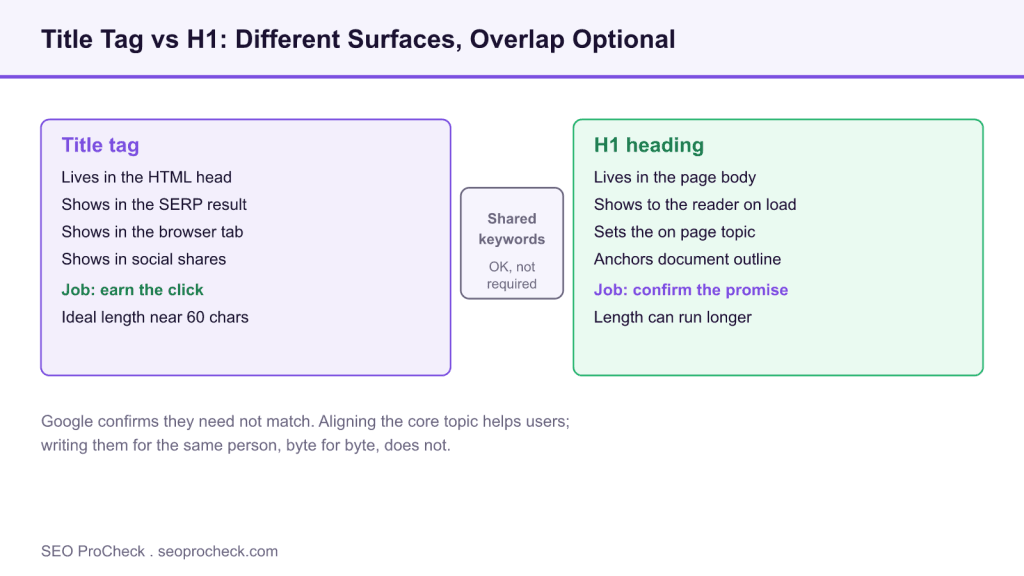
Google's John Mueller confirmed the title tag and the H1 do not have to match, because they serve different surfaces and audiences. Align the core topic so users are not confused, but writing them identically byte for byte gives no ranking benefit.
- The title tag lives in the head and shows in the SERP and browser tab; the H1 shows on the page itself.
- Google says the two need not be identical, and there is no penalty for differences.
- Sharing the main keyword is sensible; duplicating the exact string is not required.
- Use the room in each to serve its own job: the title earns the click, the H1 confirms the promise.

Google: Should H1 & Title Tags Match? provides valuable insights for SEO practitioners. This resource examines approaches and considerations that can improve organic search performance.
The question and Google's answer
A recurring on page SEO question is whether the H1 heading and the title tag have to match. In the exchange the source below reports, Google's John Mueller confirmed they do not: there is no requirement that they be identical and no penalty when they differ. That frees you to write each one for the job it actually does, rather than pasting the same string into both fields and hoping it helps. It does not, and treating them as interchangeable wastes two different opportunities.
Why they are different surfaces
The title tag and the H1 live in different places and reach the reader at different moments. Confusing them is like writing the same sentence for a billboard and for the first line of a letter.
| Aspect | Title tag | H1 heading |
|---|---|---|
| Where it lives | The HTML head | The page body |
| Where it shows | SERP result, browser tab, social shares | At the top of the page, to the reader |
| Primary job | Earn the click from the results page | Confirm the page delivers what was promised |
| Practical length | Near 60 characters before truncation | Can run longer, no SERP limit |
| Audience at that moment | Someone scanning ten results | Someone who already arrived |
For the fundamentals of each, see the title tag entry and the H1 tag entry.
A sensible alignment rule
The right approach is not identical, and not unrelated, but aligned. Share the core topic and the primary keyword so a visitor who clicked a result feels they landed in the right place, then let each element use its own strengths. A title might add a hook, a number, or the brand to win the click, while the H1 states the topic plainly for the reader. If your title and H1 describe genuinely different things, that is a mismatch worth fixing, because it breaks the promise that earned the click and can raise your bounce rate.
Common H1 and title mistakes
- Multiple H1s used carelessly. HTML5 technically allows more than one H1, but a single clear H1 remains the safest choice for signaling the main topic. Duplicate or competing H1s muddy it. Our check on URLs with duplicate H1s flags where this happens at scale.
- An empty or missing title. This forces Google to invent one, usually from your H1, and you lose control of your best SERP pitch.
- Forcing a byte for byte match. Copying the title into the H1 wastes the H1's freedom to speak to a reader who has already arrived.
- A title that oversells. If the title promises more than the H1 and page deliver, you win the click and lose the visit.
For the full on page treatment, see our title tags and meta descriptions guide.
What has changed since this exchange
Google's guidance here has been consistent, and nothing has reversed it. The title tag and H1 still serve different surfaces, still do not need to match, and there is still no penalty for sensible differences. The one evolution worth noting is on the title side: Google's title rewrite system, active since 2021, will sometimes replace a weak title with your H1, which is a practical reason to keep the H1 clear and descriptive even though it is not itself a strong ranking factor. Align the topic, write each element for its own audience, and you satisfy both the searcher and the reader.
Frequently asked questions
No. Google's John Mueller confirmed they do not need to be identical and there is no penalty for differences. They serve different surfaces, so it is fine, and often better, to align the core topic while writing each for its own job.
The title tag lives in the HTML head and appears in search results, the browser tab, and social shares. The H1 lives in the page body and is the main heading a visitor sees on arrival. The title earns the click; the H1 confirms the page delivers.
Yes, that is sensible. Sharing the primary keyword and core topic reassures a visitor that they landed in the right place. What you should avoid is copying the exact same string into both, since each can do its own job better with its own wording.
HTML5 technically allows it, but a single clear H1 is the safest choice for signaling the main topic. Multiple or competing H1s can muddy the page's focus, so most SEO guidance still recommends exactly one H1 per page.
The H1 is a helpful on page signal for topic clarity, but it is not a strong standalone ranking factor. Its main value is helping users and Google understand the page. Google may also use your H1 to replace a weak or missing title tag in the results.
That is a mismatch worth fixing. A visitor who clicked a result expecting one thing and sees a different heading feels misled, which can raise bounce rate. Keep the core topic aligned so the page delivers on the promise that earned the click.
This resource contributes to the knowledge base SEO practitioners need for effective optimization in an evolving search landscape.
Source: https://www.searchenginejournal.com/google-should-h1-title-tags-match/519589/
Take this with you
The assistant links open with a question about this page already written. Nothing is sent until you press enter.
Claude Vincent is a technical SEO consultant focused on crawlability, rendering, and AI-search visibility. He writes the field guides and case studies at SEO ProCheck, with a bias toward the durable, unglamorous work that decides whether search engines and AI answer engines can actually read and cite a site.
About SEO ProCheck
Technical SEO consulting and GEO strategy with 20 years of enterprise experience. Case studies, resources, and tools for search and AI visibility.
Work With Me
Technical SEO audits, GEO strategy, site migrations, and international SEO. Hourly consulting for teams who need hands-on support, not just reports.
Subscribe to our newsletter!








Recent Posts
- Most Top Sites Never Say Who They Are in Structured Data October 14, 2026
- Homepage Titles Are Mostly Too Short, Not Too Long October 8, 2026
- Who Actually Serves an llms.txt? 184 Top Sites Measured September 29, 2026