

AI Summary
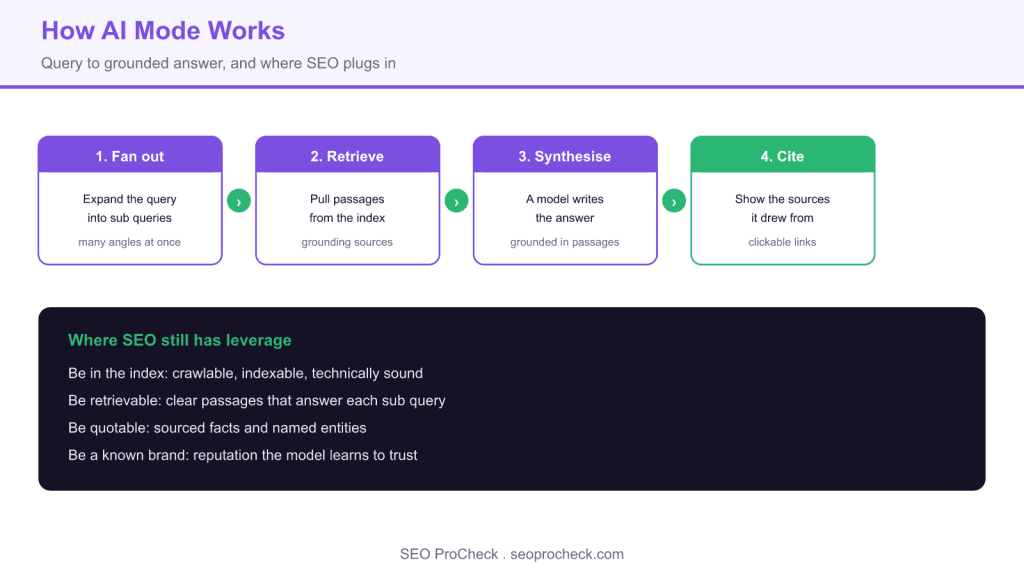
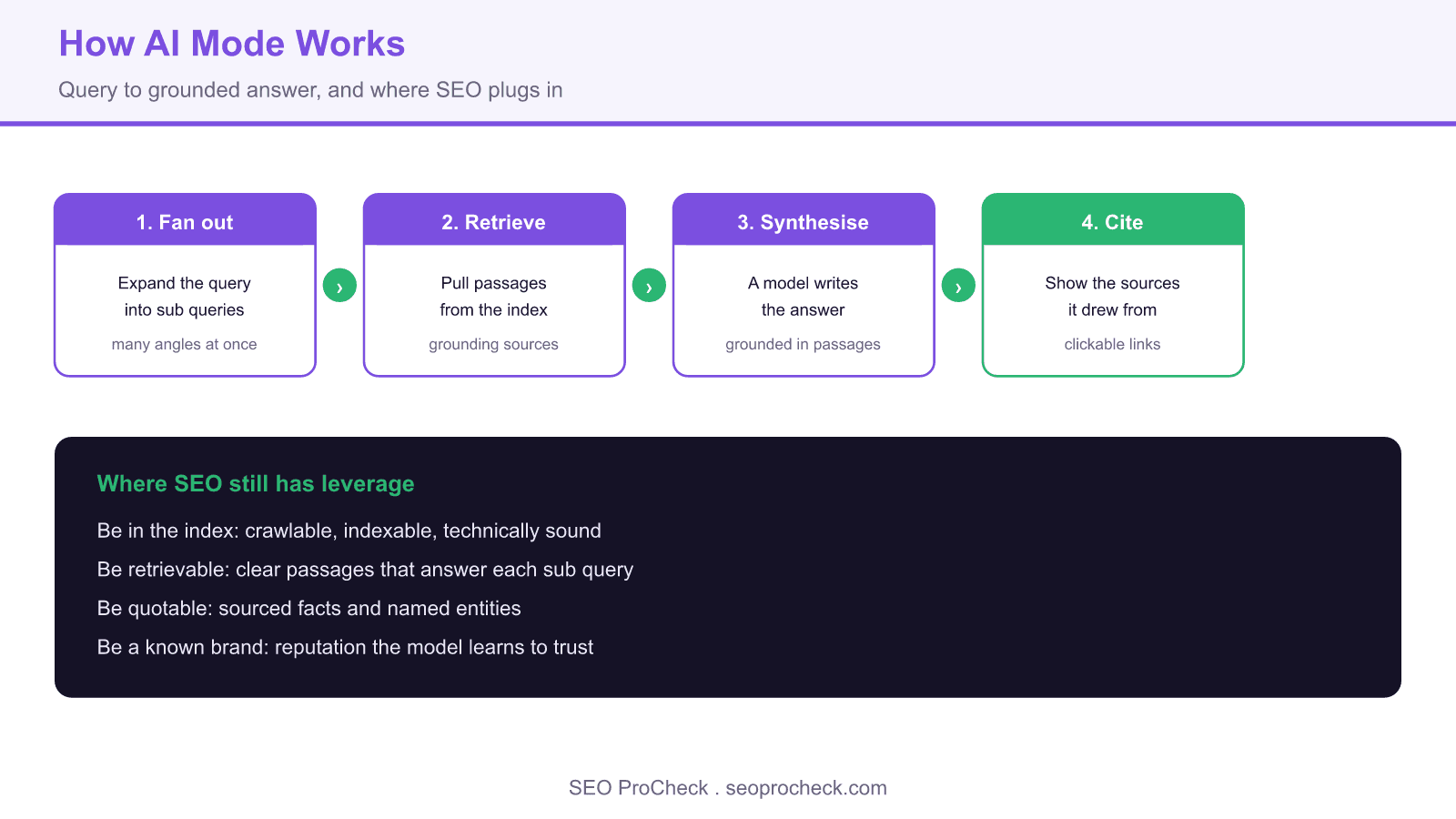
Google AI Mode works in four steps: it fans your query out into related sub queries, retrieves grounding passages from its index, uses a model to synthesise an answer from those passages, and cites the sources it used. SEO still has leverage at every step, because the model can only draw from pages that are indexed, retrievable, quotable, and from brands it has learned to trust.
- AI Mode is grounded in the search index, so being crawlable and indexable still comes first.
- Fan out means comprehensive pages get retrieved for more angles of a question.
- Clear, sourced passages are easier for the model to quote and attribute.
- Brand reputation and consistent entities influence which sources are trusted.
The emergence of AI-powered search and large language models has created new considerations for content optimization. This resource explores how content creators can adapt their strategies to maintain visibility as AI increasingly mediates information discovery.
Understanding AI Content Consumption
Large language models process content differently than traditional search algorithms. They seek factual, well-structured information that can be confidently cited. Understanding these consumption patterns helps optimize content for AI visibility alongside traditional search performance.
Optimization Approaches
Research indicates specific approaches improve AI citation likelihood: including statistics with sources, maintaining factual accuracy, structuring content for easy extraction, and demonstrating clear expertise. These tactics complement rather than replace traditional SEO fundamentals.
Strategic Implications
As AI search grows, early optimization provides compounding advantages. Building citation presence now establishes your content as an authoritative source that AI systems learn to trust. The convergence of good SEO and good GEO practices suggests quality-focused strategies benefit both channels.
This resource provides actionable guidance for the evolving intersection of content strategy and AI visibility.
Source: https://ipullrank.com/how-ai-mode-works
SEO ProCheck practitioner notes
It is easy to treat AI Mode as a black box that replaced search, but the useful mental model is a pipeline sitting on top of the same index you already optimise for. Understanding the four stages, fan out, retrieval, synthesis, and citation, shows exactly where classic SEO still moves the needle and where the emphasis shifts. Here is how we think about preparing for each stage.
Stage one: the query fans out
AI Mode does not answer your literal question in isolation. It expands it into a set of related sub queries so it can cover the topic from several angles at once. The preparation is coverage: a page that answers only one facet of a question competes for a single slice of the fan out, while a page that thoroughly covers the pricing, the setup, the alternatives, and the caveats is eligible to be retrieved for several. Breadth with depth, organised under clear headings, is the play.
Stage two: retrieval from the index
Each sub query pulls candidate passages from Google index, which means the entire foundation of technical SEO still applies. If a page is not crawlable, not indexable, or hidden behind unrendered JavaScript, it cannot be retrieved no matter how good the writing is. Confirm the basics: the page returns 200, it is not blocked in robots.txt, it carries no stray noindex, and its main content is present in the server HTML. Retrieval is where being technically sound pays off directly.
Stage three: synthesis
A model then writes the answer, grounded in the retrieved passages. This is where clarity wins. Passages that lead with a direct answer, pair claims with named sources, and avoid ambiguous pronouns are easier for the model to lift accurately. Vague, meandering copy still ranks poorly here because the model has to work harder to extract a clean statement, and it will prefer a source that states the fact plainly. Write the sentence you would want quoted.
Stage four: citation and trust
Finally, AI Mode cites the sources it used, and citation is where brand and reputation re enter. Models lean toward sources they have reason to trust, which is shaped by consistent entity signals, authoritative mentions across the web, and a track record of accurate content. You cannot force a citation, but you can be the clearest, best sourced, most consistently identified answer for your topic, which is what earns the link. Prepare by building genuine authority, not by gaming a single ranking factor.
AI Mode stages and your SEO response
| AI Mode stage | What it does | Your SEO response |
|---|---|---|
| Fan out | Expands into sub queries | Cover the topic comprehensively |
| Retrieval | Pulls passages from the index | Stay crawlable, indexable, rendered |
| Synthesis | Model writes the answer | Lead with clear, sourced answers |
| Citation | Shows trusted sources | Build brand authority and consistency |
What has changed since this explainer
Since this piece framed AI Mode as a glimpse of the future, Google has moved it from a limited experiment toward a broader, more available part of Search, and AI Overviews now appear on a large share of queries using similar mechanics. The strategic conclusion has only strengthened: the index is still the substrate, so technical health and comprehensive content remain the price of entry, while clarity and brand authority decide who gets synthesised and cited. Measurement is the newer frontier, with teams now watching AI referral traffic and citation presence rather than only tracking classic rankings.
Related reading
- AI Mode query fan out explained
- A technical SEO adaptation for AI visibility
- Will generative AI kill SEO
Frequently asked questions
How does Google AI Mode work?
AI Mode fans your query out into related sub queries, retrieves grounding passages from Google's index, uses a model to synthesise an answer from those passages, and cites the sources it drew from. It is a retrieval grounded pipeline sitting on top of the same index that classic search uses.
Does SEO still matter for AI Mode?
Yes. AI Mode retrieves from the search index, so a page must be crawlable, indexable, and technically sound to be used at all. On top of that, comprehensive coverage, clear sourced writing, and brand authority influence whether your content is retrieved, synthesised, and cited.
How do I prepare my content for AI Mode?
Cover topics comprehensively so you are eligible across the fan out, keep pages technically retrievable, lead each passage with a clear sourced answer, and build consistent brand and entity signals. In short, be indexed, be retrievable, be quotable, and be a source the model trusts.
Why are citations important in AI Mode?
Citations are how AI Mode shows the sources behind its answer, and they are a route back to your site. Being cited depends on being the clearest, best sourced answer and on having the reputation signals that lead a model to trust you, so authority and accuracy are directly rewarded.
Can I force my page into an AI Mode answer?
No. You cannot buy or force a citation. What you can do is maximise your eligibility by being technically retrievable, comprehensively covering the topic, writing quotable sourced passages, and building genuine authority, all of which raise the odds that the model selects and cites you.
Is AI Mode replacing traditional search results?
It is expanding alongside them rather than simply replacing them. AI Mode and AI Overviews add a synthesised, cited answer layer, but they draw from the same index, so the classic goals of being crawlable, relevant, and authoritative still underpin your visibility in both experiences.
Take this with you
The assistant links open with a question about this page already written. Nothing is sent until you press enter.
Claude Vincent is a technical SEO consultant focused on crawlability, rendering, and AI-search visibility. He writes the field guides and case studies at SEO ProCheck, with a bias toward the durable, unglamorous work that decides whether search engines and AI answer engines can actually read and cite a site.
About SEO ProCheck
Technical SEO consulting and GEO strategy with 20 years of enterprise experience. Case studies, resources, and tools for search and AI visibility.
Work With Me
Technical SEO audits, GEO strategy, site migrations, and international SEO. Hourly consulting for teams who need hands-on support, not just reports.
Subscribe to our newsletter!








Recent Posts
- Most Top Sites Never Say Who They Are in Structured Data October 14, 2026
- Homepage Titles Are Mostly Too Short, Not Too Long October 8, 2026
- Who Actually Serves an llms.txt? 184 Top Sites Measured September 29, 2026