

How to Build an SEO Roadmap That Sets Strategy in Motion (Free Template!)
- January 21, 2024
- General
AI Summary
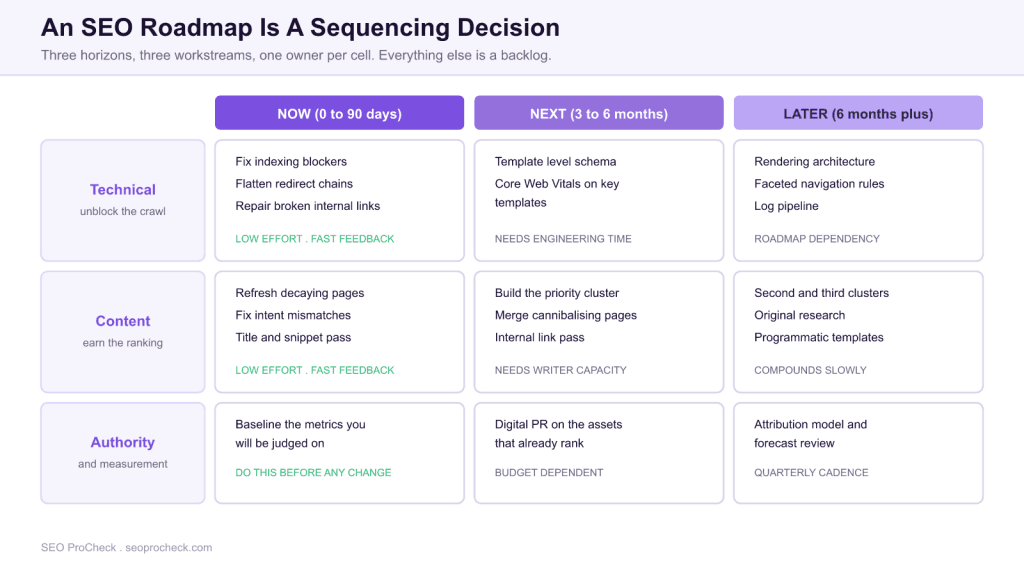
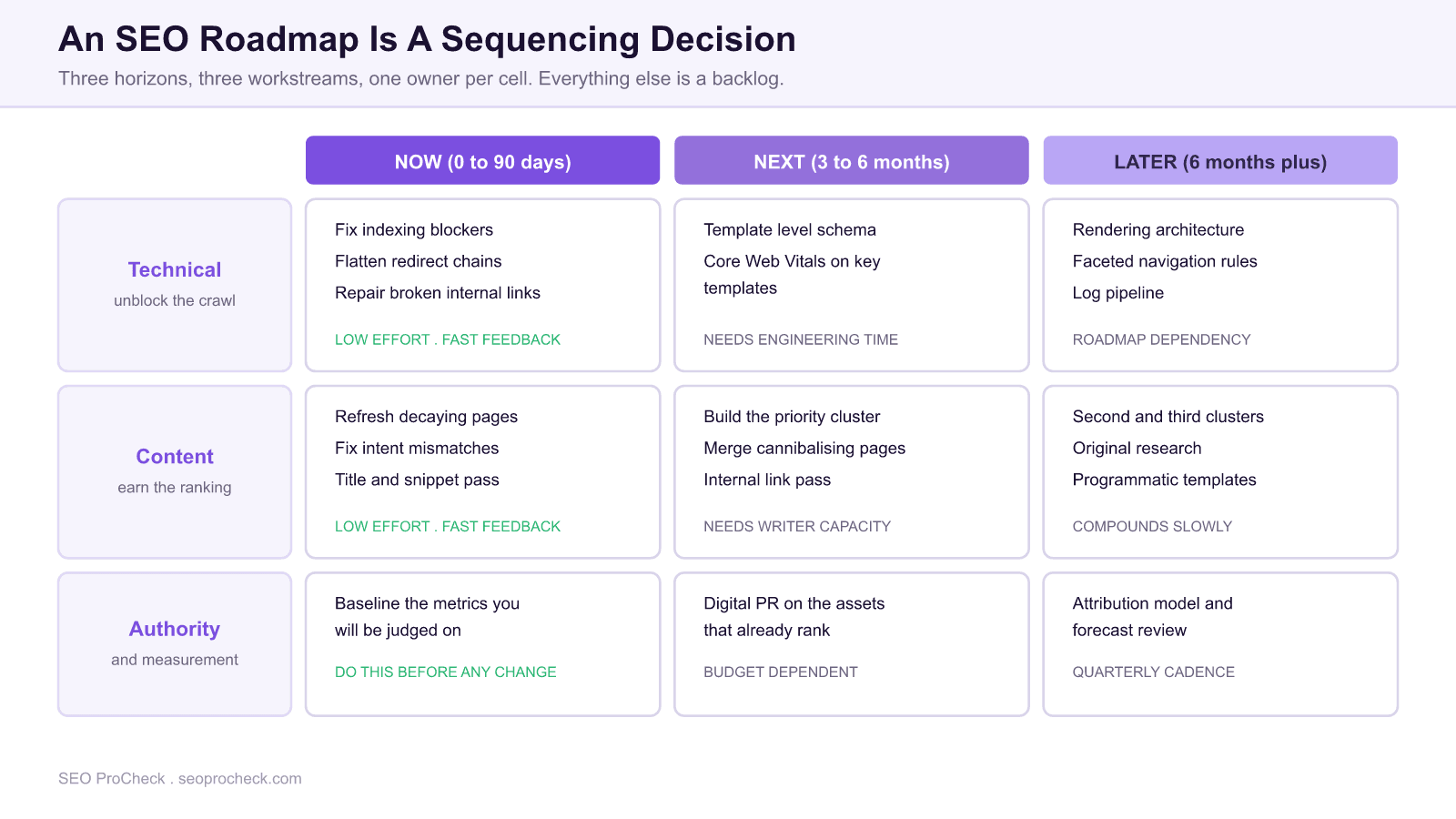
An SEO roadmap is a sequencing decision, not a task list: it states what gets done in the next 90 days, what is queued behind it, and what is deliberately deferred, with one owner per item. The structure that survives contact with a real organisation is three horizons (Now, Next, Later) crossed with three workstreams (technical, content, authority).
- Sequence by dependency and feedback speed, not by estimated impact, because impact estimates are guesses and dependencies are facts.
- Baseline your metrics before the first change ships, or you will never be able to prove the roadmap worked.
- Every item needs a named owner outside the SEO team when the work is done by engineering or editorial.
- A roadmap with no "not doing this" section is a wish list. The deferral list is the part that makes it a plan.
Most SEO roadmaps fail for the same reason: they are audit findings sorted by severity and handed to people who cannot action them. An audit tells you what is wrong. A roadmap decides what happens first, who does it, what it depends on, and what you are consciously choosing not to do this quarter. Those are different documents, and the second one is the one that gets budget.
The structure below is deliberately plain. It fits on one screen, it maps onto the way engineering and editorial teams already plan, and it forces the two decisions people avoid: sequencing and deferral. Copy the tables directly.
The roadmap template
One row per initiative. The columns exist because each one has, at some point, been the reason a roadmap item silently died.
| Column | What goes in it | Why it earns a column |
|---|---|---|
| Initiative | "Flatten redirect chains on category URLs" | Named as an outcome, not as "fix redirects." Vague items never get estimated. |
| Workstream | Technical, content, or authority | Different teams, different queues. Mixing them hides the fact that one lane is empty. |
| Horizon | Now, Next, or Later | Dated quarters go stale in three weeks. Horizons survive slippage. |
| Owner | A person, not a team | If the doer sits in engineering, the owner is in engineering. SEO cannot own work it cannot ship. |
| Depends on | The blocking item, or "nothing" | This column alone re orders most roadmaps the first time it is filled in honestly. |
| Effort | Days of the owning team's time | In the currency of whoever does the work, so it can be compared to their other commitments. |
| Success metric | The one number, and its baseline today | Chosen before the work starts. Picked afterwards, it is always the one that moved. |
| Feedback speed | Weeks until you can tell if it worked | The most underrated sequencing input. Fast feedback early buys credibility for slow bets later. |
How to decide what goes in Now
The instinct is to sort by expected impact. Resist it, because impact estimates before the fact are the least reliable number on the page. Sequence on the things you can actually know.
| Horizon | Admission criteria | Typical items |
|---|---|---|
| Now 0 to 90 days | No dependencies, effort measured in days, feedback within weeks, and the work is reversible. | Indexing blockers, redirect chains, broken internal links, intent mismatches on existing pages, title and snippet passes, metric baselining. |
| Next 3 to 6 months | Needs a resource you must schedule (engineering sprint, writer capacity, budget), but the requirements are already understood. | Template level schema, Core Web Vitals on key templates, the first content cluster, merging cannibalising pages, digital PR. |
| Later 6 months plus | Depends on an unfinished item, or on a decision nobody has made yet, or the payback is genuinely long. | Rendering architecture, faceted navigation rules, log pipeline, second and third clusters, original research, attribution modelling. |
Two rules keep this honest. First, the Now column has a hard capacity limit equal to the time actually available, so adding something means removing something. Second, an item cannot sit in Now if its "depends on" cell points at anything in Next or Later. That single check catches the most common roadmap defect, which is a headline initiative scheduled before the work it silently requires.
Baselining belongs in Now for a reason that has nothing to do with impact. If the first technical fix ships before you recorded where things stood, every later claim about the roadmap's value becomes an argument rather than a measurement. Do it in week one, even though it feels like overhead.
Understanding User Intent
Intent research is the input that decides which content work is worth sequencing at all, which is why it belongs in the roadmap rather than in a separate document nobody opens. For each priority query set, establish what the searcher is actually trying to accomplish and what format currently satisfies it, then compare that against what your page is. The gap tells you whether the fix is a rewrite, a new page, a merge, or nothing.
The reason this drives sequencing is that intent mismatches are usually cheap to fix and fast to read. A page that ranks on page two for a commercial query while being written as a definition is a rewrite of a page that already has traction, not a net new build. Those go in Now. Building a cluster to attack a query set where you have no presence at all is slower and less certain, so it goes in Next. Distinguishing the two requires actual query research rather than assumption, which is the groundwork covered in keyword research fundamentals.
Write the intent conclusion into the roadmap row itself. "Rewrite as a comparison page, currently a definition" is a brief. "Improve this page" is not, and it will come back from the writer as something you did not want.
Quality and Comprehensiveness
A roadmap has to fund a quality bar or it will quietly fund volume instead. The failure mode is familiar: the plan says twelve articles a quarter, the budget supports twelve articles a quarter at a certain cost each, and the resulting pages are thin because nobody wrote down what "done" meant. Define the bar as part of the roadmap, not as a style guide appendix.
Practically, that means each content initiative carries its own definition of done: the questions the page must answer, the assets it needs (tables, diagrams, examples), the internal links it must place and receive, and who reviews it against those criteria. When capacity gets squeezed, and it will, this is what lets you ship six complete pages instead of twelve incomplete ones. Reducing scope is a legitimate roadmap response. Reducing quality while keeping the count is how a site accumulates pages that dilute it.
Before adding anything, it is worth knowing what you already have. A content audit frequently converts a chunk of the "create" budget into a cheaper and faster "consolidate and improve" line, and that reallocation is one of the highest return decisions available at planning time.
Content Lifecycle Management
Every roadmap needs a lane that never empties. Published content decays, competitors update, products change, and a plan that allocates all capacity to new work guarantees that this quarter's wins become next year's decline. Reserve a fixed share of content capacity for maintenance from the start, so it is a planned commitment rather than an emergency response.
The trigger for maintenance should be a metric, not a calendar. Reviewing everything annually wastes effort on pages that are fine; reviewing pages that have lost sustained impressions or slipped in position puts the effort where it pays. Keep a standing review that lists declining pages, and let that list feed the maintenance lane each cycle. When a page comes up, the decision is genuinely one of update, merge, or leave it, and leaving it alone is a legitimate outcome that saves capacity for pages where the work matters.
Migrations deserve explicit roadmap treatment rather than being absorbed into a maintenance lane. A replatform or restructure can undo a year of gains in a weekend, and it needs its own sequencing, its own owner and its own pre launch and post launch checks, as set out in site migration planning.
What kills roadmaps
- No deferral list. If nothing is explicitly not happening, stakeholders assume everything is happening, and the roadmap fails by comparison to an imagined one. Write the "not this quarter" list and share it.
- Effort estimated by the wrong team. An SEO estimating engineering effort produces a number engineering will not honour. Get the estimate from whoever writes the code.
- Items with no owner outside SEO. Work that requires another team but is owned by SEO does not get scheduled, it gets discussed.
- Success metrics chosen after the fact. Recording the baseline and the target metric before the work starts is what separates a result from a story.
- Technical debt scheduled last. Content on a site that crawls badly underperforms, so the sequencing has to unblock the crawl before it funds the writing. A technical SEO audit is the input that populates the Now column of the technical lane.
- Quarterly rewrites. A roadmap rebuilt from scratch every quarter signals that none of it was ever a commitment. Review and re sequence, but keep the document continuous so slippage is visible.
FAQ
An audit is a diagnosis: it lists what is wrong and how serious each issue is. A roadmap is a plan: it decides the order, assigns an owner and an effort estimate to each item, records dependencies, and states what is deliberately deferred. Handing an audit to stakeholders as if it were a plan is the most common reason SEO work stalls.
Use horizons rather than dates: roughly 90 days for committed work, three to six months for scheduled work, and beyond six months for items with unresolved dependencies. Dated quarterly plans go stale as soon as one item slips, whereas horizons absorb slippage without invalidating the document.
Anything blocking crawling or indexing comes first, because content on pages that cannot be crawled or indexed cannot pay back. Beyond that hard blocker, the two lanes run in parallel: technical work often waits on an engineering sprint, and that waiting time is exactly when content work should be progressing.
Sort on facts rather than forecasts. Dependencies, effort in the owning team's days, and how quickly you will be able to tell whether it worked are all knowable now; projected impact is not. Front load items with no dependencies and fast feedback, because early demonstrable results are what fund the slower structural work.
Whoever can actually ship it. If the work is a template change, the owner sits in engineering; if it is a rewrite, the owner sits in editorial. SEO owns the specification, the sequencing and the measurement, but assigning ownership of work to a team that cannot execute it is how items sit untouched for a quarter.
Review monthly and re sequence quarterly. The monthly pass checks whether committed items are moving and whether anything has become blocked; the quarterly pass promotes items from Next into Now and revisits the deferral list. Rebuilding the whole document each quarter defeats the purpose, because it hides which commitments kept slipping.
Source: https://thegray.company/blog/how-to-build-seo-roadmap
Take this with you
The assistant links open with a question about this page already written. Nothing is sent until you press enter.
Claude Vincent is a technical SEO consultant focused on crawlability, rendering, and AI-search visibility. He writes the field guides and case studies at SEO ProCheck, with a bias toward the durable, unglamorous work that decides whether search engines and AI answer engines can actually read and cite a site.
About SEO ProCheck
Technical SEO consulting and GEO strategy with 20 years of enterprise experience. Case studies, resources, and tools for search and AI visibility.
Work With Me
Technical SEO audits, GEO strategy, site migrations, and international SEO. Hourly consulting for teams who need hands-on support, not just reports.
Subscribe to our newsletter!








Recent Posts
- Most Top Sites Never Say Who They Are in Structured Data October 14, 2026
- Homepage Titles Are Mostly Too Short, Not Too Long October 8, 2026
- Who Actually Serves an llms.txt? 184 Top Sites Measured September 29, 2026