

AI Summary
Topical authority mapping is the practice of planning comprehensive, interlinked coverage of a subject so AI systems and search engines see you as a trusted source on it. You build a pillar page, surround it with intent specific cluster pages, audit for gaps, and link everything so context flows between pages.
- Element code CO-016, a content strategy check for AI visibility.
- A topic map has a pillar hub, supporting clusters, and internal links that connect them.
- Depth on one topic map beats thin coverage spread across many unrelated subjects.
- Gap audits find the entities and questions your competitors cover and you do not.
Quick Reference
Element Code: CO-016
Issue: No strategic mapping of topical authority for AI visibility
Impact: Scattered efforts
Fix: Create strategic topical authority map for GEO
Detection: Content strategy analysis
What Is This Issue?
Strategic focus on key topics produces better results than scattered content.
Why This Matters for Your Website
Focused effort builds stronger authority than breadth.
How to Fix This Issue
- Identify topics: Where should you be authoritative?
- Map coverage: What exists vs needed?
- Build systematically: Comprehensive coverage
Tools for Detection
- Content strategy: Map topical authority
AI Search and GEO Considerations
Strategic topical authority building is core GEO strategy.
TL;DR (The Simple Version)
Create a strategic map of topics where you want AI visibility. Focus efforts on comprehensive coverage.
What a topic map is
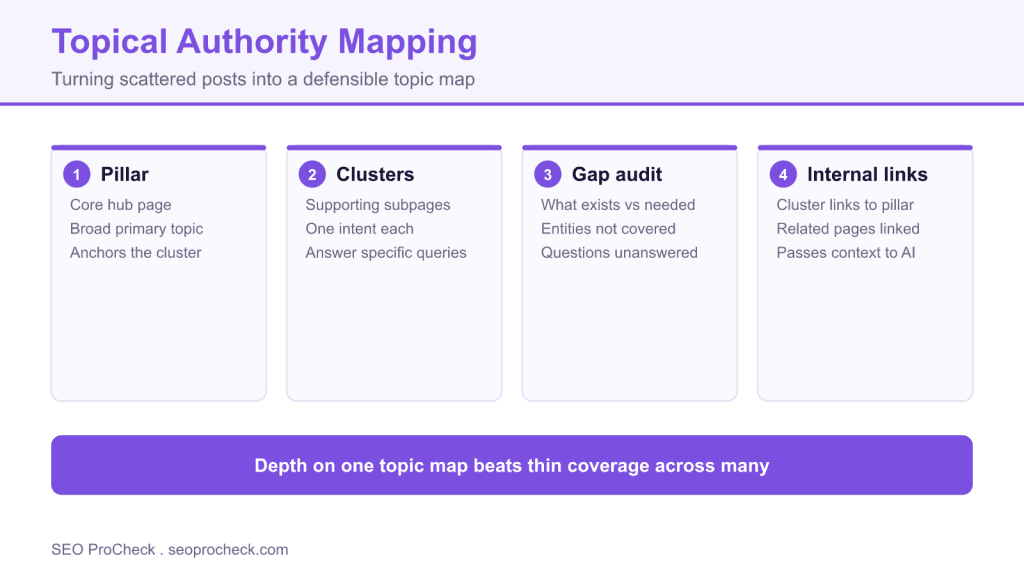
A topic map is a deliberate plan for covering a subject completely rather than publishing whatever comes to mind. It has three moving parts: a pillar page that anchors the broad topic, a set of cluster pages that each answer one specific intent, and an internal link structure that ties them together so a model can follow the relationships between them.
The four stages in practice
- Pick the pillar. Choose a topic broad enough to support many subpages but narrow enough that you can genuinely be authoritative on it. The pillar page gives an overview and links out to every cluster.
- Define clusters by intent. Each cluster page targets one clear question or task, not a keyword variant of another page. One intent per page keeps the map clean and prevents cannibalization.
- Run a gap audit. List the entities, subtopics, and questions a complete resource would cover, then mark what exists, what is thin, and what is missing. Competitor pages and the "people also ask" set are useful inputs here.
- Wire the internal links. Every cluster links up to the pillar, the pillar links down to every cluster, and closely related clusters link to each other. This link graph is how context passes to AI systems and how authority concentrates.
Why AI systems reward mapped coverage
Retrieval and answer systems build a picture of which sites cover a topic thoroughly. When your pages consistently cover the entities and questions that belong to a subject, and link them coherently, you become a repeated candidate for answers across that whole topic rather than for one lucky query. Scattered one off posts, by contrast, never accumulate into that signal.
Measuring authority growth
You cannot read a topical authority score off a dashboard, but you can track proxies. Watch the number of distinct queries a topic cluster ranks for in Search Console, the share of cluster pages earning impressions, and how often your pages appear as citations when you test AI answers across the topic. Growth in the breadth of queries, not just the volume, is the clearest sign the map is working.
What changed since: entity based coverage now matters as much as keyword coverage. AI systems reason about the concepts a topic contains, so a map that covers the full set of related entities and their relationships outperforms one that merely repeats a head keyword across many thin pages.
Reference table
| Mapping stage | Question it answers | Output |
|---|---|---|
| Pillar selection | Where do we want to be authoritative? | One broad hub page |
| Cluster definition | What specific intents support the pillar? | A list of one intent subpages |
| Gap audit | What exists versus what is needed? | A prioritized content backlog |
| Internal linking | How does context flow between pages? | A pillar and cluster link graph |
Frequently Asked Questions
What is topical authority mapping?
It is planning comprehensive, interlinked coverage of a subject so search engines and AI systems treat you as a trusted source on it. The map has a pillar hub, intent specific cluster pages, and internal links that connect them.
What is the difference between a pillar and a cluster?
A pillar is a broad hub page that introduces the whole topic and links to everything below it. A cluster is a focused page that answers one specific intent within that topic and links back up to the pillar.
How do I find content gaps?
List every entity, subtopic, and question a complete resource on the subject would cover, then mark what you already have, what is thin, and what is missing. Competitor coverage and people also ask results are useful inputs for the list.
How many cluster pages does a topic need?
There is no fixed number. Aim to cover every distinct intent and entity that belongs to the topic, with one page per intent. Depth and completeness matter more than hitting a page count, and thin filler pages can dilute the map.
Does internal linking really affect AI visibility?
Yes. Internal links pass context between related pages and concentrate authority on the pillar. A coherent link graph helps AI systems understand how your pages relate, which supports being surfaced across a whole topic rather than one query.
How do I measure topical authority?
Track proxies rather than a single score: the number of distinct queries a cluster ranks for, the share of cluster pages earning impressions, and how often your pages are cited when you test AI answers across the topic.
Related SEO ProCheck checks
- AI Citation Worthiness Score
- Definition Box Optimization
- Content Freshness Score
- All content and GEO checks
Take this with you
The assistant links open with a question about this page already written. Nothing is sent until you press enter.
Claude Vincent is a technical SEO consultant focused on crawlability, rendering, and AI-search visibility. He writes the field guides and case studies at SEO ProCheck, with a bias toward the durable, unglamorous work that decides whether search engines and AI answer engines can actually read and cite a site.
About SEO ProCheck
Technical SEO consulting and GEO strategy with 20 years of enterprise experience. Case studies, resources, and tools for search and AI visibility.
Work With Me
Technical SEO audits, GEO strategy, site migrations, and international SEO. Hourly consulting for teams who need hands-on support, not just reports.
Subscribe to our newsletter!








Recent Posts
- Most Top Sites Never Say Who They Are in Structured Data October 14, 2026
- Homepage Titles Are Mostly Too Short, Not Too Long October 8, 2026
- Who Actually Serves an llms.txt? 184 Top Sites Measured September 29, 2026