

AI Summary
Handling expired or outdated articles means deciding, page by page, whether to update, consolidate, keep, or remove them rather than letting them rot in the index. The right choice depends on whether the page still has value, whether it overlaps a stronger page, and whether it has earned links, so a quick audit beats a blanket delete.
- Update and keep the URL when a page still has traffic, rankings, or relevance worth refreshing.
- Consolidate and 301 redirect when a page overlaps a stronger one covering the same topic.
- Never let a page that earns backlinks simply 404, redirect it so the equity is preserved.
- Use 410 or noindex only for genuinely dead, link free pages that add nothing but bloat.

Every content site eventually accumulates articles that have gone stale: a guide to a discontinued feature, a news post about an event long past, a roundup of tools that no longer exist. Left alone, these pages drag on quality signals, waste crawl budget, and confuse users who land on them. But the reflex to simply delete everything old is a mistake. The right approach is a short decision process applied to each page.
Start with an honest audit
Before touching anything, gather the data for each candidate URL: current organic traffic, ranking keywords, backlinks pointing to it, and how well it still matches search intent. Those four inputs decide the outcome. A page with no traffic but a handful of strong backlinks needs completely different treatment from a page with no traffic and no links. Skipping the audit is how sites accidentally delete pages that were quietly holding valuable links or still ranking for a term nobody remembered.
The four outcomes
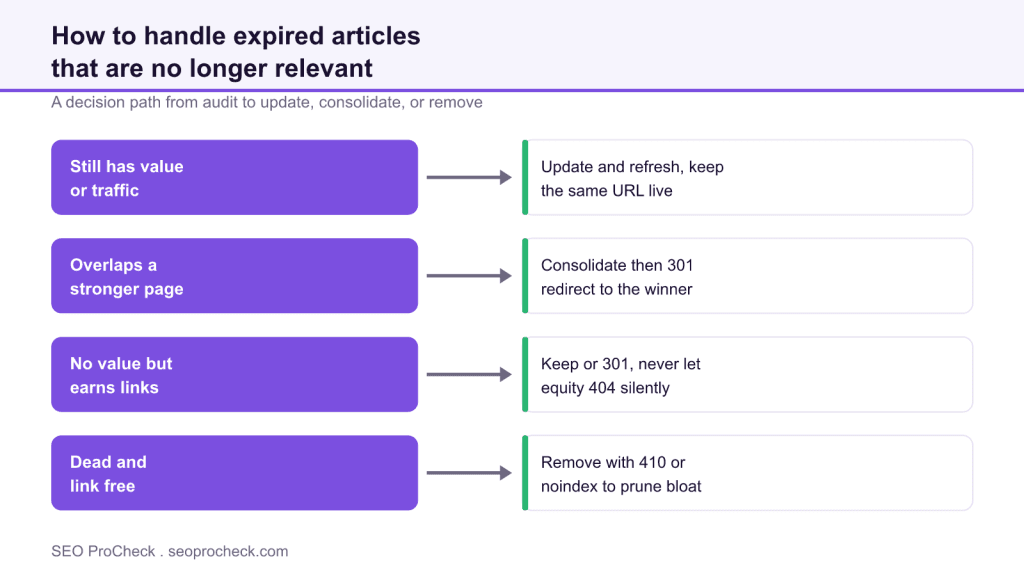
Almost every expired article resolves into one of four decisions:
- Update and keep the URL. If the topic is still relevant and the page still earns traffic or rankings, refresh the content, correct outdated facts, and keep the same URL so it retains its history. This is usually the highest value move because you are building on equity you already own.
- Consolidate and redirect. If the page overlaps a stronger article covering the same ground, merge the useful parts into the winner and 301 redirect the weaker URL to it. You concentrate authority instead of splitting it across near duplicates.
- Keep or redirect for the links. If a page has little traffic but earns backlinks, do not let it die into a 404. Either keep it and refresh lightly, or 301 redirect it to the most relevant live page so the link equity flows somewhere useful.
- Remove cleanly. If a page is genuinely dead, has no traffic, no rankings, and no links, then pruning it is fair. Use a 410 to tell Google it is gone for good, or noindex if you want to keep it accessible but out of search.
That last category connects to a broader technical health metric. Watching your content pruning rate helps you keep a large site lean without cutting so aggressively that you remove pages that were still pulling their weight.
A decision table for expired content
The table below turns the four outcomes into a quick lookup you can apply during an audit.
| Page situation | Action | Technical method |
|---|---|---|
| Still relevant, still gets traffic | Update and refresh | Keep the same URL, 200 |
| Overlaps a stronger page | Consolidate | 301 redirect to the winner |
| Low traffic but earns backlinks | Preserve equity | Keep or 301 to a relevant page |
| Dead, no traffic, no links | Remove | 410 gone, or noindex |
| Outdated but easily corrected | Fix in place | Edit content, keep URL |
Handle the redirects carefully
Whenever you consolidate or remove a page with links, the redirect target matters. Sending an old URL to a closely related page passes its value cleanly. Dumping every retired URL onto the homepage does not, because Google often treats an irrelevant redirect as a soft 404 and drops the equity anyway. Map each redirect to the most relevant live destination, and check that you are not creating long redirect chains that dilute the signal and slow crawling.
What has changed with the helpful content era
Managing expired content used to be mostly about tidiness. Since Google's helpful content systems began rewarding sites that are consistently useful and demoting those padded with unhelpful pages, pruning and refreshing outdated articles has become a genuine ranking lever. A large stock of stale, thin, or irrelevant pages can weigh on how the whole site is judged. The core method has not changed, though: audit before you act, preserve value where it exists, and remove only what truly adds nothing. Do that on a schedule rather than in a panic and your site stays both lean and trustworthy.
The original summary and source for this entry are preserved below.
How To Deal With Expired Articles That Are No Longer Relevant provides valuable insights for SEO practitioners. This resource examines approaches and considerations that can improve organic search performance.
Key Concepts
Understanding the fundamental principles behind this topic helps inform strategic decisions. Whether optimizing for traditional search or emerging AI platforms, foundational concepts remain relevant. This resource covers the essential knowledge practitioners need.
Implementation Considerations
Moving from concept to execution requires understanding practical constraints and opportunities. Different situations call for different approaches. This resource provides guidance for applying concepts in real-world contexts.
Measuring Impact
SEO efforts require measurement to demonstrate value and guide optimization. Identifying appropriate metrics, establishing baselines, and tracking progress enables data-driven improvement. This resource addresses how to evaluate success.
This resource contributes to the knowledge base SEO practitioners need for effective optimization in an evolving search landscape.
Frequently asked questions
What should I do with expired or outdated articles?
Audit each one and choose from four outcomes: update and keep the URL, consolidate and redirect to a stronger page, preserve it for its backlinks, or remove it cleanly if it is truly dead. Avoid blanket deletion.
Should I delete old content for SEO?
Only if a page has no traffic, no rankings, and no backlinks. Deleting pages that still earn links or rankings can lose value. Updating or redirecting is usually better than deleting.
When should I use a 301 redirect for old content?
When a page overlaps a stronger page or has backlinks worth keeping. Redirect it to the most relevant live page so its equity is preserved, and avoid pointing everything at the homepage.
What is the difference between 410 and noindex for dead pages?
A 410 tells Google the page is permanently gone and should be removed from the index. Noindex keeps the page accessible to users but excludes it from search. Use 410 for true removals and noindex when you still want the page available.
Does pruning old content help rankings?
It can. Google's core ranking systems, which absorbed the helpful content system in March 2024, reward sites that are consistently useful, so removing or refreshing large amounts of stale, thin content can improve how the whole site is judged.
How often should I audit for expired content?
Run a content audit on a regular schedule, such as quarterly or twice a year, rather than reacting in a panic. Regular reviews keep the site lean and prevent stale pages from piling up.
Take this with you
The assistant links open with a question about this page already written. Nothing is sent until you press enter.
Claude Vincent is a technical SEO consultant focused on crawlability, rendering, and AI-search visibility. He writes the field guides and case studies at SEO ProCheck, with a bias toward the durable, unglamorous work that decides whether search engines and AI answer engines can actually read and cite a site.
About SEO ProCheck
Technical SEO consulting and GEO strategy with 20 years of enterprise experience. Case studies, resources, and tools for search and AI visibility.
Work With Me
Technical SEO audits, GEO strategy, site migrations, and international SEO. Hourly consulting for teams who need hands-on support, not just reports.
Subscribe to our newsletter!








Recent Posts
- Most Top Sites Never Say Who They Are in Structured Data October 14, 2026
- Homepage Titles Are Mostly Too Short, Not Too Long October 8, 2026
- Who Actually Serves an llms.txt? 184 Top Sites Measured September 29, 2026