

AI Summary
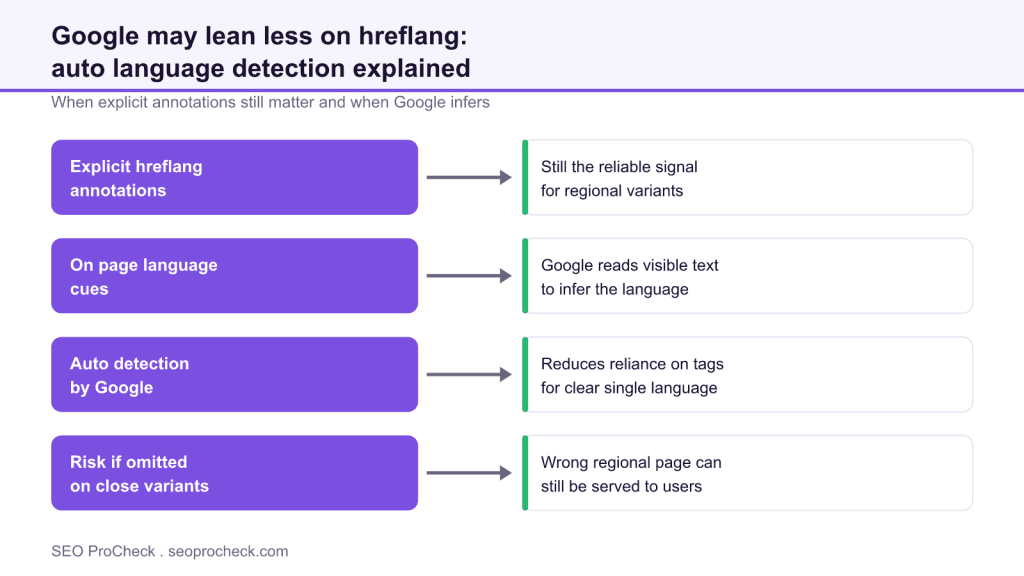
Reports that Google may rely less on hreflang point to Google getting better at detecting a page's language automatically from its visible content. Explicit hreflang annotations still matter for choosing between regional variants of the same language, so the practical advice is to keep correct hreflang in place while making sure your on page language signals are unambiguous.
- hreflang tells Google which language and regional version of a page to serve to which users.
- Google increasingly infers the primary language of a page from its visible text.
- Auto detection helps most for clearly single language pages, less for close regional variants.
- Removing hreflang on similar variants like US and UK English can cause the wrong page to be served.

Every so often a report circulates that Google is going to lean less on hreflang, and international SEOs brace themselves. The nuance usually gets lost in the headline. Google is not abandoning hreflang. It is getting better at working out a page's language on its own, which reduces how much it needs the annotation in some cases but not in others. Understanding where the line falls is what keeps you from making an expensive mistake.
What hreflang actually does
hreflang is an annotation that tells Google two things about alternate versions of a page: the language and, optionally, the region they are meant for. When it is set up correctly, a searcher in France is served the French page and a searcher in Canada is served the Canadian version, even when the underlying content is similar. It is a targeting signal, not a ranking boost. Its whole job is to make sure the right existing page reaches the right audience.
Why Google can lean on it less
Detecting the language of a page is something modern systems do well. If a page is written entirely in Japanese, Google does not need a tag to tell it that, the visible text makes it obvious. As that language detection has improved, the annotation becomes redundant for the straightforward case of a page in one clear language with no near duplicate variant in another. For those pages, a missing or slightly wrong hreflang tag matters less than it used to, because Google can fall back on what it reads on the page itself.
Where hreflang still matters a lot
The reliance drops for clear cut single language pages. It does not drop for the hard case that hreflang was invented to solve: distinguishing between regional variants of the same language. US English and UK English pages look almost identical to a language detector. So do Spanish pages aimed at Spain versus Mexico, or Portuguese aimed at Portugal versus Brazil. Auto detection cannot reliably tell those apart from the text alone, so the explicit regional signal in hreflang remains the dependable way to make sure a British user does not land on the American page with the wrong prices, spelling, and shipping. This is one of the classic international SEO mistakes to avoid: stripping out hreflang because you heard Google needs it less, then watching the wrong regional page get served.
When to keep, simplify, or rely on detection
The decision comes down to how similar your variants are. The table below summarises how I advise clients to handle each situation.
| Situation | Auto detection reliable? | Recommendation |
|---|---|---|
| Single page in one clear language | Yes | hreflang optional but harmless to keep |
| Different languages, one per market | Mostly | Keep hreflang for cleaner targeting |
| Same language, different regions | No | Keep hreflang, it is essential here |
| Broken or non reciprocal tags | Not applicable | Fix or remove, never leave errors live |
Practical takeaways
Keep correct hreflang in place, especially for same language regional variants, because that is the scenario auto detection cannot solve. At the same time, do not treat hreflang as a substitute for clear on page signals. Make the visible language of each page unambiguous, set the html lang attribute correctly, use local currency and spelling, and keep your annotations accurate and reciprocal. If Google can read your intent from the page and confirm it from the tag, you get the best of both systems.
What has changed since this news broke
Since the original report, Google representatives have repeated that hreflang remains supported and useful, particularly for regional targeting, and that improved language detection is a complement rather than a replacement. Nothing in the update justifies tearing out a working hreflang setup. The sensible response is maintenance, not removal: audit your existing annotations for errors and reciprocity, fix the broken ones, and make sure your on page language cues back up whatever your tags claim.
The original summary and source for this entry are preserved below.
Google May Rely Less On Hreflang, Shift To Auto Language Detection provides valuable insights for SEO practitioners. This resource examines approaches and considerations that can improve organic search performance.
Key Concepts
Understanding the fundamental principles behind this topic helps inform strategic decisions. Whether optimizing for traditional search or emerging AI platforms, foundational concepts remain relevant. This resource covers the essential knowledge practitioners need.
Implementation Considerations
Moving from concept to execution requires understanding practical constraints and opportunities. Different situations call for different approaches. This resource provides guidance for applying concepts in real-world contexts.
Measuring Impact
SEO efforts require measurement to demonstrate value and guide optimization. Identifying appropriate metrics, establishing baselines, and tracking progress enables data-driven improvement. This resource addresses how to evaluate success.
This resource contributes to the knowledge base SEO practitioners need for effective optimization in an evolving search landscape.
Frequently asked questions
Is Google getting rid of hreflang?
No. Google is getting better at detecting a page's language automatically, which reduces its reliance on hreflang for simple cases, but the annotation is still supported and still important for regional targeting.
What is hreflang used for?
hreflang tells Google which language and, optionally, which regional version of a page to serve to which users. It ensures the right existing page reaches the right audience rather than boosting rankings.
When can I rely on Google's automatic language detection?
When a page is written in one clear language with no near duplicate variant in another language, Google can usually infer the language from the visible text without needing hreflang.
When is hreflang still essential?
For distinguishing regional variants of the same language, such as US and UK English or Spain and Mexico Spanish. Language detection cannot reliably tell those apart, so the explicit signal is needed.
Should I remove my hreflang tags?
No. Removing correct hreflang, especially on same language regional variants, can cause Google to serve the wrong page. Audit and fix your tags instead of deleting them.
What on page signals support language targeting?
Set the html lang attribute correctly, use local spelling and currency, keep the visible content clearly in the intended language, and make sure your hreflang annotations are accurate and reciprocal.
Claude Vincent is a technical SEO consultant focused on crawlability, rendering, and AI-search visibility. He writes the field guides and case studies at SEO ProCheck, with a bias toward the durable, unglamorous work that decides whether search engines and AI answer engines can actually read and cite a site.
About SEO ProCheck
Technical SEO consulting and GEO strategy with 20 years of enterprise experience. Case studies, resources, and tools for search and AI visibility.
Work With Me
Technical SEO audits, GEO strategy, site migrations, and international SEO. Hourly consulting for teams who need hands-on support, not just reports.
Subscribe to our newsletter!





Recent Posts
- Can AI Crawlers Actually Read Your Site? I Measured 400 of the Biggest September 5, 2026
- The Pre-Publish Quality Gate for AI-Assisted Content August 6, 2026
- AGENTS.md vs llms.txt vs llms-full.txt: Which Agent File Does What July 18, 2026