AI Summary
A "Why Us" page is a sales document, so read it as evidence rather than reassurance: the claims worth trusting are the ones a provider can prove with named clients, owned analytics and a written audit. The strongest filter is asking any prospective SEO partner to show a client whose organic revenue they grew and to explain exactly how they measured it.
- Credible signals are verifiable: references you can call, case studies with real numbers, and reporting you own.
- Guaranteed number-one rankings and secret methods are warning signals, not selling points.
- Judge a provider on business KPIs such as organic revenue and qualified leads, not raw ranking positions.
- AI search has raised the bar: a modern partner should speak to answer engines and E-E-A-T, not just blue links.
Why Us provides valuable insights for SEO practitioners. This resource examines approaches and considerations that can improve organic search performance.
Every SEO agency publishes a "Why Us" page, and almost every one of them promises expertise, results and partnership. Those words cost nothing to write, so they carry no information on their own. The useful skill for anyone hiring an SEO provider, whether an in house lead vetting an agency or a founder choosing a first consultant, is turning that page of adjectives into a short list of claims you can actually verify. This piece treats the "Why Us" page as a document to audit rather than a pitch to absorb.
What a Why Us page is really for
A provider writes a "Why Us" page to reduce the buyer's perceived risk. That is a legitimate goal, and a good page does it with proof. The problem is that the same layout, the same trust badges and the same superlatives are equally available to a specialist team and to a reseller who will outsource your account overseas the day the contract signs. The page cannot tell you which one you are reading. Only the evidence behind it can, and evidence is exactly what a weak provider leaves off.
So the first move is to mentally strip every unfalsifiable phrase. "Passionate about results," "data driven," "cutting edge" and "trusted by businesses" all survive deletion with no loss of meaning. What remains after you delete them is the real content: named clients, specific outcomes, a described process, and the people who will do the work. If almost nothing remains, that absence is itself the finding.
Credible signals versus warning signals
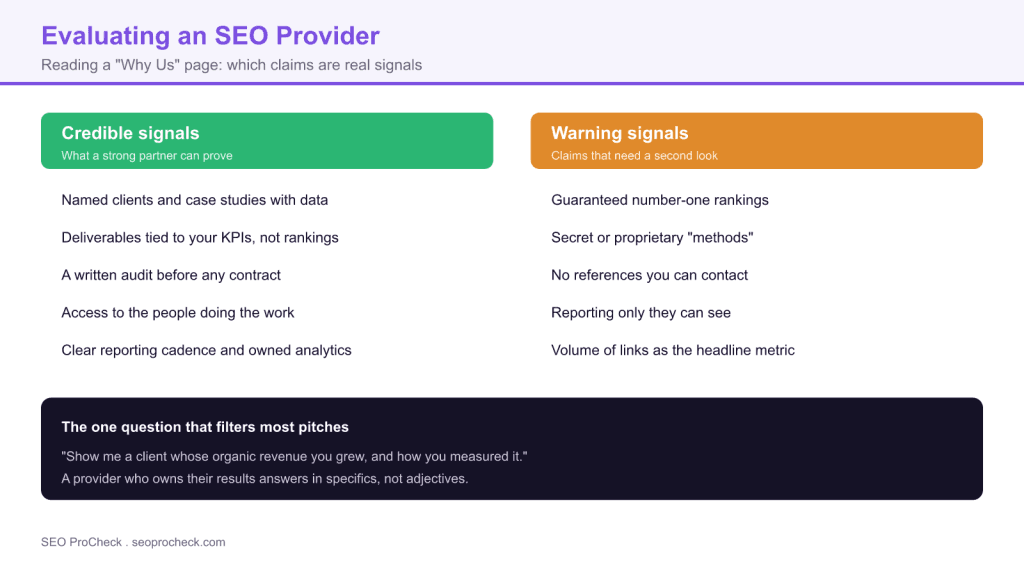
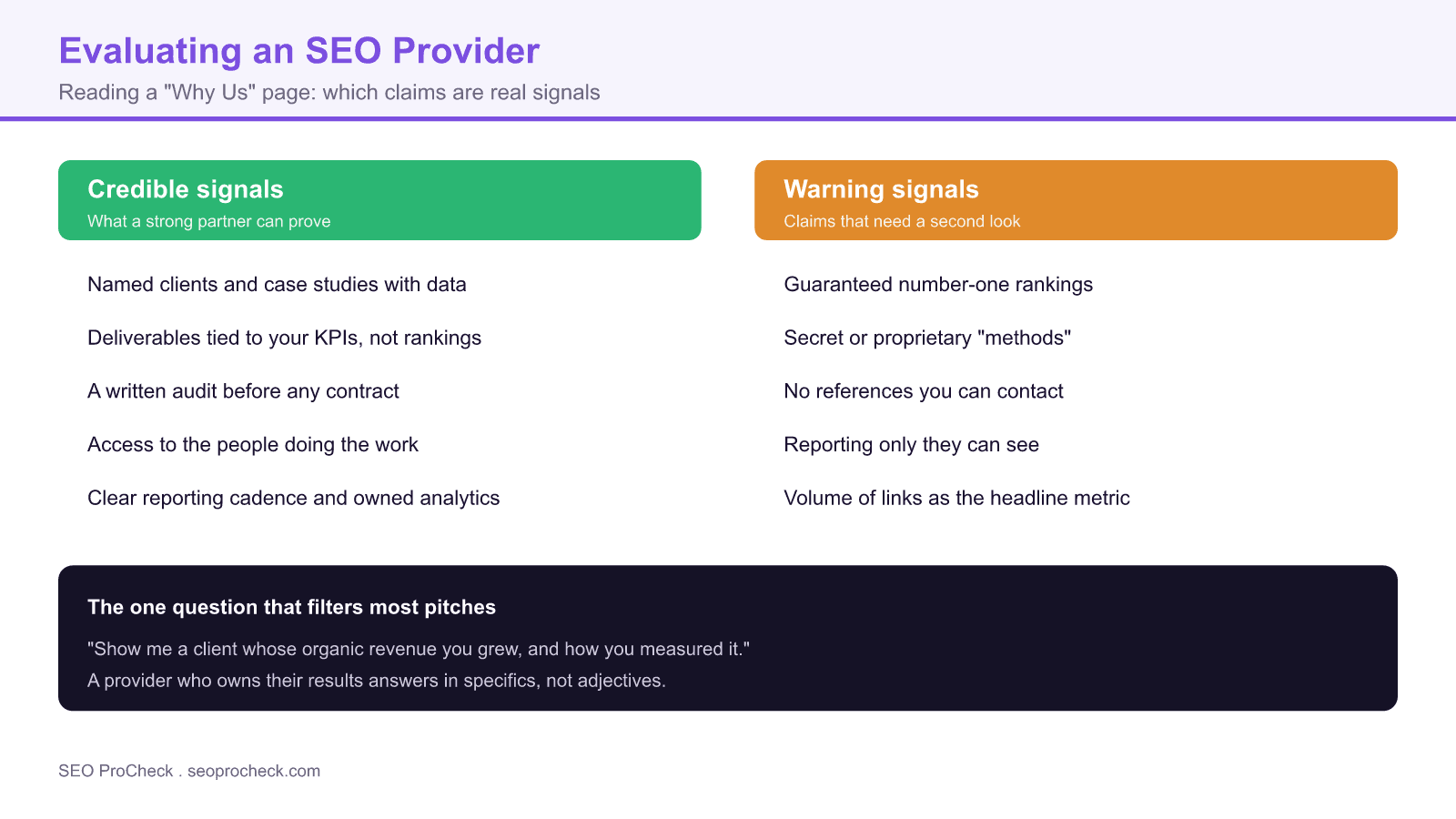
The diagram above splits the common claims into two columns. The dividing line is simple: can the claim be checked by someone outside the agency? A case study naming a client and a measured result can be checked, because you can contact that client. A promise of "number one on Google" cannot be checked in advance and, worse, is a promise no honest provider makes, because no one controls the ranking algorithm. Use the table below to convert each claim into a verification step before you take a call.
| Claim on the page | How to verify it | Reading |
|---|---|---|
| "Proven results for clients" | Ask for two references in your sector you can call | Specifics offered freely is a strong signal |
| "Guaranteed rankings" | Ask what happens to the fee if the guarantee misses | No one controls the algorithm, so treat as a red flag |
| "Proprietary process" | Ask them to walk you through one recent audit | Real process survives explanation; a secret one rarely does |
| "Transparent reporting" | Ask to see a sample report and who owns the analytics | Reporting inside your own property beats a locked dashboard |
| "Full service team" | Ask who specifically does the work and where | Access to the practitioners beats access to an account manager |
The questions that do the filtering
A short set of direct questions separates most providers faster than any page can. Ask each one and listen for whether the answer arrives in specifics or in adjectives.
- Show me a client whose organic revenue you grew, and how you measured it. A provider who owns their outcomes reaches for a named example and a metric. A weak one reaches for a testimonial slide.
- What would you not do for us? Every real strategy has trade offs. A provider who claims to do everything for everyone has no strategy, only capacity.
- Who owns the analytics, the site and the content when we part ways? The correct answer is always you. Providers who keep leverage in the accounts are protecting churn, not you.
- How do you approach AI overviews and answer engines? This one dates a provider instantly, as the next section explains.
What has changed in evaluating SEO providers
The "Why Us" template has barely moved in a decade, but the work behind it has changed enough that the old checklist misses things. Two shifts matter most when you read a provider's page today.
First, search results are no longer a clean list of ten blue links. Google AI Overviews, and answer engines such as ChatGPT and Perplexity, now satisfy a large share of informational queries without a click. A provider whose entire value proposition is "we get you to position one" is selling a smaller asset than they were in 2019. Ask how they think about being cited inside an AI answer, not only ranked beneath it. If the concept is new to them, that is useful information.
Second, Google has leaned hard into E-E-A-T and its helpful content signals, which reward demonstrated experience and penalise thin, scaled output. A modern partner should talk about author expertise, first hand evidence and genuine usefulness, not about publishing volume. If a provider still pitches "we will publish forty articles a month," they are describing the exact pattern recent updates suppress. The right conversation is about organic traffic that converts, sustained over quarters, rather than a spike of low value pages.
Turning the audit into a decision
Once you have stripped the adjectives, verified the checkable claims and asked the filtering questions, you usually have a clear read. A provider who offered references, explained their process, handed over a sample report and spoke fluently about AI search and business outcomes has earned a trial. One who deflected to superlatives, guarded their methods and measured success in rankings alone has told you what a paid engagement would feel like. Before any of that, run your own baseline so you can judge their claims against reality: our SEO checks give you an independent starting picture, and the wider articles library covers the individual signals a good provider should already be managing.
Frequently asked questions
Be very cautious. No provider controls Google's ranking algorithm, so no one can honestly guarantee a specific position. Guarantees usually rely on either low competition keywords nobody searches for, or fine print that voids the promise. A trustworthy provider forecasts ranges and ties commitments to work delivered, not to positions they cannot control.
Ask for two references in your sector you can actually call, ask to see a sample monthly report, ask who owns the analytics and content if you leave, and ask them to walk you through a recent audit. Finish with how they approach AI overviews and answer engines. The pattern of the answers, specific or vague, tells you more than any page.
Ask who specifically will do the work and where they sit. Resellers route your account to a third party the moment the contract signs, so they resist naming the practitioners and describing the process in detail. A specialist team introduces the people, shows their prior work and explains the workflow without hesitation.
The reporting should lead with business outcomes: organic revenue or leads, qualified organic sessions, and conversions from search. Rankings and impressions are useful diagnostics but poor headline metrics, because they can rise while revenue stays flat. Insist that the reporting lives inside analytics you own rather than a dashboard only the agency can access.
It matters more, because the criteria have shifted. A provider whose page and pitch still revolve entirely around ranking beneath ten blue links is selling a shrinking asset. Look for a partner who understands being cited inside AI overviews and answer engines, and who frames success as durable organic demand rather than a single ranking position.
Usually yes. A paid or sample audit shows how a provider actually thinks, surfaces the real state of your site, and lets you judge their depth before committing to a retainer. Providers confident in their work are comfortable putting findings in writing first. A refusal to show any analysis before signing is itself a data point.
Source: https://www.seodirect.org/why-us
Claude Vincent is a technical SEO consultant focused on crawlability, rendering, and AI-search visibility. He writes the field guides and case studies at SEO ProCheck, with a bias toward the durable, unglamorous work that decides whether search engines and AI answer engines can actually read and cite a site.
About SEO ProCheck
Technical SEO consulting and GEO strategy with 20 years of enterprise experience. Case studies, resources, and tools for search and AI visibility.
Work With Me
Technical SEO audits, GEO strategy, site migrations, and international SEO. Hourly consulting for teams who need hands-on support, not just reports.
Subscribe to our newsletter!