

AI Summary
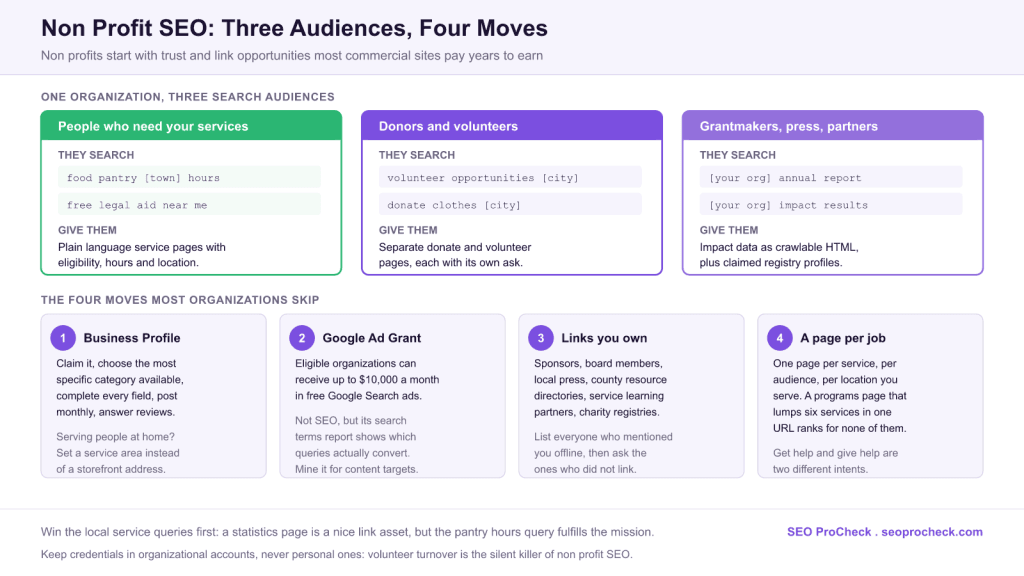
Non profit SEO comes down to four moves most organizations skip: claim and fully build out a Google Business Profile, apply for the Google Ad Grant, convert offline authority into backlinks, and build a separate page for every audience you serve. Non profits usually start with the trust and link opportunities commercial sites pay years to earn, so the gap is almost always execution rather than authority.
- One site serves three searchers at once: beneficiaries looking for services, supporters looking to give or volunteer, and grantmakers or journalists vetting you.
- Eligible organizations can receive up to $10,000 a month in free Google Search ads through the Google for Nonprofits program.
- Unlinked mentions from sponsors, partners and local press are the highest conversion link outreach that exists: you already earned the mention.
- Publish impact data as crawlable HTML rather than only as a PDF. PDFs rank poorly and rarely earn links.
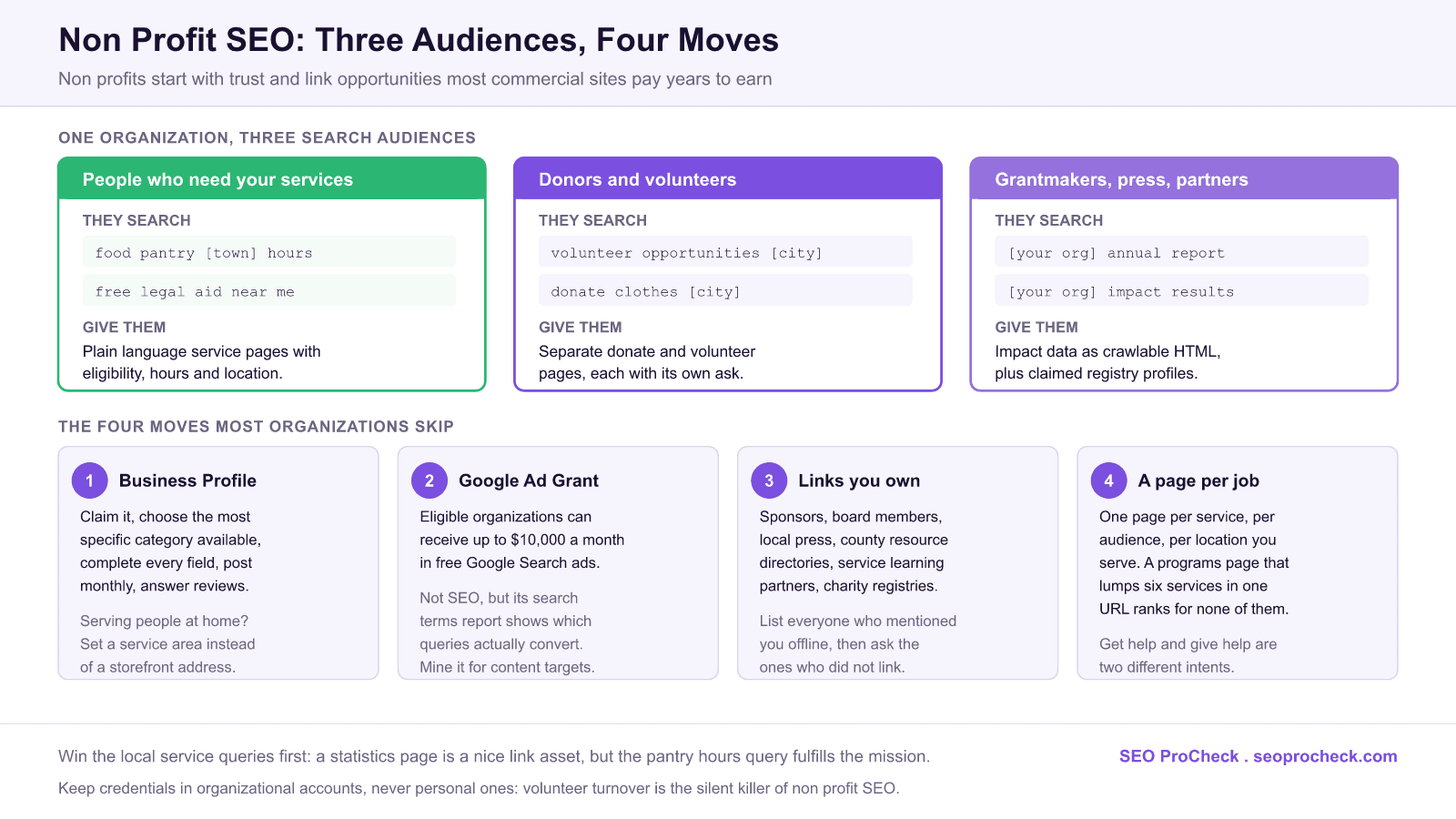
Non-profit SEO comes down to four moves most organizations skip: claim and fully build out a Google Business Profile, apply for the Google Ad Grant (up to $10,000/month in free Search ads), convert your natural authority (partners, press, .edu and .gov relationships) into backlinks, and build separate pages for each audience you serve: donors, volunteers, and the people who need your services. Non-profits typically start with link opportunities and community trust that commercial sites pay years to earn; the gap is almost always execution, not authority.
Understanding Local SEO for Non-Profits
Local SEO represents a critical component of modern SEO strategy, and for non-profits it is usually the highest-leverage channel: most searches that matter ("food bank near me," "volunteer opportunities [city]," "free legal aid [county]") are local queries answered by the map pack before the organic results. As search engines continue to evolve and user expectations shift, understanding the nuances of local SEO becomes essential for maintaining and improving organic visibility. The non-profit twist is that you are ranking for three different searcher types at once: beneficiaries looking for services, supporters looking to give or volunteer, and journalists or grantmakers vetting you. This guide covers the key concepts, implementation approaches, and strategic considerations that non-profit teams need to master.
The Non-Profit SEO Playbook
1. Google Business Profile first
Claim your profile at business.google.com, choose the most specific category available (e.g., "Non-profit organization" plus a service category like "Food bank" or "Animal shelter"), and complete every field: hours, service areas, photos of the actual facility and people, and the appointment/donation link. Keep your name, address and phone identical everywhere they appear, because inconsistent details across your site, your profile and the registries are the most common reason a small organization fails to consolidate into one map pack entity. Post monthly (events, drives, impact updates) because profile activity and review responses are visible trust signals. Ask engaged volunteers and (where appropriate and ethical) clients to leave reviews, and respond to all of them. If you serve people at home rather than at your office, set a service area instead of a storefront address.
2. The Google Ad Grant and what SEO owes it
Eligible 501(c)(3)s (and equivalents outside the US) can receive up to $10,000/month in Google Search ads through the Google for Nonprofits program. This is not SEO, but it shapes SEO strategy two ways: grant traffic reveals which queries actually convert to donations and sign-ups (mine the Ads search-terms report for organic content targets), and grant policy requires a quality website: the landing pages you build to keep the grant are the same pages that rank organically.
3. Turn your offline authority into links
Non-profits hold link assets most businesses can't buy: board members' companies, corporate sponsors (ask for a link in their CSR/community page, not just a logo swap), local news that covers your events, city and county resource directories, .edu partnerships with service-learning programs, and charity registries (Candid/GuideStar, Charity Navigator) whose profiles you should claim and complete regardless, since they double as citations. A concrete quarterly exercise: list every organization that mentioned you offline (every sponsor, partner, host venue, and press hit) and check which ones link. The unlinked mentions are your outreach list, and the ask ("could you link our name in that article?") converts far better than cold outreach.
4. Structure the site by audience and service
One page per service, per audience, per location you serve. "Programs" pages that lump six services into one URL can't rank for any of them. A food bank should have distinct pages for "get food assistance in [city]," "donate food," "volunteer at our warehouse," and "host a food drive": each matching a different query with different intent. Put impact numbers, eligibility criteria, and plain-language FAQs on the beneficiary pages; put outcomes and financials transparency on the donor pages.
Non-Profit SEO Priorities: Task, Where, Why
| Task | Where to do it | Why it matters / decision criteria |
|---|---|---|
| Claim + complete Google Business Profile | business.google.com; pick specific categories, add photos, post monthly | Wins the map pack for "near me" service and donation queries; free and usually uncontested locally |
| Apply for Google Ad Grant | Google for Nonprofits (validation via Goodstack/Percent) | $10k/month free Search ads; its search-terms report doubles as organic keyword research |
| Claim charity-registry profiles | Candid/GuideStar, Charity Navigator, BBB Wise Giving, state associations | Trusted links plus the pages donors and grantmakers actually check before giving |
| Reclaim unlinked mentions | Search Google News and sponsor/partner sites for your org name | Highest-conversion link outreach that exists; you already earned the mention |
| One page per service + audience | Site architecture / CMS | Distinct queries ("get help" vs "give help") need distinct pages to rank |
| Add NonprofitOrganization schema | Site-wide JSON-LD: "@type": "NGO" or NonprofitOrganization, with nonprofitStatus, address, sameAs to registry profiles | Disambiguates the entity for Google's Knowledge Graph and ties your site to your registry listings |
| Publish annual report / impact data as HTML | Convert the PDF into a crawlable page with tables | Original data earns citations and links; PDFs earn almost none |
| Event pages with Event schema | Each fundraiser/drive gets its own URL, kept live after the event | Ranks for recurring "[event] [city] [year]" searches; accumulated links compound year over year |
Key Considerations for Non-Profit Organization SEO Tips
When approaching local SEO, several factors require careful attention. Technical implementation must align with broader objectives while maintaining site performance and user experience. The balance between optimization and over-optimization requires ongoing monitoring and adjustment based on performance data and algorithm changes. Industry benchmarks and competitor analysis provide context: for a non-profit, "competitors" in the SERP sense are other organizations and government pages ranking for your service queries, and studying them shows which content formats Google expects. Non-profit-specific considerations: many organizations serve vulnerable populations, so write beneficiary pages at a plain-language reading level, in every language your community speaks: translated service pages are both a service obligation and an almost uncontested ranking opportunity. Accessibility (WCAG basics: alt text, heading structure, contrast) overlaps heavily with technical SEO and is often a funder requirement anyway. And resist the temptation to chase national informational keywords before your local service queries are won; a food-insecurity statistics page is a nice link asset, but "food pantry [your town] hours" is the query that fulfills the mission.
Implementation Best Practices
Successful implementation begins with thorough auditing of current state and clear goal definition. Document baseline metrics before making changes to enable accurate impact measurement: for a non-profit that means Search Console clicks segmented by branded vs. service queries, GBP views and direction requests, and donation/volunteer form completions in GA4. Prioritize changes based on potential impact and implementation effort, focusing on high-impact items first: for most small organizations that order is GBP, registry profiles, service-page architecture, then link reclamation. Test changes in staging environments when possible, and monitor closely after deployment. Maintain documentation of changes: volunteer and staff turnover is the silent killer of non-profit SEO programs, and a simple runbook (logins, what was done, what's recurring) is what survives the transitions.
Common Mistakes to Avoid
Several patterns consistently cause problems in non-profit SEO implementations. Rushing implementation without proper planning leads to errors that can be costly to fix. Ignoring the interplay between different SEO factors creates conflicts that undermine results. Failing to monitor and iterate based on performance data means missing optimization opportunities. The non-profit-specific failures are predictable: burying everything important in PDFs (annual reports, program guides) that never rank; letting the news/blog section go dark for a year, which reads as abandonment to both users and crawlers; treating the website as a brochure aimed only at donors while beneficiaries, the larger search audience, can't find eligibility or hours; and losing access to the domain, GBP, or analytics when the one volunteer who set them up leaves. Keep credentials in organizational, not personal, accounts.
Measuring Success
Effective measurement requires defining appropriate KPIs aligned with mission objectives. Track both leading indicators (rankings, impressions, GBP actions) and lagging indicators (donations, volunteer sign-ups, service requests) to build a complete picture. In GA4, register form submissions for donations and volunteering as key events so organic's contribution is visible in reports; in Search Console, watch non-branded service queries specifically, because branded traffic mostly measures your offline reputation, not your SEO. Establish reasonable timeframes for evaluation, as SEO changes often take weeks or months to fully manifest. Compare performance against historical baselines, and report SEO wins to the board in mission terms ("212 people found the intake page from search this quarter"), which is what sustains the program's budget.
Strategic Recommendations
Approach local SEO as an ongoing program rather than a one-time project. Build processes for regular auditing, monitoring, and optimization that survive staff changes: a monthly 30-minute checklist (GBP post, review responses, Search Console scan, one content update) outperforms an annual heroic overhaul. Stay current with industry developments and algorithm changes that may affect your strategy. Invest in education for team members to build internal capabilities rather than renting them permanently, though note many agencies and consultants offer non-profit rates, and skilled-volunteering platforms can source one-off technical help. Consider how local SEO fits within your broader communications and fundraising strategy for maximum impact: every campaign, event, and press hit is also a link and content opportunity if the website is in the loop.
Frequently Asked Questions
Yes, because the highest-impact items are free and mostly one-time: Google Business Profile, charity-registry profiles, clear service pages, and asking existing partners for links. A volunteer or staffer can cover the essentials in a few hours a month. SEO's compounding nature suits non-profits precisely because paid channels stop the moment budget stops.
It's up to $10,000/month in free Google Search ads for eligible non-profits via the Google for Nonprofits program. It doesn't change your organic rankings directly, but it feeds SEO in two ways: the search-terms report shows which real queries drive conversions (your organic content roadmap), and the landing-page quality the grant requires is the same quality organic search rewards.
Three buckets, in priority order: service queries from beneficiaries ("free tax help [city]," "domestic violence shelter near me"), supporter queries ("volunteer opportunities [city]," "donate clothes [city]"), and informational queries where you hold real expertise or data. Start with the local service and supporter queries (lower competition, direct mission impact) before national informational terms.
Convert relationships you already have: sponsors' CSR pages, board members' organizations, partner agencies, local media covering your events, city/county resource directories, and .edu service-learning or clinic pages. Claim registry profiles (Candid/GuideStar, Charity Navigator). Then publish one linkable asset a year (your impact data as an HTML page, or a local needs report) and pitch it to the outlets that already cover you.
Publish both, but make HTML the primary version. PDFs rank poorly, are painful on mobile, largely invisible to analytics, and rarely earn links; the same statistics as a crawlable page with proper headings and tables can rank and get cited for years. Keep the designed PDF as a download link on the HTML page for grantmakers who want it.
Moderately, and it's cheap to add. Site-wide NGO/NonprofitOrganization JSON-LD with your legal name, address, nonprofitStatus, and sameAs links to your GuideStar/Charity Navigator profiles helps Google connect your site to its Knowledge Graph entity. Add Event schema on fundraiser pages and FAQPage where you have genuine FAQs. It won't rescue weak content, but it sharpens how the strong content is understood and displayed.
Take this with you
The assistant links open with a question about this page already written. Nothing is sent until you press enter.
Claude Vincent is a technical SEO consultant focused on crawlability, rendering, and AI-search visibility. He writes the field guides and case studies at SEO ProCheck, with a bias toward the durable, unglamorous work that decides whether search engines and AI answer engines can actually read and cite a site.
About SEO ProCheck
Technical SEO consulting and GEO strategy with 20 years of enterprise experience. Case studies, resources, and tools for search and AI visibility.
Work With Me
Technical SEO audits, GEO strategy, site migrations, and international SEO. Hourly consulting for teams who need hands-on support, not just reports.
Subscribe to our newsletter!








Recent Posts
- Most Top Sites Never Say Who They Are in Structured Data October 14, 2026
- Homepage Titles Are Mostly Too Short, Not Too Long October 8, 2026
- Who Actually Serves an llms.txt? 184 Top Sites Measured September 29, 2026