

Does removing listings that don't match the location of the page increase organic traffic?
- April 14, 2023
- Content
AI Summary
Removing listings that do not match a page location can raise organic traffic because it tightens local relevance and reduces thin, off-topic content, but the gain depends on whether you lose useful long-tail coverage in the process. The reliable way to know for your own site is a controlled A/B split test rather than a sitewide rollout.
- The tested change filters a location page so it shows only listings inside that location, not distant or unrelated ones.
- Winning tests usually improve topical focus, crawl efficiency and internal linking signals for the page.
- The main risk is cannibalizing long-tail entrances that the removed listings previously captured.
- Validate with a split test on a page group and read organic entrances, not rankings alone.
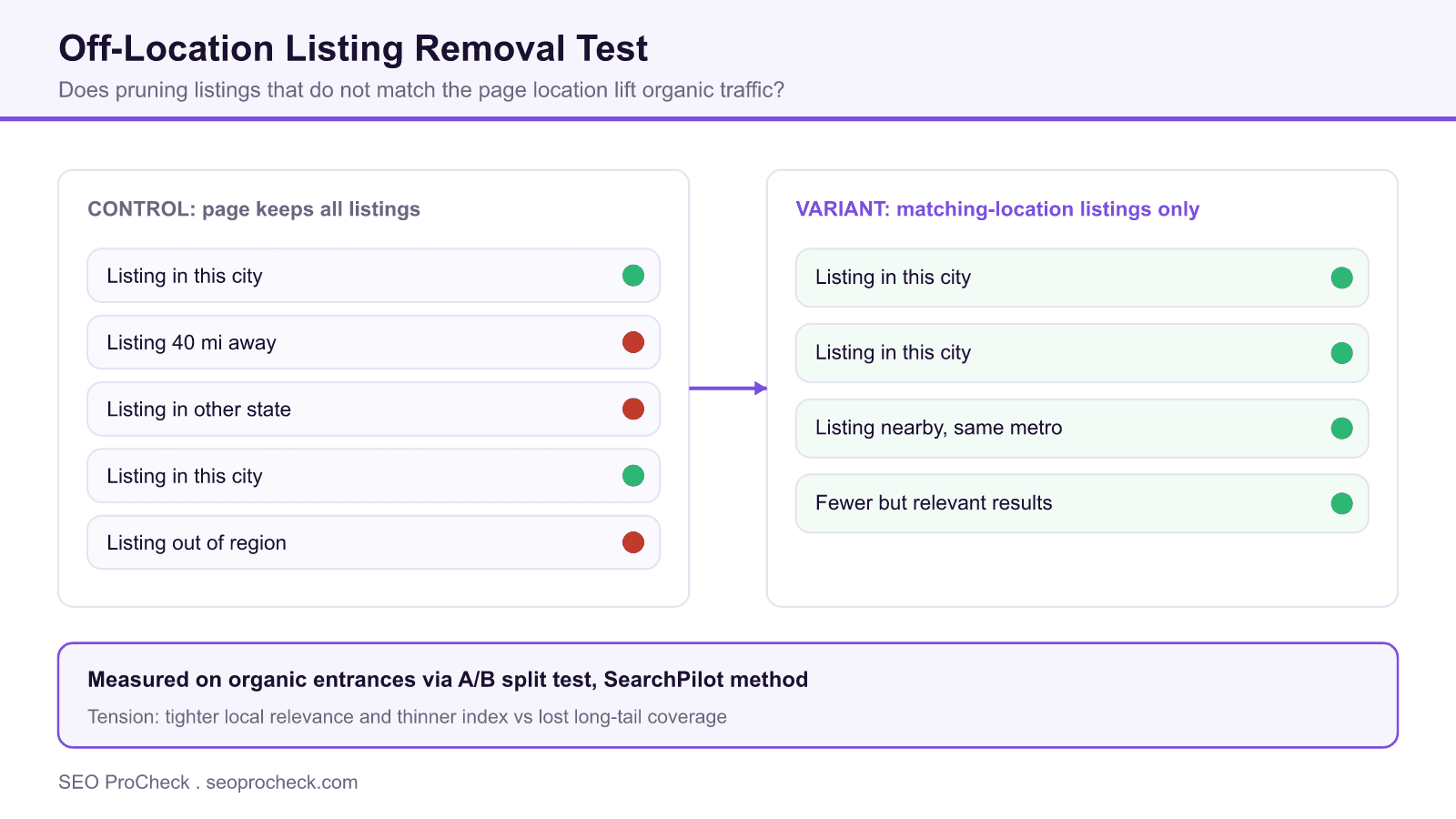
This case study looks at a common question for directories, marketplaces, real estate portals and store locators: if a page is meant to represent one city or region, does stripping out listings that sit outside that area actually lift organic traffic? The intuition is that a tighter, more relevant page should rank better for local intent. The reality is more nuanced, which is exactly why it is worth testing rather than assuming.
Why off-location listings dilute a page
Location pages earn rankings by being the clearest match for a place plus a category, for example "plumbers in Leeds" or "apartments in Austin". When the page also lists results 40 miles away, in another metro, or in a different state, three things happen. First, the unique on-page text becomes less about the target place, so the page competes less cleanly for the head term. Second, low relevance listings add crawlable URLs and internal links that pull authority toward pages users did not come for. Third, engagement suffers when visitors scroll past results they cannot use, which can feed back into how the page performs.
The variant that was tested
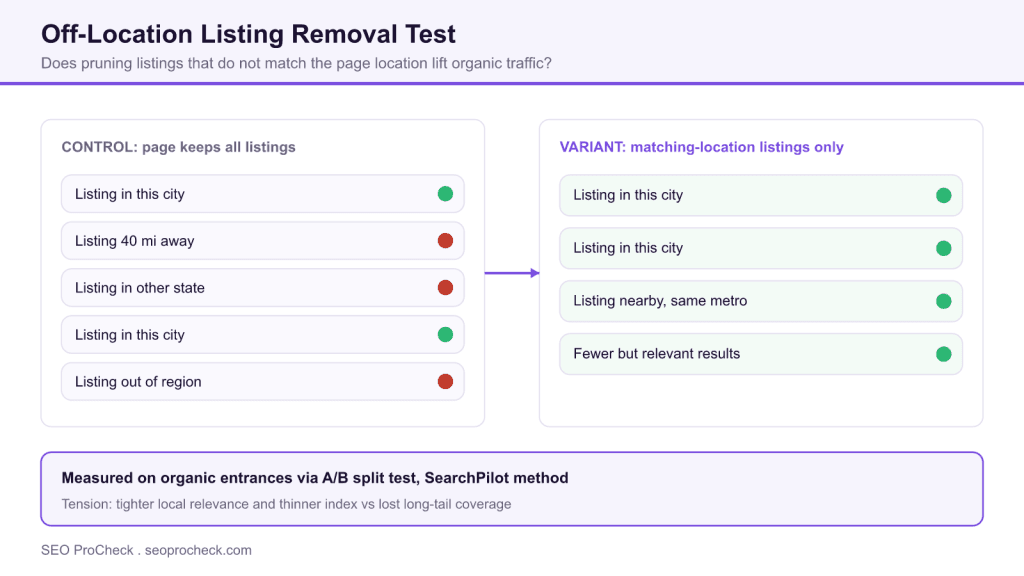
The change is simple to describe and harder to ship: keep only the listings whose location genuinely matches the page, and either remove the rest or move them behind a clearly separate "nearby" module. In the diagram above, the control keeps every listing, including out of region results, while the variant keeps only listings in the target city or its immediate metro. The hypothesis is that the tighter set improves relevance enough to lift organic entrances even though the page now shows fewer results.
How to run this as a controlled test
Do not roll this out sitewide on day one. On a template with hundreds or thousands of location pages, split the pages into a statistically comparable control group and variant group, apply the filter only to the variant, and measure organic entrances over a full business cycle. Tools built for SEO split testing bucket pages and model the counterfactual so you can read a real effect. If you cannot split test, stage the change on a small, representative sample of pages and watch Search Console impressions, average position and clicks for those exact URLs before committing.
Implementation details that matter
When you remove a listing from a page, decide what happens to its own detail URL. If the individual listing still deserves to exist, keep it indexable and reachable from a relevant parent, not orphaned. If it does not, apply a deliberate handling: a 301 to the closest relevant page, or a considered noindex, follow using your meta robots configuration. Never let removed listings turn into soft 404s or dead internal links. Keep an eye on crawl stats in Search Console, because a cleaner listing structure often improves how efficiently Googlebot spends its budget on the pages you care about.
What has changed since this test
The underlying principle has only grown stronger. Google's helpful content signals and ongoing core updates reward pages that satisfy a specific intent and penalize thin, templated pages that pad themselves with loosely related content. Local packs and the local finder also weigh proximity and relevance heavily, so a location page that is unambiguously about one place tends to be a cleaner candidate. At the same time, do not delete coverage that ranks: if certain off-location listings quietly capture long-tail searches, moving them into a labelled nearby section can preserve those entrances while still cleaning up the primary page.
Trade-offs when removing off-location listings
| Factor | Keep all listings | Location-matched only |
|---|---|---|
| Topical relevance | Diluted by distant results | Sharp match for place plus category |
| Long-tail coverage | Broader, some incidental entrances | Narrower, risk of losing them |
| Crawl efficiency | More low value URLs and links | Fewer, more focused URLs |
| User experience | Irrelevant results to scroll past | Only usable, local results |
| Best way to decide | Assumption | Controlled A/B split test |
Related reading on SEO ProCheck: local SEO fundamentals, local SEO case studies, meta robots and noindex handling, content SEO practices.
Frequently asked questions
Does removing off-location listings always increase organic traffic?
No. It often helps by improving relevance and crawl focus, but it can also remove pages or content that captured long-tail searches. The direction of the effect is site specific, which is why a controlled split test is the honest way to decide.
How do I test this without hurting the whole site?
Split your location pages into a control group and a variant group, apply the filter only to the variant, and compare organic entrances over a full cycle. If you cannot split test, stage the change on a small representative sample and monitor those exact URLs in Search Console first.
What should happen to a listing I remove from a page?
Decide its fate deliberately. Keep it indexable under a relevant parent if it still has value, 301 it to the closest relevant page if it does not, and avoid leaving soft 404s or broken internal links behind.
Will fewer listings on the page look thin to Google?
Not if the remaining content is genuinely relevant and useful. Thinness is about value for the intent, not raw count. A focused page of ten relevant listings usually beats a padded page of fifty mixed ones.
Should nearby results be shown at all?
They can be, but label them clearly as nearby and keep them separate from the primary set. That preserves any long-tail value without diluting the core relevance of the page.
What metric proves the test worked?
Organic entrances to the tested page group, read against the control. Rankings for a single keyword move too noisily to trust on their own, so measure clicks and impressions across the whole template.
Source: https://www.searchpilot.com/resources/case-studies/matching-search-intent-test/
Claude Vincent is a technical SEO consultant focused on crawlability, rendering, and AI-search visibility. He writes the field guides and case studies at SEO ProCheck, with a bias toward the durable, unglamorous work that decides whether search engines and AI answer engines can actually read and cite a site.
About SEO ProCheck
Technical SEO consulting and GEO strategy with 20 years of enterprise experience. Case studies, resources, and tools for search and AI visibility.
Work With Me
Technical SEO audits, GEO strategy, site migrations, and international SEO. Hourly consulting for teams who need hands-on support, not just reports.
Subscribe to our newsletter!







Recent Posts
- Can AI Crawlers Actually Read Your Site? I Measured 400 of the Biggest September 5, 2026
- The Pre-Publish Quality Gate for AI-Assisted Content August 6, 2026
- AGENTS.md vs llms.txt vs llms-full.txt: Which Agent File Does What July 18, 2026