How Britney Muller deindexed 75% of Moz.com's site and saw success - Credo
- January 25, 2018
- Content
AI Summary
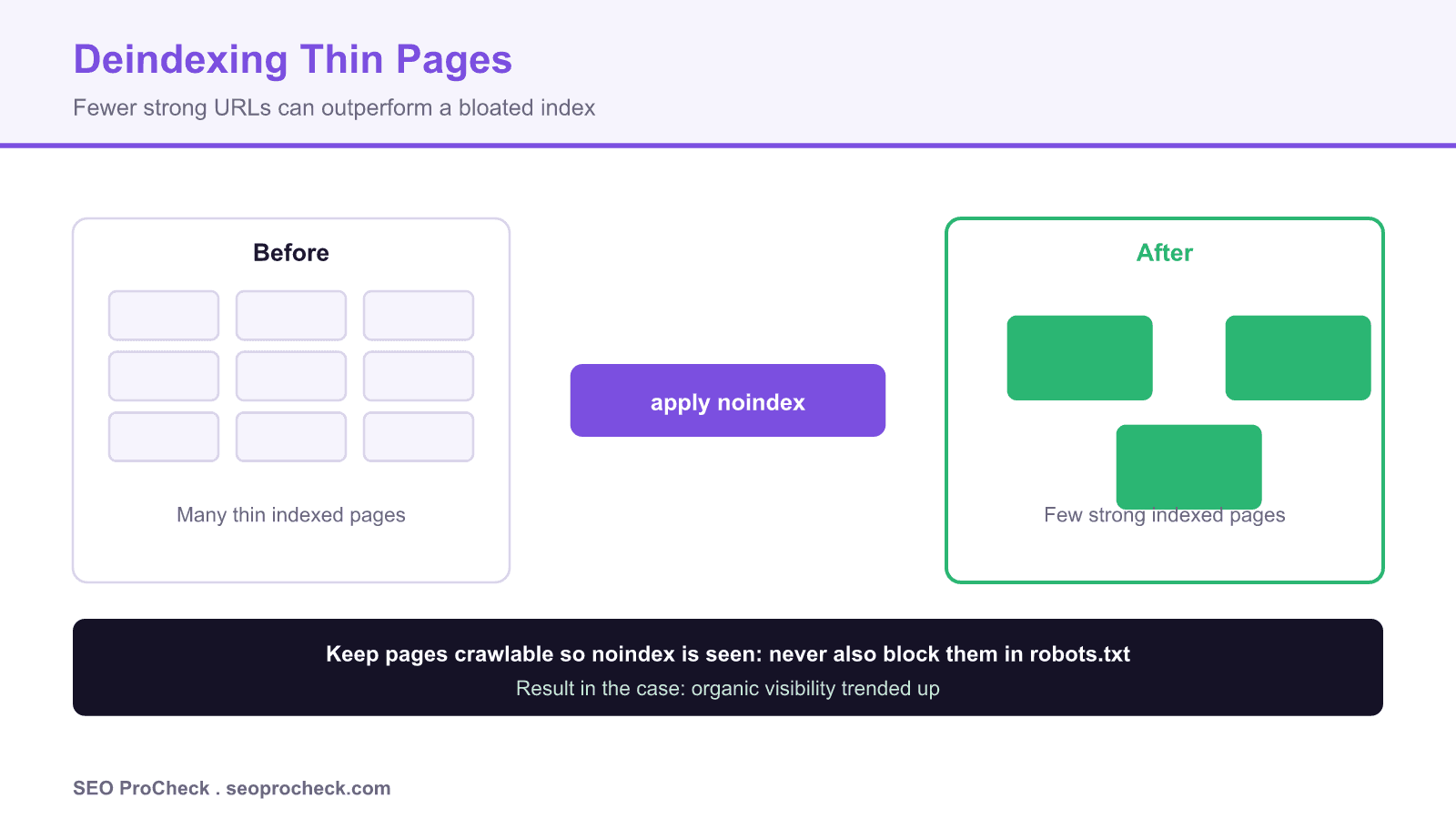
The Moz case popularised by Britney Muller showed that removing a large share of low value pages from the index, using noindex rather than deletion, can coincide with a rise in organic performance. The lesson is index quality over index size: fewer strong URLs can outperform a bloated index of thin ones.
- Noindex keeps a page live for users while removing it from search results, unlike deletion.
- Reducing index bloat concentrates crawl budget and quality signals on pages that can rank.
- The page must stay crawlable for noindex to be seen, never also block it in robots.txt.
- This is a judgement call, so audit value before deindexing, and monitor after.
One of the most cited index-management stories in SEO is the Moz cleanup associated with Britney Muller, in which a large share of the site was removed from Google's index and organic performance improved rather than collapsed. It sounds counterintuitive: how does showing search engines fewer of your pages make you more visible? The answer is index quality over index size, and the mechanism is worth understanding before you copy the tactic.
What actually happened
The move was a deliberate deindexing of low value pages, the kind of thin, near-duplicate, or auto-generated URLs that large sites accumulate over years. Crucially, these pages were not deleted. They were kept live for users where useful and removed from search results with the noindex directive. The reported outcome was that organic visibility held up and improved as the bloated index shrank to a core of pages that genuinely deserved to rank. It is a case study, not a controlled experiment, so treat it as a strong illustration of a principle rather than a guaranteed formula.
Why removing pages can lift performance
Two forces are at work. First, quality is assessed partly at the site level, so a large mass of weak pages can drag on how the whole domain is perceived. Trimming that mass concentrates the quality signal. Second, crawl attention is finite. When search engines spend time repeatedly fetching thin URLs that will never rank, the pages you care about get crawled and refreshed less often. Removing dead weight redirects that attention toward pages that can earn traffic. Our guide on improving crawling and indexing with noindex and robots directives goes deeper on that budget dynamic.
The critical technical detail: noindex is not a robots.txt block
The single most common way teams break this tactic is by confusing the tools. The noindex directive lives in the page's robots meta tag or the X-Robots-Tag HTTP header, and a crawler can only obey it if it is allowed to fetch the page and read the directive. If you also block the same URL in robots.txt, the crawler never sees the noindex, so the page can linger in the index with a bare listing. The rule is simple: to deindex a page, keep it crawlable and let the noindex be read, then only consider a robots.txt block much later once the page has dropped out. Our noindex glossary entry and the full meta robots and X-Robots-Tag reference spell out the exact syntax.
| Action | What it does | Page still live for users? | Best for |
|---|---|---|---|
| noindex meta tag | Removes an HTML page from results | Yes | Thin pages you still want visitors to reach |
| X-Robots-Tag noindex | Same, via HTTP header | Yes | PDFs, images, non-HTML files |
| 301 redirect | Sends URL and equity elsewhere | No | Pages with links and a good target |
| 410 Gone | Signals intentional removal | No | True dead weight with no equity |
| robots.txt block | Stops crawling, not indexing | Yes | Never use this to deindex |
How to apply the lesson without hurting yourself
Deindexing at scale is a judgement call, so audit before you act. Identify pages that are thin, duplicative, or have had no organic traffic and no links over a long window, and separate them from seasonal pages, conversion pages, and cluster-supporting pages that look quiet but do real work. Apply noindex to the genuine low value set, keep those URLs crawlable, and update internal links so you are not funnelling authority into pages you just told search engines to ignore. Then monitor. Watch indexed-page counts fall in Search Console and watch whether your retained pages hold or gain. If visibility drops, you removed something valuable, and because you used noindex rather than deletion you can reverse it quickly.
The takeaway
The Moz story is not an argument for deindexing pages at random. It is an argument for treating your index as a curated set of your best work. Fewer strong pages, crawled and refreshed often and free of thin-content drag, can outperform a large index padded with URLs that were never going to rank. Audit first, use noindex deliberately, keep the pages crawlable, and measure the result.
Reading the signals after you deindex
Once the noindex tags are live, the feedback comes mainly from Google Search Console. Watch the Pages report, where the deindexed URLs should migrate over days to weeks into the excluded bucket labelled as excluded by noindex tag, which confirms the directive was seen. Keep an eye on total indexed pages trending down toward your intended core, and on the Performance report for your retained pages, which is the number that actually matters. A healthy outcome looks like a shrinking index alongside flat or rising clicks on the pages you kept. A warning sign is clicks falling on retained pages, which suggests you deindexed something that was quietly feeding the site through internal links or long tail queries. Because noindex is reversible, the safe play is to deindex in batches and let each batch settle before the next, so a mistake is small, visible, and easy to undo rather than a single sweeping change you cannot cleanly diagnose.
Source: https://www.getcredo.com/britney-muller/
Frequently asked questions
Did deindexing pages really help Moz rank better?
In the reported case, removing a large share of low value pages from the index coincided with improved organic performance. It illustrates index quality over index size, though as a case study it is not a controlled guarantee.
What is the difference between noindex and deleting a page?
Noindex keeps a page live for users while removing it from search results, and it is reversible. Deleting removes the page entirely, so noindex is the safer tool for thin pages you still want visitors to reach.
Why can removing pages increase traffic?
Because quality is assessed partly at the site level and crawl attention is finite. Trimming thin pages concentrates quality signals and frees crawl budget for the pages that can actually rank.
Can I block a page in robots.txt to deindex it?
No. A robots.txt block stops crawling, so the crawler never sees the noindex directive and the page can stay indexed. Keep the page crawlable and let the noindex be read instead.
How do I decide which pages to deindex?
Audit for thin, duplicative, or persistently zero-traffic pages with no links, while protecting seasonal, conversion, and cluster-supporting pages. Apply noindex to the genuine low value set and monitor the result.
Is this safe to do at scale?
It can be, with care. Because noindex is reversible, you can deindex in batches, watch indexed counts and retained-page performance, and roll back quickly if visibility drops.
Claude Vincent is a technical SEO consultant focused on crawlability, rendering, and AI-search visibility. He writes the field guides and case studies at SEO ProCheck, with a bias toward the durable, unglamorous work that decides whether search engines and AI answer engines can actually read and cite a site.
About SEO ProCheck
Technical SEO consulting and GEO strategy with 20 years of enterprise experience. Case studies, resources, and tools for search and AI visibility.
Work With Me
Technical SEO audits, GEO strategy, site migrations, and international SEO. Hourly consulting for teams who need hands-on support, not just reports.
Subscribe to our newsletter!